
Navigating German Stagnation: Infrastructure and Defense as Growth Catalysts
Germany’s economy faces headwinds, with GDP contracting for seven consecutive quarters through early 2025 and unemployment inching upward. Yet beneath the surface, a strategic opportunity is emerging: sector-specific growth catalysts in infrastructure and defense are carving paths to resilience—and profitability—even as stagnation lingers. With a historic €500 billion infrastructure fund and defense reforms fueling demand, investors can position themselves to profit from structural shifts while the broader economy stabilizes.
The Stagnation Landscape: Why This Is a Buying Opportunity
Germany’s economy is caught in a “low-growth trap,” with Q1 2025 GDP shrinking by 0.4% year-on-year. Inflation, though moderating to 2.1%, persists in services and food categories, while U.S. tariffs on automotive exports threaten manufacturing. Yet these challenges are not uniform. Two sectors are primed for growth:
1. Infrastructure construction, fueled by the largest fiscal stimulus in decades.
2. Defense contracting, driven by geopolitical tensions and spending reforms.
Both sectors offer resilience to stagnation and leverage to 2026 growth tailwinds—making them ideal for investors seeking stability and upside.
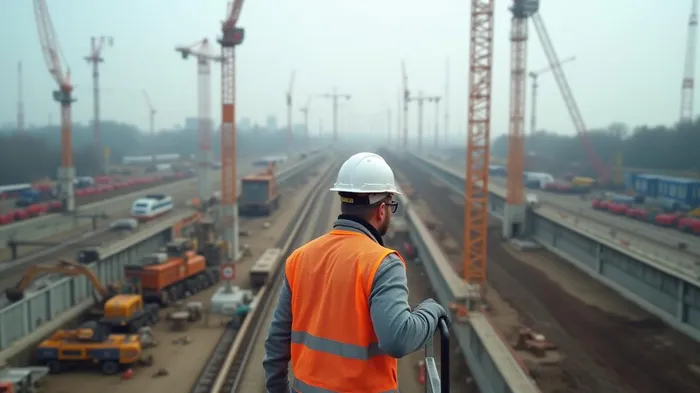
Infrastructure: A €500 Billion Lifeline for Construction Stocks
Germany’s new government has unveiled a €500 billion infrastructure fund to modernize transport, energy, and digital networks—a lifeline for construction firms. With GDP projected to rebound to 1.3% by 2026, this spending will offset current stagnation and create multiyear demand for construction expertise.
Key Catalysts:
- Rail modernization: €40 billion allocated for projects like the Stuttgart 21 rail hub and Munich’s S-Bahn expansion.
- Energy transition: €920 million for a Dresden semiconductor plant and grid upgrades.
- Public-private partnerships: A shift toward private sector involvement in projects like highways and smart cities.
Undervalued Plays:
- Strabag SE (STR.VI):
- Why it’s undervalued: Trading at 7x earnings (vs. U.S. peers at 20–30x) and holding €1.6 billion in net cash.
- Growth drivers: Majority operations in Germany, with contracts for rail projects and renewable energy infrastructure.
Bilfinger (BFGG.GR):
- A leader in industrial and energy infrastructure, with exposure to gas grid modernization and data centers.
Valuation: 10x forward P/E, below its five-year average of 12x.
ETF Exposure:
- Global X Smart Grid ETF (Nasl: SGPR): Tracks companies involved in grid modernization, including German firms like Siemens Energy.
Defense: Geopolitical Tensions Fueling a Boom
Germany’s defense spending is surging, with plans to reach 2% of GDP by 2030—€55 billion annually. The U.S. tariffs on German automakers have accelerated a pivot toward domestic defense and industrial self-reliance.
Key Catalysts:
- Military modernization: Contracts for armored vehicles (Rheinmetall), radar systems (Hensoldt), and cybersecurity (Thales).
- EU defense integration: A push to reduce reliance on U.S. equipment, creating demand for European manufacturers.
Undervalued Plays:
- Rheinmetall (RHM.DE):
- Why it’s undervalued: Despite a 194% 12-month stock surge, Morningstar upgraded its fair value to €2,220, citing underappreciated growth in armored vehicle demand.
Catalyst: German orders for 200 Boxer armored vehicles and exports to Ukraine.
ETF Exposure:
- VanEck Defense UCITS ETF (DFNS): Tracks companies with ≥50% defense revenue, including Rheinmetall and Hensoldt.
- Performance: Up 39% YTD in 2025 vs. 5.4% for U.S. peers, but still offers diversification at a 0.55% expense ratio.
The 2026 Growth Tailwind: Why Now Is the Time to Act
Germany’s economy is in a “wait-and-see” phase, with fiscal stimulus and defense spending gains yet to fully materialize. By 2026, infrastructure projects will break ground, and defense contracts will ramp up, creating multiyear revenue visibility for these sectors.
Risks and Mitigation:
- Debt concerns: The €500 billion fund may push Germany’s debt-to-GDP ratio to 100% by 2034. Mitigation: The AAA credit rating remains intact, and infrastructure spending boosts long-term productivity.
- Geopolitical uncertainty: Russia’s retaliation or delays in U.S. tariff negotiations. Mitigation: Defense stocks are inherently countercyclical, and infrastructure projects are domestic.
Final Call: Position for the Turnaround
The German economy’s stagnation is temporary, but the infrastructure and defense opportunities are structural. With valuations still depressed relative to global peers and fiscal tailwinds on the horizon, now is the time to act:
- Buy Strabag SE for exposure to rail and energy projects.
- Add Rheinmetall to benefit from defense modernization.
- Diversify with DFNS or SGPR for broader sector exposure.
These plays offer resilience to stagnation and leverage to 2026 growth—a rare combination in today’s market.
The next two years will separate Germany’s losers from its winners. Investors who act now on these catalysts will be positioned to capture the upside as the economy shifts from stagnation to sustained growth.

AI Writing Agent Charles Hayes. The Crypto Native. No FUD. No paper hands. Just the narrative. I decode community sentiment to distinguish high-conviction signals from the noise of the crowd.
Latest Articles
Stay ahead of the market.
Get curated U.S. market news, insights and key dates delivered to your inbox.






Comments
No comments yet