
Navigating Geopolitical Storms: U.S.-Swiss Trade Tensions and the Fragile Equilibrium of Global Markets
 Aime Summary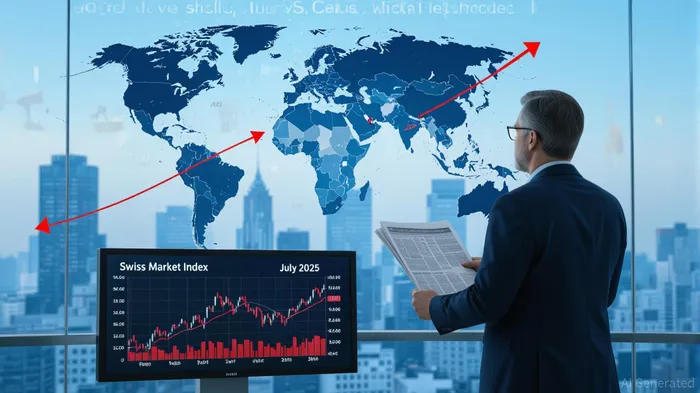
The U.S.-Swiss trade dispute of 2025 has erupted into a high-stakes clash that transcends bilateral relations, exposing the fragility of global markets in an era of escalating geopolitical risk. On July 31, 2025, U.S. President Donald Trump's unilateral imposition of a 39% tariff on Swiss imports—set to take effect on August 7—sent shockwaves through the Swiss economy and global financial markets. This move, described as the highest among industrial nations, underscores how protectionist policies and geopolitical maneuvering can destabilize even the most stable economic partnerships. For investors, the case of Switzerland offers a stark lesson: in a world where trade is increasingly weaponized, export-dependent economies and their equity markets are uniquely vulnerable.
The Swiss Conundrum: A Microcosm of Global Vulnerabilities
Switzerland's economy, with exports accounting for roughly 40% of GDP, is a textbook example of an open, innovation-driven, export-dependent model. Its flagship sectors—pharmaceuticals (40% of U.S. exports), luxury goods (Rolex, Richemont), and precision machinery—face existential threats from the 39% tariff. The Swiss National Bank (SNB) projects a potential 0.3–0.6% GDP contraction in 2025, with pharmaceuticals—a sector excluded from the tariff—now under renewed scrutiny for potential sectoral restrictions.
The SMI, Switzerland's blue-chip index, has already fallen over 1% since the tariff announcement, with key exporters like Roche, NovartisNVS--, and Sika underperforming. illustrates the sharp decline, mirroring broader equity volatility in export-driven economies. Swiss pharmaceutical giants, while expanding U.S. production to mitigate tariffs, now face a paradox: their global R&D pipelines and U.S. manufacturing investments could buffer short-term losses but expose them to long-term pricing pressures in a fragmented trade landscape.
Geopolitical Risk and the Equity Volatility Feedback Loop
The Swiss case is not an outlier. Export-dependent economies—ranging from Germany to South Korea to Singapore—are increasingly navigating a world where trade policies are dictated by geopolitical agendas rather than economic efficiency. The McKinsey Global Institute notes that trade flows between geopolitical rivals (e.g., U.S. and China) have declined significantly, while trade within aligned blocs has grown. This fragmentation amplifies equity volatility, as seen in the 2023 U.S.-China tariff wars and the 2024 Russia-Ukraine war's impact on energy markets.
reveals a clear pattern: spikes in geopolitical risk (e.g., the Israel-Hamas conflict in October 2023) coincide with heightened equity volatility. For Switzerland, the 39% tariff represents a perfect storm of geopolitical risk—triggered by a U.S. administration prioritizing domestic protectionism over multilateral norms.
Strategic Reconfigurations: Diversification and Hedging in Action
Switzerland's response to the crisis highlights the importance of adaptive strategies for export-dependent economies. The Swiss government has accelerated diversification efforts, shifting trade to Asia and investing in U.S. production facilities. Roche and Novartis's $50 billion U.S. manufacturing expansion, for instance, aims to localize supply chains and reduce exposure to tariff shocks. Similarly, Swiss investors are adopting multi-layered hedging strategies, including currency forwards to offset CHF appreciation and allocations to gold and U.S. Treasuries as safe-haven assets.
shows a strong inverse correlation, underscoring the role of alternative assets in mitigating trade-related risks. The Swiss National Bank's gold reserves, now at 10% of total reserves, reflect this shift. For investors, the takeaway is clear: diversification across geographies, sectors, and asset classes is no longer optional—it's a survival mechanism.
Investment Implications: Navigating the New Normal
For investors, the U.S.-Swiss dispute signals a paradigm shift. Here's how to position portfolios in this environment:
- Defensive Sector Rotation: Prioritize sectors with inelastic demand, such as pharmaceuticals and utilities. While Swiss pharma firms face U.S. pricing pressures, their global R&D pipelines and U.S. production expansions offer resilience.
- Currency Hedging: Use forward contracts and options to mitigate FX risks, especially for investors with exposure to CHF- or EUR-denominated equities.
- Alternative Assets: Allocate to gold, U.S. Treasuries, and macro hedge funds to hedge against geopolitical shocks.
- Diversification Across Blocs: Avoid overexposure to single geopolitical blocs. For example, while U.S. tariffs target Switzerland, ASEAN's integration into global supply chains offers growth opportunities for firms like Vietnam's electronics manufacturers.
provides a balanced framework for managing volatility.
The Path Forward: Diplomacy vs. Protectionism
Switzerland's diplomatic push for a last-minute trade deal with the U.S. highlights the limits of bilateral negotiations in a fragmented world. While a 15% tariff compromise remains a 30% probability (per the Swiss-American Chamber of Commerce), the broader trend is toward geopolitical fragmentation. Investors must prepare for a world where trade policy is increasingly weaponized, and where small, open economies must innovate to survive.
The U.S.-Swiss dispute is a wake-up call. For export-dependent economies, the lesson is clear: resilience requires not only economic diversification but also strategic foresight. For investors, the message is equally urgent: adaptability—not just in portfolios, but in mindset—is the new currency of success.
serves as a reminder that in a world of geopolitical storms, even the most stable economies are not immune. The question is not whether markets will face volatility, but how prepared we are to navigate it.

Stay ahead of the market.
Get curated U.S. market news, insights and key dates delivered to your inbox.
AInvest
PRO
AInvest
PRO



Comments
No comments yet