
Navigating Geopolitical Risks: Strategic Insights for Tech Stock Investments
 Aime Summary
Geopolitical risks—such as trade wars, sanctions, or regional conflicts—can significantly impact global markets. For investors in technology stocks, understanding these risks is crucial. Tech companies often rely on global supply chains, international talent, and regulatory environments that shift with political tides. In this article, we’ll break down how geopolitical events influence tech stocks and provide actionable strategies to manage these risks.
What Are Geopolitical Risks and Why Do They Matter?
Geopolitical risks refer to events or tensions between nations that disrupt economic or market stability. Examples include trade restrictions, cyberattacks, sanctions, or conflicts. For tech stocks, key risks include:- Supply chain disruptions: Tech companies depend on global manufacturing hubs (e.g., semiconductors from Taiwan or South Korea).- Regulatory changes: Governments may impose data privacy laws or restrict foreign tech firms (e.g., China’s cybersecurity regulations).- Currency fluctuations: Political instability can weaken currencies, affecting multinational companies’ profits.
Strategies to Mitigate Geopolitical Risks
- Diversify Geographically: Invest in companies with operations across multiple regions. For example, a chipmaker with factories in the U.S., Germany, and Singapore is less vulnerable to a single country’s political issues.
- Focus on Resilient Sectors: Prioritize companies in areas less sensitive to geopolitical shifts, such as software-as-a-service (SaaS) firms, which rely less on physical supply chains.
- Monitor Policy Trends: Track political developments in key markets. For instance, U.S.-China trade tensions often impact companies like NVIDIANVDA-- or Huawei due to export controls.
- Use Hedging Tools: Investors can use options or ETFs to hedge against market volatility caused by geopolitical events.
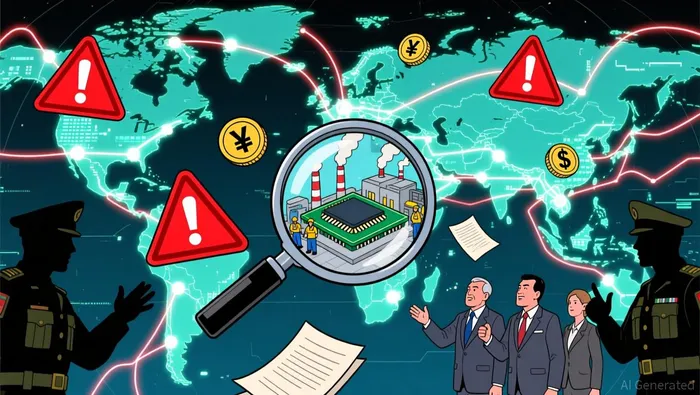
Case Study: U.S.-China Trade Tensions and Tech Stocks
In 2023, U.S. export restrictions on advanced semiconductors to China caused immediate market jitters. Companies like NVIDIA and ASMLASML-- saw stock prices drop by 10–15% in a single week. However, firms that diversified their customer bases (e.g., IntelINTC--, which also serves European and Indian markets) fared better. Conversely, when the U.S. and China reached a tentative agreement to ease restrictions in early 2024, tech stocks rebounded sharply, with the Nasdaq Composite rising 8% in a month. This example highlights how geopolitical shifts create short-term volatility but also opportunities for well-prepared investors.
Risks and Considerations
Geopolitical risks are inherently unpredictable, and even well-planned strategies can’t eliminate all uncertainties. Over-reliance on a single region or company can amplify losses. To mitigate this:- Avoid Overexposure: Limit investments in companies heavily tied to politically unstable regions.- Stay Informed: Follow news from sources like the U.S. Department of Commerce or the World Bank for policy updates.- Rebalance Regularly: Adjust your portfolio as geopolitical landscapes evolve.
Key Takeaways
Geopolitical risks are a reality for tech investors, but they don’t have to derail your strategy. By diversifying geographically, staying informed, and focusing on resilient sectors, you can navigate uncertainty with confidence. Remember, no strategy is foolproof, but understanding these dynamics empowers you to make smarter, more adaptive decisions. In a rapidly changing world, preparation is your best defense.

Stay ahead of the market.
Get curated U.S. market news, insights and key dates delivered to your inbox.
AInvest
PRO
AInvest
PRO



Comments
No comments yet