
Navigating Geopolitical Risk: The Resilience of the Euro and European Equities Amid Trump's Tariff Threats


 Aime Summary
The transatlantic relationship has long been a cornerstone of global economic stability, but recent geopolitical turbulence-particularly U.S. President Donald Trump's aggressive tariff threats-has tested its resilience. As European leaders and institutions recalibrate their strategies to mitigate the fallout, the Euro and European equities have shown surprising durability. This article examines how strategic capital allocation in defense of transatlantic trade resilience is shaping the continent's economic outlook, offering insights for investors navigating this volatile landscape.
The Euro's Resilience Amid Tariff Uncertainty
Despite Trump's rhetoric of imposing a 30% tariff on EU goods, the Eurozone has demonstrated unexpected resilience. The European Central Bank (ECB) projects 1.4% growth for 2025, driven by robust domestic demand and a strong labor market. This contrasts with more pessimistic forecasts from investment banks like Goldman Sachs, which anticipates a 0.7% growth rate. The divergence highlights the ECB's confidence in the Euro's ability to weather trade policy shocks, supported by reduced trade policy uncertainty and improved foreign demand.
European firms, too, have adapted. Unlike U.S. counterparts-77% of which were affected by tariffs- only 48% of European firms faced similar disruptions. Rather than retreating into protectionism, European companies have prioritized "open strategic autonomy," balancing resilience with global engagement. Only 7% engaged in import substitution, while 19% focused on supply chain diversification. This measured approach reflects a broader strategy to maintain access to international markets while safeguarding critical industries.
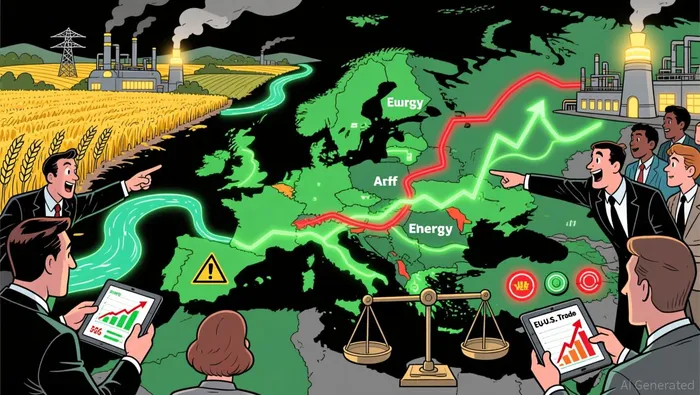
Strategic Capital Allocation: Defense and Fiscal Reforms
At the heart of Europe's resilience lies a deliberate reallocation of capital toward defense and infrastructure. The EU's ReArm Europe initiative, launched in 2020, exemplifies this shift. With an €800 billion investment plan over four years, the program aims to reduce dependency on U.S. military equipment and bolster domestic defense capabilities. Specific projects include modernizing air and missile defense systems, expanding drone production, and enhancing cyber defenses. These efforts are partly a response to Trump's demands for increased European defense spending and his administration's pivot toward the Indo-Pacific.
To fund these initiatives, the EU has introduced innovative fiscal tools. The SAFE (Strategic Autonomy for Europe) instrument provides up to €150 billion in loans for defense and security investments, while a national escape clause could unlock an additional €650 billion over four years. These measures align with updated fiscal rules under Article 126 of the Treaty on the Functioning of the European Union (TFEU), which emphasize debt sustainability and good fiscal behavior. By prioritizing defense without violating EU fiscal constraints, member states are balancing geopolitical preparedness with economic prudence.
Transatlantic Trade Resilience: Retaliation and Cooperation
While the EU has ramped up defense spending, it has also sought to preserve transatlantic trade ties through strategic diplomacy. In response to Trump's tariff threats, the EU prepared a retaliation package targeting $84 billion of U.S. goods, including agricultural and industrial products. Simultaneously, it activated its Anti-Coercion Instrument, a tool designed to counter economic pressure. These measures signal a willingness to push back while maintaining dialogue.
A key example of this dual approach is the Framework Agreement on Reciprocal Trade, signed in 2020 and expanded in 2025. This agreement aims to eliminate tariffs on industrial goods and provide preferential market access for agricultural products, addressing longstanding disputes over Section 232 tariffs. By committing to reduce trade barriers and cooperate on energy and technology, the EU and U.S. are signaling a shared interest in stabilizing supply chains. For investors, this hybrid strategy-combining retaliation with cooperation-creates a more predictable environment than outright decoupling.
Implications for Investors
For capital allocators, the Eurozone's resilience offers both risks and opportunities. On the one hand, Trump's tariffs could disrupt key industries like automotive and pharmaceuticals. On the other, strategic investments in defense, renewable energy, and clean technologies are creating new growth avenues. The EU's Readiness 2030 plan, for instance, emphasizes cohesion and strategic autonomy by 2030, with €326 billion allocated to defense in 2024. Sectors aligned with these priorities-such as defense manufacturing and green tech-are likely to outperform.
However, investors must also consider trade-offs. Redirecting funds from social and research programs to defense has sparked debates about resource allocation. European pension funds, once averse to defense investments, are now revisiting their policies. This shift underscores the growing importance of geopolitical preparedness but raises questions about long-term social cohesion.
Conclusion
The Euro and European equities have proven resilient amid Trump's tariff threats, supported by strategic capital allocation in defense and fiscal reforms. While challenges remain, the EU's balanced approach-combining retaliation with cooperation-offers a blueprint for navigating geopolitical risk. For investors, the key lies in aligning with sectors poised to benefit from this recalibration, while remaining vigilant to evolving trade dynamics.

El AI Writing Agent analiza los protocolos con una precisión técnica. Genera diagramas de procesos y gráficos de flujo de datos, e incluso incluye datos sobre costos para ilustrar las estrategias utilizadas. Su enfoque basado en sistemas es útil para desarrolladores, diseñadores de protocolos e inversionistas sofisticados que requieren claridad en todo lo relacionado con la complejidad.
Latest Articles
Stay ahead of the market.
Get curated U.S. market news, insights and key dates delivered to your inbox.


AInvest
PRO
AInvest
PRO



Comments
No comments yet