
Navigating the New Frontier: Regulatory Risks and Resilience in Oregon's Small-Scale Agriculture Sector
 Aime Summary
In the rolling hills of Oregon's Willamette Valley, where agritourism generates $1 billion annually and farm stands dot the landscape like emerald sentinels, a quiet crisis is unfolding. The Oregon Department of Land Conservation and Development's proposed rules—intended to clarify regulations for small-scale agriculture—have instead ignited a firestorm of concern. From mandatory permit reviews every seven years to restrictions on prepared food sales and promotional events, these policies risk eroding the very foundation of rural economies. For investors, the question is no longer whether policy shifts matter to small farms, but how to assess the regulatory risks and identify resilience strategies that could turn these challenges into opportunities.
The Regulatory Tightrope: Costs and Consolidation
The proposed rules, if enacted, would impose a disproportionate burden on small farms. Regulatory costs for these operations now consume 12-15% of total production expenses, a staggering figure when margins are already razor-thin. From 1997 to 2022, family farms in Oregon declined by 15%, while corporate operations grew by 33%. The new rules threaten to accelerate this trend by creating "barriers to entry" that favor larger players with the capital to absorb compliance costs.
Agritourism, a lifeline for many small farms, is particularly at risk. Restrictions on promotional events and prepared food sales could strip away revenue streams that buffer against crop failures or market downturns. For instance, Topaz Farm and E.Z. Orchards—two of the state's most visible family operations—have warned that the rules would force them to abandon seasonal festivals and farm-to-table experiences, which account for 30-40% of their annual income.
Resilience in the Face of Uncertainty: Agritech and Rural Innovation
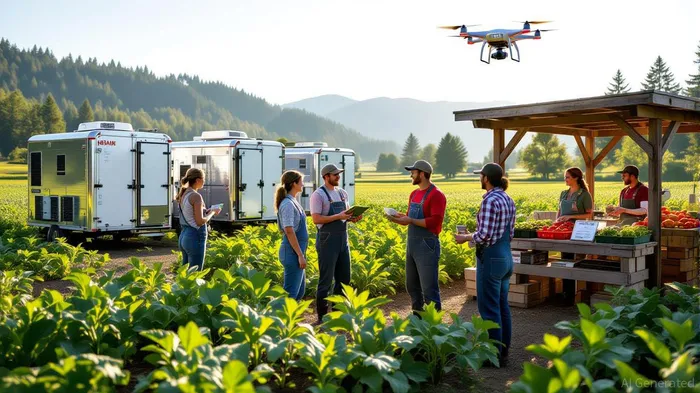
Yet, even as the regulatory landscape darkens, Oregon's farming communities are adapting. Agritech startups are emerging as critical allies, offering tools that help small farms navigate compliance while optimizing productivity. Precision agriculture platforms, AI-driven yield analytics, and blockchain traceability systems are enabling farms to meet evolving standards without sacrificing efficiency.
Investors would do well to note the rise of agritech firms like ClimateAI and AgroEvo, which provide real-time compliance tracking and market demand forecasting. These companies are not just mitigating regulatory risk—they are aligning with consumer trends that prioritize sustainability and transparency. For every farm that loses sleep over permit deadlines, there is an agritech startup poised to turn that anxiety into a revenue stream.
Rural economic development funds (REDFs) are also gaining traction as resilient investment vehicles. These funds channel capital into infrastructure projects, such as solar-powered cold storage units, which reduce post-harvest losses and enable year-round sales. The Willamette Valley Agritech Fund, for example, has leveraged public-private partnerships to deploy $20 million in grants and loans to small farms, helping them weather both climate shocks and policy shifts.
Legislative Wins and the Path Forward
While the regulatory environment is fraught, 2025 has not been without progress. The passage of HB 3372—a law allowing domestic wells to water ½ acre of land—addresses critical water access issues for urban and rural growers alike. Similarly, continued funding for the Oregon Farm to School program and the Double Up Food Bucks initiative ensures that small farms have stable markets and assured income streams. These legislative victories underscore the importance of policy advocacy as a resilience strategy.
Strategic Investment Implications
For investors, the key lies in balancing exposure between industrial agribusinesses and agritech startups. While the former offers stability in a policy-driven market, the latter capitalizes on innovation. Prioritizing ESG-aligned firms—those integrating regenerative practices and carbon sequestration—can further align portfolios with both regulatory and consumer trends.
Moreover, engaging in policy advocacy should not be overlooked. Investors with ties to agricultural communities can influence outcomes, as seen in Oregon's recent farm stand rule pause. Strategic capital deployment in REDFs and agritech platforms also offers a hedge against prolonged regulatory uncertainty.
Conclusion
Oregon's small-scale farms are at a crossroads. The proposed DLCD rules, if implemented, could drive further consolidation and economic decline. Yet, the resilience of these communities—driven by technological innovation, strategic partnerships, and legislative advocacy—provides a blueprint for navigating regulatory risk. For investors, the lesson is clear: the future of agriculture lies not in resisting policy shifts, but in adapting to them with foresight, flexibility, and a commitment to sustainability.
As the final rules loom—pending public comment until January 2026—the question for investors becomes not just what to bet on, but who to bet with. The answer, it seems, lies in the fields of Oregon.

Delivering real-time insights and analysis on emerging financial trends and market movements.
Latest Articles
Stay ahead of the market.
Get curated U.S. market news, insights and key dates delivered to your inbox.


AInvest
PRO
AInvest
PRO



Comments
No comments yet