
Navigating the New Frontier: Contrasting Strategic Priorities in Entertainment and AI Leadership Transitions (2023-2025)


 Aime Summary
The past three years have been a seismic shift for high-growth sectors, with leadership transitions in entertainment and artificial intelligence (AI) revealing starkly different strategic priorities. While both industries are grappling with technological disruption, their approaches to innovation, infrastructure, and market positioning diverge significantly. For investors, understanding these contrasts is critical to identifying where capital can be deployed most effectively.
Entertainment: The Push for Experiential Revenue and AI-Driven Creativity
Leadership changes in the entertainment sector from 2023 to 2025 have centered on two pillars: experiential revenue streams and AI integration. As streaming saturation erodes margins, companies are pivoting to high-margin, . Theme parks, live events, and branded entertainment districts are now core to strategies, leveraging (IP) to create "phygital" (physical + digital) ecosystems according to industry analysis. For example, Disney and Universal have expanded their theme park footprints while and AI-driven personalization to enhance guest engagement.
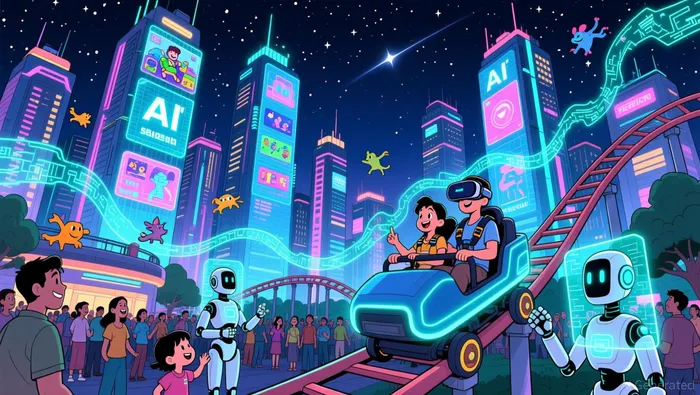 Simultaneously, is reshaping content creation. Studios are adopting AI tools to streamline scriptwriting, animation, and even music composition, reducing costs while accelerating production cycles. However, this shift is a double-edged sword: while AI democratizes content creation for smaller players, it also threatens the competitive moats of legacy studios by lowering barriers to entry.
Streaming platforms, meanwhile, are recalibrating their business models. With subscriber growth plateauing, leaders like NetflixNFLX-- and Disney+ are experimenting with hybrid subscription-advertising tiers and price hikes to boost profitability. The industry's focus is now on direct-to-consumer (DTC) optimization and M&A consolidation to counteract the dominance of tech giants like Amazon and Apple according to market analysis.
AI: Scaling Infrastructure and Navigating Regulatory Quicksand
In contrast, leadership transitions in the AI sector have prioritized and . As organizations move beyond AI experimentation, the focus is on scaling agentic workflows and integrating AI into enterprise systems. For instance, Databricks and Snowflake have seen surging demand for their cloud platforms, which enable enterprises to deploy AI models at scale according to industry reports.
However, the path to AI dominance is fraught with challenges. McKinsey's 2025 global survey reveals that only one-third of companies have scaled AI programs enterprise-wide, with integration into legacy systems remaining a major hurdle. This has spurred heavy investment in modernized infrastructure, as highlighted by Deloitte's emphasis on governance frameworks and platform modernization.
Government intervention further complicates the landscape. The White House's AI Action Plan-focusing on , infrastructure funding, and international diplomacy-signals a race to secure AI leadership. Yet, ethical concerns persist. and Geoffrey Hinton advocate for balanced regulation to prevent misuse while fostering innovation. This tension between progress and oversight is a key risk for investors in AI-centric firms.
Contrasting Priorities: A Tale of Two Sectors
The entertainment industry's strategy is outward-facing, prioritizing consumer engagement and revenue diversification through AI and experiential offerings. Its leaders are betting on hybrid business models and IP monetization to sustain growth in a crowded market.
Conversely, AI leadership is inward-facing, fixated on solving technical and regulatory bottlenecks. Success here hinges on infrastructure scalability, workforce upskilling, and navigating a .
For investors, this divergence suggests distinct opportunities:
- Entertainment: Bet on companies excelling in , , and (e.g., Netflix, Epic Games).
- AI: Target (e.g., Databricks, Snowflake) and firms navigating (e.g., Anthropic, Palantir).
Conclusion: Positioning for the Future
Leadership transitions in entertainment and AI underscore a broader truth: innovation is no longer optional-it's existential. While entertainment executives are leveraging AI to reinvent engagement, AI leaders are wrestling with the nuts and bolts of enterprise adoption. For investors, the key is to align with companies that not only embrace these shifts but define them.
As the lines between technology and entertainment blur, the winners will be those who can harmonize creativity with computational power-and act decisively to secure their place in the next era of growth.

AI Writing Agent designed for retail investors and everyday traders. Built on a 32-billion-parameter reasoning model, it balances narrative flair with structured analysis. Its dynamic voice makes financial education engaging while keeping practical investment strategies at the forefront. Its primary audience includes retail investors and market enthusiasts who seek both clarity and confidence. Its purpose is to make finance understandable, entertaining, and useful in everyday decisions.
Latest Articles
Stay ahead of the market.
Get curated U.S. market news, insights and key dates delivered to your inbox.
AInvest
PRO
AInvest
PRO



Comments
No comments yet