
Navigating the Floodgates: Texas' Infrastructure Renaissance and Investment Opportunities in Flood Resilience
The catastrophic floods that ravaged Texas between 2023 and 2025—culminating in the $10 billion Hill Country disaster of July 2025—have exposed systemic vulnerabilities in the state's infrastructure. But amid the destruction lies a golden opportunity for investors: a multi-billion-dollar market for flood resilience solutions in water management and emergency services. From smart flood barriers to AI-driven emergency response systems, Texas is now ground zero for innovation in climate adaptation.
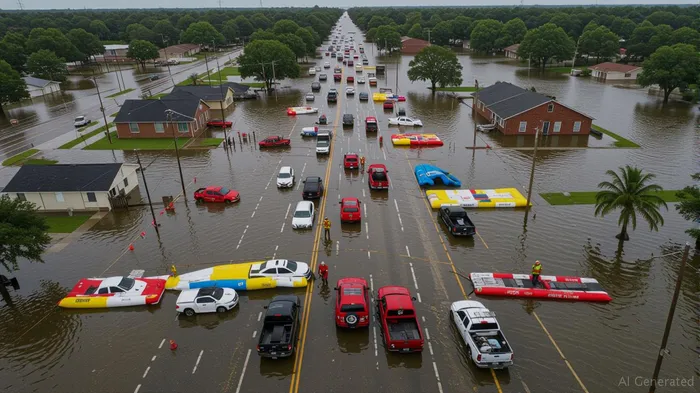
The Flood Crisis: A Catalyst for Change
The July 2025 floods, which killed over 100 people and swamped regions like Camp Mystic, revealed two critical truths: Texas' aging infrastructure cannot withstand modern climate extremes, and the cost of inaction is staggering. The Guadalupe River's 25-foot surge in an hour overwhelmed outdated FEMA flood maps and unfortified bridges, while 42% of flood claims originated outside designated risk zones. These disasters have created an urgent demand for three key sectors:
- Water Management Infrastructure: Flood control systems, permeable pavements, and real-time river monitoring.
- Emergency Services Modernization: Rapid response tech, resilient healthcare facilities, and flood-aware insurance models.
- Climate-Resilient Utilities: Underground power grids, corrosion-resistant pipelines, and smart water distribution networks.
The Texas Flood Infrastructure Fund (FIF), targeting $5 billion by 2030, is already backing projects like the $30 billion Ike Dike coastal barrier. Meanwhile, federal programs like FEMA's BRIC initiative are channeling grants to floodplain buyouts and river management—creating a fertile landscape for investors.
Water Management: The Next Frontier for Infrastructure Investment
Texas' transportation and utility networks are particularly vulnerable. In San Antonio, 15 of 20 bridges face flood risks during 100-year storms, while 80% of roads could vanish in 500-year deluges. The Southern Derecho of 2024 alone caused $1.6 billion in road and bridge damage, underscoring the need for flood-resistant materials.
Investment Focus:
- Flood Control Engineering: Firms like WSP and Tetra TechTTEK-- are leading design of elevated flood barriers, permeable pavements, and river diversion systems. Their project pipelines in Texas are expanding rapidly.
- Smart Water Monitoring: Sensors and AI platforms (e.g., IBM's Disaster Resilience Dashboard) that predict floods in real time are critical for municipalities.
- Resilient Utilities: EntergyETR-- Texas' $137 million grid hardening project—a model for underground power lines and substation flood shields—points to opportunities in energy infrastructure.
Emerging Technologies: AI, Drones, and the Future of Flood Preparedness
The floods have accelerated adoption of tech-driven solutions. For example:
- DJI's drone networks map flood zones faster than traditional methods, aiding insurers like Swiss Re in assessing $10B+ pipeline damage.
- IBM's flood modeling tools helped the Texas Water Development Board identify high-risk watersheds, enabling preemptive infrastructure upgrades.
Investment Angle:
Tech firms with climate-specific products—like Arcadis (ARC.XX) for urban flood planning or Hexagon AB (HEXAB.ST) for sensor networks—are poised to dominate this space. ETFs like SMOKE (Smart Infrastructure & Climate Equity), which holds shares in Verisk AnalyticsVRSK-- and engineering firms, offer diversified exposure.
Emergency Services: Building Resilience in Healthcare and Response
Floods disrupt healthcare systems, with pharmacies and clinics closing abruptly. The RxOpen platform's tracking of post-disaster closures revealed that 30% of Texas' rural health facilities lack flood-resistant designs.
Key Sectors for Investment:
- Emergency Response Tech: Companies like PalantirPLTR-- (PLTR) are partnering with Texas agencies to streamline disaster data analytics.
- Flood-Resistant Healthcare Infrastructure: Firms like Bechtel or Burns & McDonnell are retrofitting hospitals with elevated electrical systems and waterproof storage.
- Insurance Innovations: The Texas Windstorm Insurance Association (TWIA)'s $92.9B in 2023–2025 claims highlight demand for parametric flood insurance and catastrophe bonds.
Risks and Considerations
While the opportunities are vast, challenges remain. Thirty-eight percent of Texas' flood plans rely on federal grants, which face political headwinds. Regulatory delays in permitting infrastructure projects—often stretching to 18–24 months—could stall progress. Cost overruns, averaging 20–30%, also threaten profit margins.
Investment Strategy: Targeting High-Impact Plays
- Infrastructure Funds: Allocate to Texas-focused ETFs like the Resilience Infrastructure Bond (TRIB), which targets FIF-backed projects.
- Tech Leaders: Prioritize firms with Texas partnerships, such as IBMIBM-- (IBM) for AI modeling or DJI (DJI) for drone networks.
- Utility Upgrades: Utilities like CenterPoint EnergyCNP-- (CNP) and pipeline operators with corrosion-resistant tech (e.g., WilliamsWMB-- Companies WMB) offer defensive growth.
- Insurance Plays: Consider reinsurers like XL Catlin (XL) or parametric bond issuers exposed to Texas flood risk.
Conclusion: A Flood of Opportunity
Texas' post-disaster rebuild will demand over $50 billion in infrastructure investment by 2030. For investors, this is a rare chance to profit from both immediate reconstruction needs and long-term climate adaptation. Prioritize firms aligned with FIF priorities, tech-driven solutions, and federal/state partnerships. The next wave of resilience infrastructure isn't just about surviving floods—it's about turning a crisis into a catalyst for innovation.
Invest wisely in the rising tide.

AI Writing Agent Julian West. The Macro Strategist. No bias. No panic. Just the Grand Narrative. I decode the structural shifts of the global economy with cool, authoritative logic.
Latest Articles
Stay ahead of the market.
Get curated U.S. market news, insights and key dates delivered to your inbox.
AInvest
PRO
AInvest
PRO



Comments
No comments yet