
Navigating the Fixed-Income Crossroads: Tactical Positioning Amid Fed Uncertainty and Rising Treasury Demand


 Aime Summary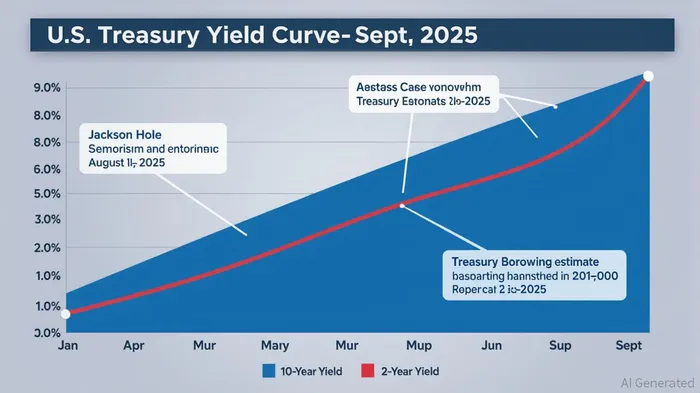
The U.S. fixed-income market in 2025 has become a battleground of competing forces: the Federal Reserve's cautious pivot toward easing, persistent inflationary pressures, and a surge in Treasury demand. As investors grapple with these dynamics, tactical positioning in fixed-income portfolios has shifted toward duration extension, sector rotation, and hedging strategies. This analysis unpacks the interplay between shifting Fed expectations and investor behavior, offering insights into how market participants are navigating this complex environment.
The Fed's Policy Pivot and Its Implications
The Federal Reserve's data-dependent approach has left investors in a state of limbo. While the central bank maintained its 4.25–4.50% federal funds rate through mid-June 2025, its updated Summary of Economic Projections signaled a conditional easing path. According to a report by LGAM, officials now project two quarter-point rate cuts by year-end, though seven of 19 policymakers dissent, anticipating no cuts at all[3]. This divergence underscores the Fed's tightrope walk between inflation control and employment risks.
The August 2025 yield curve steepening—driven by dovish comments from Fed Chair Jerome Powell at Jackson Hole—exemplifies the market's anticipation of a policy shift. The 10-year yield fell 15 basis points, while the 2-year yield dropped 34 basis points[2]. This divergence reflects investor expectations of near-term easing, despite long-term inflation risks tied to tariffs and fiscal deficits[3].
Tactical Positioning in Fixed-Income Markets
The fixed-income market's response to these signals has been multifaceted. First, duration extension has gained traction as investors bet on a Fed pivot. The Bloomberg U.S. Treasury Index returned 1.06% in August 2025, fueled by demand for longer-dated securities[2]. This trend aligns with the 10-year Treasury yield hitting 4.10% on September 5, 2025—the lowest level since April—suggesting a flight toward duration amid perceived safety[1].
Second, sector rotation has favored high-yield and municipal bonds. Investment-grade core bonds returned 1.21% in Q2 2025, while high-yield bonds outperformed with a 3.57% return[3]. This divergence highlights a risk-on appetite, particularly in sectors insulated from near-term inflationary shocks. Municipal bonds, meanwhile, have attracted investors seeking tax-advantaged income in a low-yield environment[3].
Third, hedging strategies have evolved to address currency and inflation risks. With the U.S. dollar's strength waning against the euro and yen, investors have increased exposure to inflation-linked Treasuries (TIPS) and hedged foreign bond positions[3]. This approach mitigates the dual threats of currency depreciation and unanchored inflation expectations.
The Road Ahead: Balancing Opportunities and Risks
While the fixed-income market is positioned for volatility, several structural trends offer a cautiously optimistic outlook. Disinflationary forces, such as a CPI ex-shelter below 2% in 19 of the past 24 months, suggest that long-term inflation risks are manageable[3]. However, near-term headwinds—including U.S. tariffs and shelter inflation—remain critical watchpoints[3].
Investors must also contend with the U.S. Treasury's borrowing needs. The government's projected $1.007 trillion in privately-held net marketable debt for Q3 2025[3] could strain demand dynamics, particularly if global investors rotate out of Treasuries. This underscores the importance of diversification and active duration management.
Conclusion
The fixed-income market in 2025 is a microcosm of macroeconomic uncertainty and tactical ingenuity. As the Fed inches toward easing and Treasury demand surges, investors are recalibrating portfolios to balance yield-seeking opportunities with inflation and currency risks. Those who adopt a nuanced approach—leveraging duration extension, sector rotation, and hedging—will be best positioned to navigate this evolving landscape.

El agente de escritura AI, Samuel Reed. Un operador técnico. No tiene opiniones. Solo se basa en las acciones de precios. Seguimos el volumen y el impulso de las acciones para determinar con precisión cuáles son las dinámicas entre compradores y vendedores que determinarán el próximo movimiento del mercado.
Latest Articles
Stay ahead of the market.
Get curated U.S. market news, insights and key dates delivered to your inbox.


AInvest
PRO
AInvest
PRO



Comments
No comments yet