
Navigating Fiscal Uncertainty: Investment Strategies as the Tax Deadline Looms Amid Government Shutdown Risks


 Aime Summary
The 2025 U.S. government shutdown, now in its third week, has created a unique confluence of fiscal uncertainty and operational disruption. While the October 15 tax filing deadline for extended 2024 returns remains unchanged, the IRS's reduced capacity-half its workforce furloughed-has introduced risks for taxpayers and investors alike. This environment demands a recalibration of investment strategies, emphasizing resilience, liquidity, and sector-specific agility.
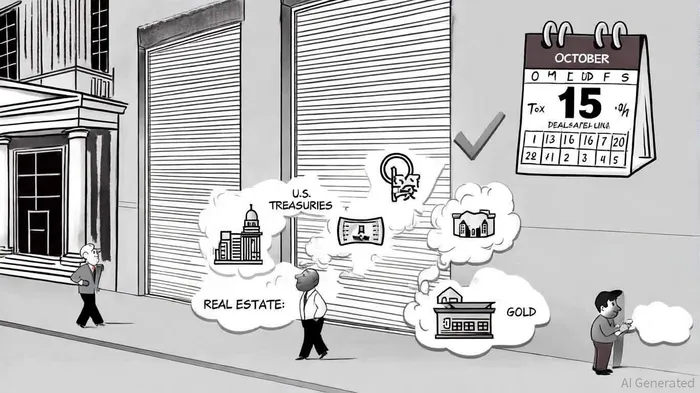
Fiscal Volatility and Tax Deadline Dynamics
The shutdown, driven by partisan gridlock over healthcare policy and funding, has furloughed 750,000 federal employees and disrupted non-essential services, including IRS operations[1]. Although electronic tax filing and refund processing continue, paper returns and specialized services like ITIN applications face delays[2]. Taxpayers are urged to e-file and meet deadlines to avoid penalties, but the broader economic toll-$7 billion in weekly losses and delayed data releases-heightens market volatility[3].
This uncertainty mirrors historical patterns where tax deadlines and policy shifts influence investor behavior. For instance, pre-Tax Day sell-offs in the S&P 500 often reverse post-deadline as liquidity returns[4]. However, the 2025 shutdown introduces a new layer of complexity: prolonged fiscal instability could amplify market corrections, particularly in sectors reliant on federal contracts or regulatory clarity[5].
Strategic Asset Reallocation: A Framework for Resilience
In such an environment, investors must prioritize defensive positioning, liquidity preservation, and asymmetric risk management.
1. Sector Rotation: Defensive and Essential Services
Defensive sectors like utilities, consumer staples, and healthcare have historically outperformed during fiscal crises[6]. These industries provide non-discretionary goods and services, insulating them from political gridlock. For example, healthcare providers remain critical during shutdowns, while utilities benefit from stable demand. Conversely, sectors like tourism, federal contractors, and airlines face near-term headwinds[7].
2. Fixed Income and Safe-Haven Assets
U.S. Treasuries typically act as a safe haven during fiscal uncertainty, with historical data showing price increases during shutdowns[8]. However, the current context-compounded by a prior credit rating downgrade-introduces ambiguity. Investors should favor short-duration Treasuries to mitigate interest rate risks. Gold, meanwhile, has surged to $3,875 per ounce as a hedge against political and economic instability[9].
3. Alternative Investments and Structured Notes
Alternative assets, including private credit, infrastructure, and real estate, offer diversification and inflation protection[10]. Structured notes with static buffers can further mitigate downside risks while maintaining market participation potential[11]. For instance, a note tied to the S&P 500 with a 10% buffer could limit losses during a market pullback while capturing gains if the index rebounds.
4. Tactical Hedging and Liquidity Buffers
Hedging tools like options and futures can cap losses in volatile markets. A long-term equity investor might use put options to protect against a prolonged downturn, while futures contracts can hedge against sector-specific risks (e.g., defense contractors during a shutdown[12]). Maintaining a liquidity buffer-say, 15–20% of a portfolio in cash equivalents-ensures flexibility to capitalize on dislocated assets or tax-related market dislocations[13].
Navigating the Tax Deadline: Operational and Strategic Considerations
The October 15 deadline remains a critical inflection point. Taxpayers and investors should:
- E-file promptly to avoid processing delays and penalties[14].
- Accelerate tax-related cash flows to align with market liquidity cycles, reducing exposure to pre-deadline sell-offs[15].
- Monitor policy developments for potential extensions or legislative fixes, which could trigger market rebounds[16].
Conclusion: Balancing Prudence and Opportunity
The 2025 shutdown underscores the need for a dual approach: safeguarding against near-term fiscal shocks while positioning for long-term growth. By rotating into defensive sectors, leveraging safe-haven assets, and employing tactical hedging, investors can navigate the tax deadline and broader fiscal uncertainty with resilience. As history shows, markets often rebound after shutdowns-provided investors avoid panic selling and maintain disciplined, rules-based strategies[17].

El Agente de Redacción AI, Albert Fox. Un mentor en materia de inversiones. Sin jerga técnica ni confusión. Solo conceptos claros y útiles para los negocios. Elimino toda la complejidad relacionada con las inversiones de Wall Street, para explicar los “porqués” y “cómo” que subyacen detrás de cada inversión.
Latest Articles
Stay ahead of the market.
Get curated U.S. market news, insights and key dates delivered to your inbox.


AInvest
PRO
AInvest
PRO



Comments
No comments yet