
Navigating U.S. Fiscal Sustainability: Balancing Debt, Tariffs, and Strategic Sector Exposure


 Aime Summary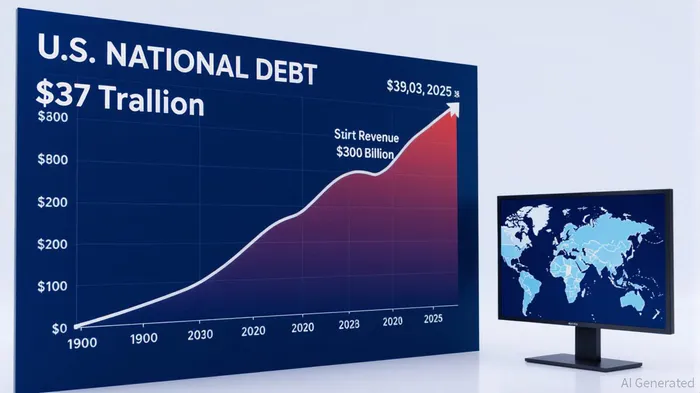
The U.S. fiscal landscape in 2025 is a paradox of strength and fragility. While the economy remains a global powerhouse—boasting a per capita GDP of $89,000 and outpacing peers post-pandemic—the nation's debt burden has reached $29.4 trillion, with deficits projected to balloon to $2.7 trillion by 2035. Tariff-driven revenue surges, meanwhile, have injected $30 billion in July 2025 alone, masking deeper structural imbalances. For investors, this duality demands a nuanced approach: leveraging the resilience of U.S. sovereign-linked assets while hedging against long-term fiscal risks.
The Fiscal Tightrope: Debt, Deficits, and Tariff Revenue
The Congressional Budget Office (CBO) and Committee for a Responsible Federal Budget (CRFB) paint a stark picture. Federal debt held by the public is expected to climb from 100% of GDP in 2025 to 118% by 2035, with net interest payments soaring to $1.8 trillion (4.1% of GDP). The “One Big Beautiful Bill Act” (OBBBA), which extended tax cuts and expanded tariffs, has exacerbated this trajectory. While tariffs have generated a 242% year-over-year revenue spike, they've also triggered retaliatory measures from trade partners and inflationary pressures.
Credit rating agencies are divided. S&P GlobalSPGI-- Ratings reaffirmed its “AA+” rating with a stable outlook, citing tariff revenue as a buffer against fiscal deterioration. Moody'sMCO--, however, stripped the U.S. of its final AAA rating in May 2025, warning of “unsustainable fiscal trajectories” and political gridlock. Fitch echoed concerns, noting that repeated debt ceiling brinkmanship and structural spending imbalances threaten long-term credibility.
Sector-Specific Opportunities and Risks
Tariffs have reshaped industries, creating both vulnerabilities and opportunities:
1. Manufacturing and Retail: Tariffs on steel, aluminum, and autos have raised input costs, squeezing margins for manufacturers and retailers. For example, the 50% tariff on copper has strained electronics and construction sectors, while the 25% auto tariff has disrupted supply chains. However, domestic producers with U.S.-sourced components (e.g., Tesla's Gigafactories) may gain competitive advantages.
2. Pharmaceuticals and Semiconductors: Threatened tariffs of 250% on pharmaceuticals and 100% on semiconductors could disrupt critical supply chains, but companies like IntelINTC-- and MerckMRK-- may benefit from reshoring incentives.
3. Small Businesses and E-commerce: The elimination of the de minimis exemption has increased costs for small importers, but larger retailers with diversified sourcing (e.g., Walmart) may absorb these shocks more effectively.
Strategic Investment Framework
For investors, the key lies in balancing exposure to U.S. sovereign-linked assets with sector-specific hedging:
1. Sovereign-Linked Assets: U.S. Treasuries remain a cornerstone of diversification, despite rising yields. The 10-year Treasury yield stabilized at 4.25–4.5% post-May 2025, reflecting demand for safe-haven assets. However, investors should consider shorter-duration bonds to mitigate interest rate risks.
2. Sector Rotation: Overweight industries poised to benefit from tariffs (e.g., domestic steel producers like Nucor) while underweighting those facing retaliatory measures (e.g., agricultural exporters).
3. Hedging Mechanisms: Gold and inflation-protected securities (TIPS) can offset long-term fiscal risks. Additionally, shorting overvalued tech stocks (e.g., the “Magnificent 7”) may capitalize on market corrections driven by economic slowdowns.
4. Emerging Markets Exposure: Diversify into markets less reliant on U.S. trade (e.g., Southeast Asia) to mitigate retaliatory tariff impacts.
The Long Game: Policy Uncertainty and Legal Challenges
The fiscal outlook hinges on unresolved legal battles. If the U.S. Trade Court rules many tariffs illegal, debt could surge to 134% of GDP by 2035, per CRFB. Investors should monitor litigation timelines and prepare for volatility in sectors like manufacturing and retail.
Conclusion: A Calculated Approach to Resilience
The U.S. economy's resilience—bolstered by a diversified industrial base and robust consumer demand—offers a floor for growth. Yet, the interplay of rising debt, tariff-driven distortions, and political uncertainty demands a strategic, adaptive approach. By prioritizing sector-specific exposure, hedging against fiscal risks, and maintaining liquidity, investors can navigate this complex landscape while capitalizing on emerging opportunities.
In the end, the U.S. fiscal story is one of contradictions: a nation with unparalleled economic might, yet teetering on the edge of structural imbalance. For those who can parse the signals, the path forward is not just about survival—it's about thriving in an era of transformation.

Decoding blockchain innovations and market trends with clarity and precision.
Latest Articles
Stay ahead of the market.
Get curated U.S. market news, insights and key dates delivered to your inbox.
AInvest
PRO
AInvest
PRO



Comments
No comments yet