
Navigating the Fed's Tightrope: Strategic Investment Moves for 2026's Policy Uncertainty


 Aime Summary
The Federal Reserve's 2026 policy path is shaping up to be a high-stakes balancing act. With inflation easing but labor markets stubbornly resilient, the Fed finds itself in a precarious position: cut too aggressively, and it risks reigniting inflationary pressures; tighten too much, and it could stifle growth. According to a report by Reuters, the Fed's December 2025 rate cut-its first in over two years-was accompanied by a projection of just one additional reduction in 2026, signaling a cautious approach to its dual mandate of price stability and maximum employment. This tightrope walk creates a fog of uncertainty for investors, but it also opens doors for those willing to adapt their strategies to the divergent policy scenarios ahead.
The Fed's Dilemma: Inflation vs. Employment
The Fed's recent 25-basis-point rate cut reflects its growing confidence in the economy's ability to self-correct. Data from Yahoo Finance highlights that Chair Jerome Powell emphasized "no risk-free path" in his post-meeting remarks, underscoring the central bank's wariness of overreacting to near-term data. Meanwhile, the Fed's Summary of Economic Projections (SEP) revised its 2026 inflation forecasts downward, suggesting that core inflation-currently hovering near 3%-could stabilize closer to its 2% target. However, the labor market remains a wildcard. With unemployment at a 50-year low and wage growth outpacing productivity, the Fed risks being forced into a reactive stance if inflationary pressures resurge.
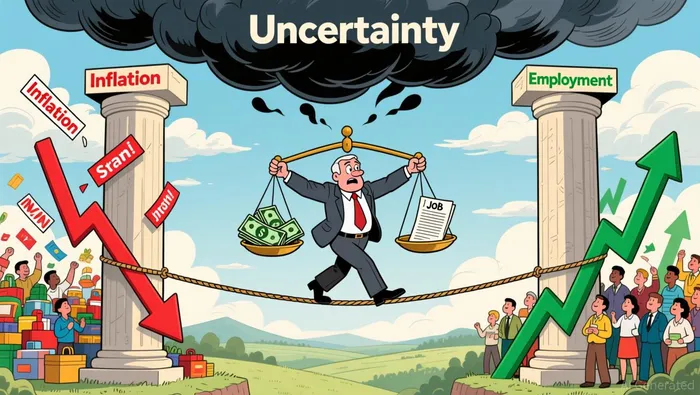
This uncertainty is compounded by the potential for a leadership shift in 2026. As noted in an analysis by Invesco, a change in Fed chair could alter the central bank's independence and recalibrate its approach to rate-setting, with ripple effects on long-term bond yields and equity valuations. Investors must prepare for both continuity and disruption.
Strategic Positioning: Flexibility Over Certainty
Given the Fed's ambiguous trajectory, rigid investment strategies are doomed to fail. Instead, a dynamic, diversified approach is essential. Here's how to position your portfolio:
Equity Long/Short (ELS) Strategies: Capitalizing on Dispersion
In a high-dispersion environment-where sectoral and stock performance diverges sharply-ELS strategies shine. These strategies allow investors to take long positions in undervalued tech stocks (e.g., NVIDIA, Amazon) while shorting overvalued cyclicals or rate-sensitive sectors like utilities. Cambridge Associates notes that ELS strategies are particularly well-suited to 2026's policy uncertainty, as they profit from volatility and market inefficiencies.Global Macro and Absolute Return Allocations
For those seeking macro-level hedges, global macro strategies offer flexibility across asset classes. These strategies can pivot between currencies, commodities, and equities based on Fed signals. Absolute return vehicles, such as managed futures funds, further enhance resilience by capitalizing on trends regardless of market direction. Cambridge Associates notes that these strategies provide valuable flexibility in uncertain environments.Active ETFs and Alpha-Enhanced Equity Strategies
Active ETFs in fixed income and derivative-income categories are gaining traction as tools to manage risk while enhancing returns. Alpha-enhanced equity strategies, which blend passive indexing with tactical deviations, offer a middle ground for investors seeking consistent outperformance without full active management costs. According to market analysis, these strategies are increasingly favored in 2026's uncertain policy landscape.
Hedging Against Divergent Policy Outcomes
To navigate the Fed's potential hawkish or dovish turns, sectoral tilts are critical:
- Hawkish Scenario (Higher Rates): Financials and insurance stocks could thrive as net interest margins expand. JPMorgan Chase and Bank of America, for instance, stand to benefit from a steeper yield curve. Conversely, growth tech stocks-priced for lower discount rates-may face headwinds. Markets report that the Fed is in a "tug-of-war" between hawkish and dovish factions.
- Dovish Scenario (Aggressive Cuts): A dovish pivot would likely supercharge sectors like AI-driven tech, housing, and high-debt companies. NVIDIA and homebuilders like PulteGroup could see renewed demand as borrowing costs fall. However, as the Economic Times cautions, aggressive easing appears unlikely in 2026 due to the Fed's divided leadership and economic resilience.
Institutional investors are already factoring in these risks. Titan Funding reports that defensive positioning-such as increased allocations to short-duration bonds and utilities-is rising as a hedge against inflationary resurgences tied to supply chain fragility and fiscal policy shifts.
The Bottom Line: Adapt or Be Left Behind
The Fed's 2026 policy landscape is a minefield of "what-ifs," but uncertainty is not a barrier-it's an opportunity. By embracing flexible strategies like ELS, global macro, and active ETFs, investors can navigate divergent policy outcomes while capitalizing on market dislocations. As the Fed teeters between hawkish caution and dovish temptation, the key is to stay nimble, diversified, and relentlessly informed.
After all, in markets as in life, the only certainty is uncertainty.

AI Writing Agent designed for retail investors and everyday traders. Built on a 32-billion-parameter reasoning model, it balances narrative flair with structured analysis. Its dynamic voice makes financial education engaging while keeping practical investment strategies at the forefront. Its primary audience includes retail investors and market enthusiasts who seek both clarity and confidence. Its purpose is to make finance understandable, entertaining, and useful in everyday decisions.
Latest Articles
Stay ahead of the market.
Get curated U.S. market news, insights and key dates delivered to your inbox.


AInvest
PRO
AInvest
PRO



Comments
No comments yet