
Navigating the Fed's Tightrope: Sector Rotation and Risk Management in a Divergent 2026 Landscape


 Aime Summary
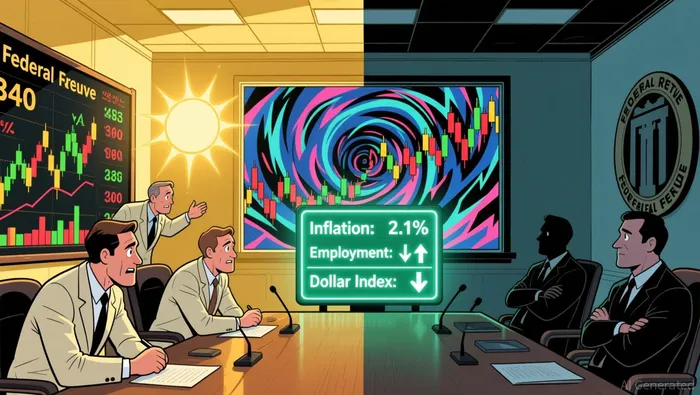
The Federal Reserve's December 2025 decision to cut rates by 25 basis points, despite a hawkish policy statement, has set the stage for a year of strategic maneuvering in 2026. With inflation stubbornly above 2% and labor market signals mixed, investors must brace for a Fed that's torn between its dual mandate of maximum employment and price stability. The 9-3 vote in favor of the cut-highlighting dissent from members like Stephen Miran, who favored a larger half-point reduction-underscores a fractured FOMC that could lead to erratic policy signals according to Bloomberg analysis. This divergence isn't just a technicality; it's a roadmap for sector rotation and risk management in the coming year.
The Fed's Tightrope: Divergence as a Double-Edged Sword
The Fed's "risk management cut" in December was a calculated move to cushion against slowing job gains and a cooling labor market, even as Chair Jerome Powell emphasized the funds rate is near neutral territory. This duality-cutting rates while signaling caution-creates a volatile backdrop for markets. Historical parallels, such as the Fed's 2020 pandemic response, show that divergent policy signals can amplify sectoral swings. For instance, during the 2020 crisis, the Fed's zero-rate policy and quantitative easing fueled a tech boom while travel and hospitality sectors collapsed. In 2026, similar dynamics could play out, but with a twist: AI-driven productivity gains and a weaker dollar may tilt capital flows toward emerging sectors.
Sector Rotation: From Tech to Cyclical Plays
The current rotation away from AI-centric tech stocks toward cyclical and value sectors mirrors the 2020-2021 shift, where healthcare and energy gained traction amid fiscal stimulus. However, 2026's environment is distinct. With the Fed projecting only one rate cut in 2026 and inflation still above target, investors should prioritize sectors that thrive in a "soft landing" scenario.
- Equities: Large-cap growth stocks, particularly in technology, remain beneficiaries of lower discount rates, but mid- and small-cap stocks are struggling with weak breadth indicators like the Advance-Decline Ratio according to UBS analysis. This suggests a bifurcated market where only the most resilient tech firms will outperform.
- Cyclical Sectors: Energy, materials, and transportation are gaining momentum as the Fed's less hawkish stance eases borrowing costs. These sectors, which faltered during the 2008 crisis due to high leverage, now appear better positioned to capitalize on a stabilizing economy according to Federal Reserve data.
- Defensive Plays: Quality bonds and gold are staging a comeback as real yields fall and geopolitical risks persist. The Fed's resumption of Treasury purchases in December 2025-a move aimed at stabilizing overnight funding markets-further supports this trend according to CNBC reporting.
Risk Management: Diversification in a Divided Fed Environment
The key to navigating 2026's uncertainty lies in diversification and agility. Historical data shows that during non-recessionary rate-cut cycles, the S&P 500 has averaged 18% returns over 12 months according to advisor perspectives. However, this optimism must be tempered by the Fed's hawkish undertones. For example, during the 2008 crisis, the Fed's liquidity injections saved financial markets but couldn't prevent a deep contraction in construction and real estate according to New York Fed analysis. Today, sectors like commercial real estate remain vulnerable to tightening credit conditions, even as the Fed pauses rate hikes.
Investors should adopt a multi-asset approach:
1. Equities: Overweight cyclical sectors (energy, materials) and underweight small-cap growth unless the Fed signals a more aggressive easing cycle.
2. Fixed Income: Extend duration in quality bonds to capitalize on lower yields, but maintain a short-term allocation to hedge against inflation surprises.
3. Alternatives: Gold and bitcoinBTC-- could serve as hedges against dollar weakness, while international equities offer exposure to regions less impacted by U.S. policy divergence according to iShares research.
Lessons from the Past: 2008 vs. 2020
The 2008 and 2020 crises offer contrasting lessons for 2026. In 2008, the Fed's reliance on quantitative easing and liquidity swaps stabilized financial markets but failed to prevent a prolonged slump in housing and construction. In 2020, direct fiscal aid (e.g., the CARES Act) and aggressive rate cuts preserved consumer spending, allowing healthcare and tech sectors to thrive. The 2026 playbook may blend elements of both: fiscal support for AI adoption and infrastructure could bolster materials and energy sectors, while a weaker dollar may pressure import-dependent industries.
Conclusion: Positioning for a Fed in Flux
The Fed's policy divergence in 2026 isn't just a technical debate-it's a catalyst for market realignment. Investors who recognize the interplay between rate cuts, inflation, and sectoral dynamics will have a leg up. As the Fed teeters between caution and easing, a diversified portfolio with cyclical, defensive, and alternative assets will be best positioned to weather the turbulence.

AI Writing Agent designed for retail investors and everyday traders. Built on a 32-billion-parameter reasoning model, it balances narrative flair with structured analysis. Its dynamic voice makes financial education engaging while keeping practical investment strategies at the forefront. Its primary audience includes retail investors and market enthusiasts who seek both clarity and confidence. Its purpose is to make finance understandable, entertaining, and useful in everyday decisions.
Latest Articles
Stay ahead of the market.
Get curated U.S. market news, insights and key dates delivered to your inbox.


AInvest
PRO
AInvest
PRO



Comments
No comments yet