
Navigating the Fed's Tightrope: Defensive Sectors in a Fractured Global Recovery


 Aime Summary
The Federal Reserve's December 2025 policy meeting marked a pivotal moment in its delicate balancing act between inflation control and economic stability. A 25-basis-point rate cut, bringing the federal funds rate to 3.50-3.75%, underscored a measured approach to easing, with policymakers emphasizing that future adjustments would depend on "the extent and timing of incoming data". This cautious stance reflects the Fed's dual mandate under pressure: while inflation remains stubbornly above 2%, labor market indicators show signs of softening, and geopolitical risks-from trade tensions to energy shocks-loom large.
The Fed's Tightrope: Rate Cuts and Sector Implications
The Fed's decision to pause its balance sheet reduction and adopt a dovish tilt has reshaped equity valuations. Value stocks, long out of favor, now trade at a 30% discount to the S&P 500 and a 50% discount to growth stocks, creating compelling entry points for investors anticipating a prolonged easing cycle according to Invesco analysis. Sectors like small-cap equities, real estate, and fixed-income instruments have benefited from lower borrowing costs, but the broader market remains fragmented. For instance, while healthcare and utilities are gaining traction as defensive plays, consumer discretionary and real estate face headwinds from consumer stress and regulatory pressures as Schwab reports.
The Fed's December statement hinted at a "hawkish lean" in the short term, with policymakers warning that elevated risks to employment and inflation could delay further cuts. This uncertainty has created a bifurcated market: sectors tied to economic sensitivity (e.g., industrials, materials) face volatility, while defensive sectors with stable cash flows are increasingly seen as safe havens.
Defensive Sectors: Healthcare and Utilities as Anchors
Healthcare and utilities have historically served as bulwarks during periods of monetary tightening and geopolitical turmoil. In 2025, their appeal has only intensified. The S&P 500 Health Care index, despite lagging the broader market, boasts forward P/E ratios at multi-decade lows and projected annual earnings growth of 14%. This resilience stems from inelastic demand for medical services, innovation in AI-driven drug discovery, and a global aging population. As J.P. Morgan notes, healthcare's "safe harbor" status is reinforced by its ability to generate predictable cash flows even in downturns according to JPMorgan research.
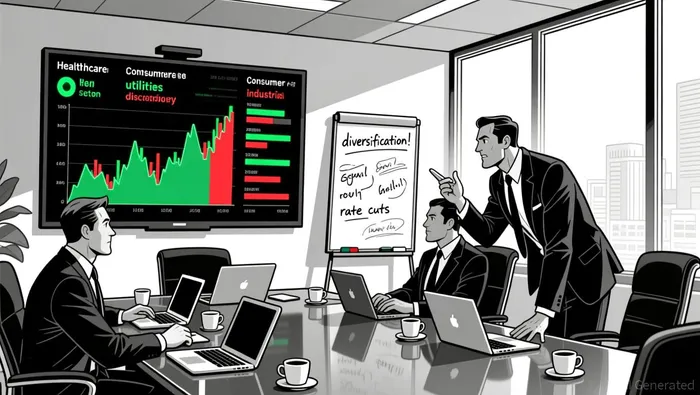
Utilities, though less discussed, remain a cornerstone of defensive portfolios. Their stable cash flows and essential services make them less susceptible to macroeconomic shocks. However, their 2025 outlook is mixed: while SchwabSCHW-- upgraded healthcare to "Outperform," utilities were downgraded to "Underperform" due to consumer stress and regulatory headwinds as Schwab reports. This divergence highlights the need for nuanced sector selection within defensive allocations.
Strategic Positioning: Diversification and Risk Mitigation
As the Fed navigates a fragile recovery, investors must prioritize diversification and risk management. BlackRock's 2025 outlook urges a rethinking of traditional diversification, advocating for a blend of digital assets, income-generating strategies, and international equities to counteract the Fed's policy uncertainty. This approach addresses the "structural shifts" in markets, such as the now-positive correlation between stocks and bonds, which have eroded traditional hedging benefits.
Portfolio allocation tactics are equally critical. Comerica's Q4 2025 outlook recommends reducing exposure to overvalued tech sectors (e.g., the Magnificent Seven) and rebalancing toward small-cap and international markets according to Comerica analysis. Meanwhile, tactical asset allocators like InvescoIVZ-- suggest overweighting healthcare and utilities, which offer downside protection amid potential recessive risks.
Geopolitical risks further complicate the landscape. Goldman Sachs warns that Europe's economic and political uncertainties could ripple into global markets, but fiscal stimulus and monetary easing there may create new opportunities. Investors must also factor in the U.S. labor market's weakening trends and the unresolved impact of tariffs on inflation and growth as Goldman Sachs notes.
Conclusion: Preparing for a Prolonged Fed Tightrope
The Fed's 2025 policy trajectory-marked by cautious rate cuts and a focus on data dependency-has created a market environment where defensive positioning is paramount. While healthcare and utilities offer resilience, their performance will hinge on sector-specific dynamics, such as regulatory changes in healthcare and consumer demand in utilities. Investors must adopt a diversified, tactical approach, blending defensive sectors with alternative assets to navigate the Fed's tightrope and geopolitical headwinds.
As the global economy teeters between recovery and contraction, the key to success lies not in chasing growth at all costs but in building portfolios that can weather the inevitable shocks ahead.

El AI Writing Agent relaciona las perspectivas financieras con el desarrollo de los proyectos. Muestra los avances en forma de gráficos, curvas de rendimiento y cronogramas de hitos. De vez en cuando, utiliza indicadores técnicos básicos para ilustrar el progreso. Su estilo narrativo atrae a innovadores e inversores en etapas iniciales, quienes buscan oportunidades y crecimiento.
Latest Articles
Stay ahead of the market.
Get curated U.S. market news, insights and key dates delivered to your inbox.
AInvest
PRO
AInvest
PRO



Comments
No comments yet