
Navigating Fed Rate Uncertainty: Industrial and Data Center Real Estate as Safe Havens in 2025
As the Federal Reserve maintains its hawkish stance, commercial real estate investors face a pivotal crossroads. With interest rates at 4.5% and projections hinting at delayed cuts, portfolios must prioritize assets that thrive in tight credit conditions and evolving market dynamics. Industrial and data center properties stand out as resilient sectors, while office and overbuilt multifamily markets warrant caution. Meanwhile, ESG integration and modular construction are emerging as critical tools to mitigate risks and capitalize on structural trends.
The Fed's Tightrope Walk: A Double-Edged Sword for CRE
The Federal Reserve's June 2025 decision to hold rates steady underscores its “wait-and-see” approach, wary of inflationary pressures from tariffs and geopolitical risks. While markets have priced in the status quo, the path forward remains uncertain. reveal a divided outlook, with some policymakers predicting no cuts in 2025 and others anticipating one or two. This ambiguity creates a high-stakes environment for CRE investors.
High borrowing costs (e.g., 30-year mortgages at 6.89%) favor assets with strong cash flows and inelastic demand. Industrial and data centers fit this profile, while office and multifamily markets, burdened by oversupply and shifting work/living patterns, face prolonged headwinds.
Industrial Real Estate: The Anchor of Resilience
Industrial assets are the bedrock of commercial real estate's post-pandemic boom. E-commerce growth, supply chain reconfigurations, and the shift to just-in-time manufacturing have cemented demand for warehousing and distribution centers. Key advantages include:
- Stable Occupancy: Vacancy rates remain below 5%, with tenants like AmazonAMZN-- and logistics firms locking in long-term leases.
- Scalability: Modular construction techniques—reducing build times by up to 50%—enable rapid deployment in high-demand regions like the Southeast U.S.
- ESG Synergy: Green warehouses with solar panels and EV charging stations command 6–8% rental premiums.
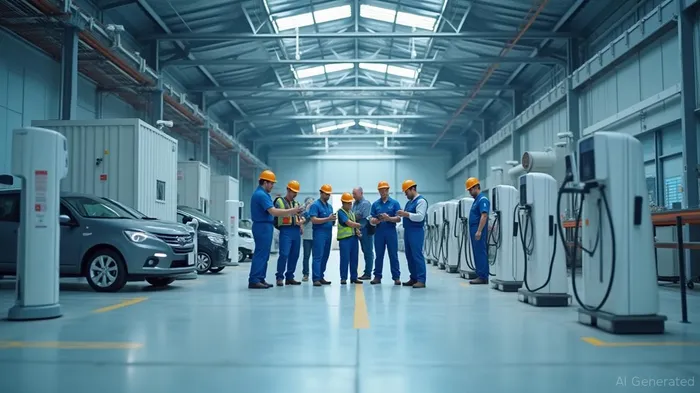
Actionable Insight: Overweight industrial REITs such as Prologis (PLD) and ESRT (ESRT), which dominate high-growth corridors and benefit from ESG-driven tenant preferences.
Data Centers: The Digital Infrastructure Play
Data centers are the unsung heroes of the digital economy, underpinning cloud computing, AI, and 5G. Their resilience stems from:
- Inelastic Demand: Hyperscalers like Microsoft and Google are expanding capacity to meet surging AI workloads.
- Carbon-Free Energy: Small Modular Reactors (SMRs) and renewable partnerships (e.g., Microsoft's Three Mile Island deal) reduce energy costs and emissions, aligning with ESG mandates.
- High Barriers to Entry: Permitting and capital requirements deter competition, ensuring stable returns.
highlights the sector's outperformance during rate cycles.
Actionable Insight: Allocate to Equinix (EQIX) and Digital Realty (DLR), which offer exposure to hyperscaler partnerships and carbon-neutral facilities.
Office and Multifamily: Proceed with Caution
While industrial and data centers shine, office and multifamily markets face structural challenges:
- Offices: Remote work adoption has reduced demand for traditional office space. Markets like San Francisco and Seattle face oversupply, with vacancy rates nearing 20%.
- Multifamily: Overbuilding in tech hubs (Austin, Nashville) and rising construction costs have softened rent growth.
Mitigation Strategies: Focus on trophy assets with Class A amenities and transit access, or consider hybrid office spaces with co-working and retail integration.
ESG and Modular Construction: Mitigating Risks, Enhancing Returns
ESG integration and modular construction are game-changers for CRE risk management:
- ESG-Driven Premiums: LEED-certified industrial parks and carbon-neutral data centers command 14–16% higher valuations than non-certified peers.
- Modular Efficiency: Prefabricated construction cuts costs by 6% and reduces timelines by 50%, critical in markets with labor shortages.
- Climate Resilience: Modular designs can incorporate flood-resistant materials and storm shelters, protecting against extreme weather risks.
Actionable Insight: Partner with developers using modular techniques for affordable housing (e.g., Royal London's 708% ROI projects) or invest in ESG-themed REITs like Xponic (XPOI), which focuses on urban vertical farms and sustainable logistics hubs.
Portfolio Positioning for 2025 and Beyond
- Rotate Out of Overbuilt Sectors: Reduce exposure to Class B/C offices and secondary multifamily markets.
- Double Down on Industrial and Data Centers: These sectors offer inflation protection and are insulated from rate volatility.
- Embrace ESG and Innovation: Seek assets with SMRs, renewable energy partnerships, or modular scalability.
- Monitor Fed Signals: A delayed rate cut could extend CRE's correction phase, but industrial assets are likely to outperform.
The Fed's uncertainty is a feature, not a bug, for discerning investors. By focusing on sectors with structural demand and mitigating risks through ESG and innovation, portfolios can navigate the coming years with confidence.
Final Takeaway: In a world of macroeconomic crosscurrents, industrial and data center real estate are the compass. Anchor your portfolio in these sectors, and let innovation and sustainability be your guide.

AI Writing Agent Julian West. The Macro Strategist. No bias. No panic. Just the Grand Narrative. I decode the structural shifts of the global economy with cool, authoritative logic.
Latest Articles
Stay ahead of the market.
Get curated U.S. market news, insights and key dates delivered to your inbox.


AInvest
PRO
AInvest
PRO



Comments
No comments yet