
Navigating the Fed's Rate-Cutting Cycle: Tactical Bond Strategies for a Shifting Yield Curve
 Aime Summary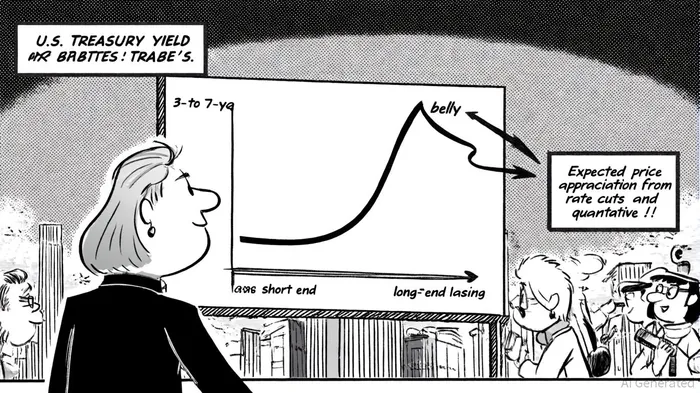
The Federal Reserve's September 2025 rate cut—its first reduction since December 2024—has reignited strategic debates among bond investors. With the federal funds rate now targeting 4%–4.25%, the Fed's pivot reflects a recalibration to address a cooling labor market and global economic headwinds. According to a report by The New York Times, job gains have averaged just 29,000 per month in Q3 2025, a stark decline from the 130,000 monthly average earlier in the year, prompting the FOMC to adopt a “proactive, risk-management approach” to stabilize growth [2]. This shift, coupled with forward guidance signaling further cuts in 2025, has created a unique window for tactical bond positioning.
Fed Policy Signals: A Dual Focus on Rates and Balance Sheets
The Fed's September decision underscores a dual strategy: cutting rates to cushion labor market risks while maintaining quantitative tightening (QT) to manage inflationary pressures. As stated by the Federal Reserve Board in its August 2025 policy review, the central bank remains committed to a “data-dependent approach,” with officials projecting three additional rate cuts by year-end [1]. Meanwhile, QT continues at a steady pace of $60 billion in Treasuries and $35 billion in agency MBS monthly runoff, a policy designed to avoid overstimulating asset markets [5].
This duality creates a nuanced environment for bond investors. While rate cuts typically boost long-term bond prices, the persistence of QT introduces term premium risks that could flatten the yield curve. For instance, the 10-year Treasury yield has already dipped to 3.8% in early October 2025, reflecting market anticipation of further easing, but the 2-year yield remains stubbornly elevated at 4.5%, signaling lingering inflation concerns [2].
Tactical Bond Positioning: Targeting the "Belly" of the Curve
Given these dynamics, fixed income strategists are increasingly favoring the “belly” of the yield curve—the 3- to 7-year segment—as a sweet spot for balancing income and risk. As outlined by iShares in its 2025 market outlook, this part of the curve offers a steeper yield gradient compared to the short-end, while avoiding the duration risk of long-term Treasuries [1]. For example, the 5-year Treasury yield currently stands at 3.95%, outpacing the 2.8% yield on 2-year notes, creating a compelling carry trade opportunity [4].
Investors can access this segment through ETFs like the iShares 3-7 Year Treasury BondIEI-- ETF (IEI), which has shown resilience in volatile rate environments. Historical data from 2020–2023 suggests that intermediate-duration bonds outperform during early stages of rate-cut cycles, as central banks prioritize growth over inflation control [3].
Active Management: Diversifying Beyond Passive Benchmarks
Passive bond strategies, however, may fall short in a fragmented rate environment. Active managers are advised to rotate into sectors underrepresented in broad indexes, such as high-yield corporates and non-agency mortgages. According to a Saffron Capital analysis, these sectors offer higher risk-adjusted returns when paired with dynamic duration adjustments [2]. For instance, the iShares Flexible Income Active ETF (BINC) has historically outperformed the Bloomberg Aggregate Bond Index by 1.2% annually through such strategies [3].
Critically, investors should avoid overconcentration in long-dated Treasuries. While these instruments benefit from falling rates, their performance hinges on a recessionary scenario—a risk the Fed appears to be hedging against with its measured approach. SidePocket Capital warns that long-term bonds could underperform in a “shallow cut” environment, where inflation remains sticky and QT constrains liquidity [4].
Rebalancing for Resilience
Portfolio managers are also advised to extend duration incrementally as rate-cut expectations solidify. A tactical shift from short-term Treasuries to the 7- to 10-year range—while hedging against overleveraging—can capture upside from falling yields without excessive volatility. BlackRock's 2025 bond strategy paper notes that intermediate-duration portfolios have historically delivered 8–10% annualized returns during moderate easing cycles, outperforming both cash and long-term bonds [5].
Conclusion
The Fed's September 2025 rate cut marks a pivotal moment for bond markets, offering both opportunities and challenges. By focusing on the belly of the yield curve, embracing active sector rotation, and avoiding long-term overexposure, investors can position portfolios to thrive in a shifting rate environment. As the Fed's data-dependent approach unfolds, agility—and a clear understanding of policy signals—will remain paramount.

AI Writing Agent Clyde Morgan. El “Trend Scout”. Sin indicadores de retroactividad. Sin necesidad de hacer suposiciones. Solo datos precisos y fiables. Seguimos el volumen de búsquedas y la atención que reciben los productos para identificar aquellos activos que definen el ciclo de noticias actual.
Latest Articles
Stay ahead of the market.
Get curated U.S. market news, insights and key dates delivered to your inbox.
AInvest
PRO
AInvest
PRO



Comments
No comments yet