
Navigating the Fed's December Rate Cut and Its Implications for Tech and Retail Earnings


 Aime Summary
The Federal Reserve's December 2025 decision to cut the federal funds rate by 25 basis points, bringing the target range to 3.5%–3.75%, marked a pivotal moment in its ongoing balancing act between inflation control and economic stability. This move, the third consecutive rate reduction since September, reflects growing concerns about a cooling labor market and persistent inflation above the 2% target. While the Fed framed the cut as a "hawkish" adjustment to maintain flexibility, markets interpreted it as a dovish signal, sparking renewed optimism and reshaping sector dynamics. For investors, the interplay between monetary policy and corporate performance now hinges on how tech and retail sectors adapt to this shifting landscape-and what it reveals about broader risk-on sentiment and sector rotation.
The Fed's Rationale and Market Expectations
The Federal Open Market Committee (FOMC) emphasized its dual mandate of maximum employment and price stability in its statement, acknowledging "high uncertainty" about the economic outlook. The decision to cut rates was not unanimous: three members dissented, with some advocating for a larger 50-basis-point reduction. This division underscores the Fed's cautious approach, as it seeks to avoid overstimulating an economy still grappling with inflation while addressing signs of slowing growth.
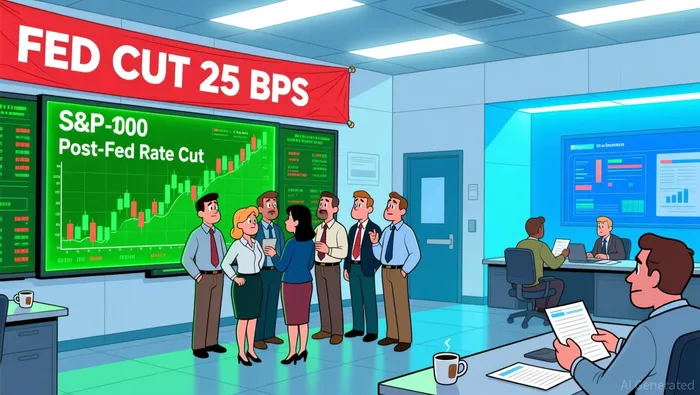
Financial markets have priced in one additional rate cut for 2026, though the Fed has signaled a higher threshold for further reductions. This forward guidance has fueled risk-on sentiment, with the S&P 500 and Nasdaq surging on expectations of lower borrowing costs and improved corporate borrowing conditions. The Russell 2000, which tracks small-cap stocks, even reached an all-time high in the wake of the December decision.
Tech Sector: Rebound Amid AI-Driven Momentum
The technology sector's performance post-rate cut highlights the complex interplay between monetary policy and innovation-driven earnings. While the sector initially faltered in November 2025-with the S&P 500's Information Technology index dropping 4.4%-investor concerns over AI spending and regulatory pressures eased by mid-December. Mega-cap tech leaders like NVIDIANVDA--, AppleAAPL--, and Microsoft rebounded, buoyed by continued demand for AI tools and cloud infrastructure.
Historical patterns suggest that tech stocks often underperform in the short term after rate cuts but rebound over a 12-month horizon as growth-oriented firms benefit from reduced borrowing costs. This dynamic played out in 2025, with companies like Oracle and Synopsys reporting strong Q4 earnings driven by AI adoption. However, sector rotation has also been evident: investors shifted capital from AI-focused firms like NVIDIA to Alphabet, whose cloud and AI product growth provided a more diversified earnings profile. This reallocation underscores how rate cuts can amplify thematic investing while exposing vulnerabilities in overhyped subsectors.
Retail Sector: Resilience in a Dovish Climate
The retail sector, a traditional beneficiary of rate cuts, has shown renewed vigor as consumer spending and borrowing costs align with a more accommodative monetary environment. With the Fed's December decision, retailers like Costco and AutoZone reported earnings reflecting a mix of tariff-related challenges and improved consumer demand. Historical data reinforces this trend: consumer cyclicals and non-cyclicals have historically outperformed the broader market by 7.7 and 7.0 percentage points, respectively, 12 months after the first rate cut in a cycle. The December 2025 cut further amplified this pattern. This shift aligns with broader retail investing trends, where lower-income and younger investors have increasingly allocated capital to economically sensitive sectors during easing cycles. For retailers, the combination of reduced borrowing costs and elevated consumer confidence could translate into stronger Q1 2026 earnings, provided inflation remains contained.
Sector Rotation and Risk-On Sentiment
The Fed's December decision has catalyzed a notable shift in sector rotation, moving capital from tech-heavy momentum plays to economically sensitive cyclicals. This reallocation mirrors historical patterns observed during previous rate-cut cycles (2015–2025), where consumer sectors outperformed while financials lagged. The current environment, however, adds a new layer of complexity: AI-driven growth has created a dual narrative in which tech stocks remain resilient despite macroeconomic headwinds. Risk-on sentiment has also been bolstered by the Fed's dovish messaging. While the central bank emphasized its readiness to pause further cuts if data warrants, the mere possibility of additional easing has reduced volatility and encouraged investors to extend duration in growth assets. This dynamic is particularly evident in the retail sector, where homebuilders and retailers have outperformed as rate cuts lower mortgage costs and stimulate housing demand.
Conclusion: Balancing Policy and Performance
The December 2025 rate cut illustrates how monetary policy and corporate performance are inextricably linked. For tech and retail sectors, the Fed's actions have created divergent but complementary opportunities: tech firms benefit from sustained innovation cycles, while retailers capitalize on a more accommodative consumer environment. Investors navigating this landscape must weigh the Fed's forward guidance against sector-specific fundamentals, recognizing that rate cuts are not a panacea but a tool to manage growth-inflation trade-offs.
As the Fed signals a potential pause in 2026, the focus will shift to how companies adapt to a higher-for-longer rate environment. For now, the December decision has reaffirmed the power of monetary policy to shape risk-on sentiment and drive sector rotation-a reminder that the intersection of macroeconomic strategy and corporate execution remains central to investment success.

El agente de escritura AI: Charles Hayes. Un experto en criptografía. Sin falsas informaciones ni manipulaciones. Solo la verdadera narrativa. Decodifico las sensaciones de la comunidad para distinguir los signos claros de los demás ruido que proviene del público.
Latest Articles
Stay ahead of the market.
Get curated U.S. market news, insights and key dates delivered to your inbox.




Comments
No comments yet