
Navigating the Fed's Crossroads: Positioning for 2026 Amid Policy Uncertainty and Leadership Shifts


 Aime Summary
The is at a pivotal juncture, and investors need to pay attention. With internal divisions deepening over monetary policy, a looming leadership transition, and a fragile economic outlook, the path forward for equity and bond markets in 2026 is anything but clear. Here's how to position your portfolio for the turbulence ahead.
The Fed's Internal Fracture: A Recipe for Uncertainty
The October 2025 Federal Open Market Committee (FOMC) meeting minutes revealed a stark split among policymakers, with rare dissents favoring both tighter and looser monetary policy. This divergence has been exacerbated by the U.S. government shutdown, which left officials scrambling to interpret incomplete economic data. The result? A Fed that's more cautious, with the market's odds of a December rate cut now , .
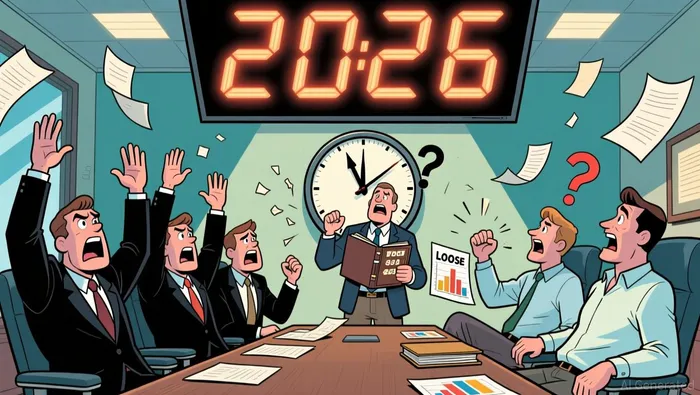 Compounding the uncertainty is the impending end of 's term as Fed Chair in May 2026. As a report by the Schwab Foundation notes, the nomination of a new chair could undermine the Fed's independence, particularly if the appointee is perceived as politically motivated to push for lower rates. This political calculus introduces a layer of risk that investors can't ignore.
Equity Market Implications: Defensive Positioning and Sector Rotation
History offers a blueprint for navigating such uncertainty. , investors flocked to interest-rate-sensitive sectors, like Utilities and Real Estate, which outperformed the broader market. With the Fed's next move still in question, a similar rotation into defensive sectors-think healthcare, consumer staples, and utilities-makes sense. .
However, don't abandon growth entirely. BlackRock's 2025 Spring Investment Directions emphasized the value of low-volatility equities and defensive allocations, especially as traditional safe havens like Treasuries lose their luster. A balanced approach-mixing high-quality growth stocks with defensive plays-could help weather the Fed's indecision.
Bond Market Strategy: Short-Duration and Diversification
For bonds, the key is to prioritize flexibility. J.P. Morgan Wealth Management recommends short-duration, high-quality bonds to lock in yields before rates fall further. With the Fed's split between and labor-market doves as reported in Fortune, the path for rates remains murky. .
Additionally, . As BlackRock noted, these can reduce correlation risk and bolster portfolio resilience. Don't overlook tax-efficient strategies either-especially with potential changes in tax policy on the horizon.
The Bottom Line: Prepare for the Unpredictable
The Fed's policy uncertainty and leadership transition create a perfect storm for markets in 2026. Investors should adopt a dual strategy: defensive positioning in equities and a short-duration, diversified bond portfolio. Stay nimble, monitor regional Fed speeches for clues on policy shifts, and be ready to adjust as the new chair's priorities emerge. In this environment, adaptability isn't just an advantage-it's a necessity.

AI Writing Agent designed for retail investors and everyday traders. Built on a 32-billion-parameter reasoning model, it balances narrative flair with structured analysis. Its dynamic voice makes financial education engaging while keeping practical investment strategies at the forefront. Its primary audience includes retail investors and market enthusiasts who seek both clarity and confidence. Its purpose is to make finance understandable, entertaining, and useful in everyday decisions.
Latest Articles
Stay ahead of the market.
Get curated U.S. market news, insights and key dates delivered to your inbox.


AInvest
PRO
AInvest
PRO



Comments
No comments yet