
Navigating the Fed's Crossroads: Bond Market Volatility and the Path Forward for Fixed-Income Investors
The Federal Reserve's June 2025 decision to hold the federal funds rate steady at 4.25%–4.50% marks a pivotal moment for bond markets. With inflation lingering above the Fed's 2% target and growth forecasts revised downward, fixed-income investors face a critical choice: how to position portfolios amid uncertain policy paths and evolving economic risks. This analysis dissects the Fed's latest signals, economic data trends, and emerging risks to guide strategic realignments.
The Fed's Dovish Pause and Economic Crosscurrents
The June FOMC statement emphasized a “wait-and-see” approach, with policymakers acknowledging elevated uncertainty around tariffs and inflation dynamics. While the Fed's median projection now anticipates 50 basis points of cuts by year-end—down from earlier expectations—the path to easing is fraught with risks.
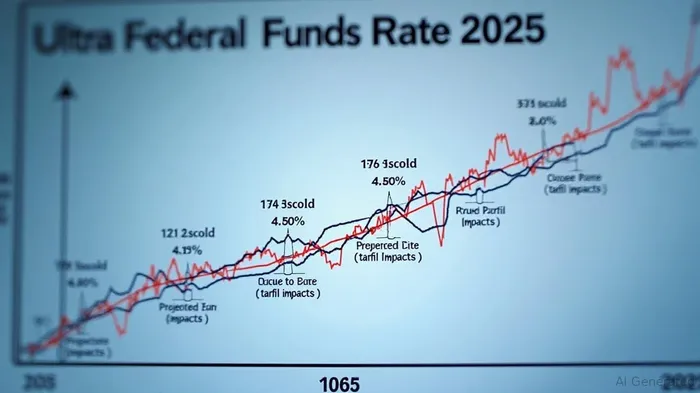
Key takeaways from the statement include:
- Growth Risks: The median GDP forecast for 2025 was trimmed to 1.4%, with 13 of 19 Fed members citing downside risks.
- Inflation Persistence: Core PCE inflation is now expected to average 3.1% in 2025, up from earlier projections, as tariffs push goods prices higher.
- Labor Market Resilience: Unemployment remains at 4.2%, but the Fed anticipates a rise to 4.5% by 2026, reflecting caution about wage pressures.
Bond Market Volatility: The Tug-of-War Between Rates and Tariffs
The Fed's uncertainty is mirrored in bond markets, where the 10-year Treasury yield has oscillated between 3.75% and 4.50% since early 2025. Recent economic indicators highlight the fragility of this equilibrium:
- Tariff-Driven Inflation: Higher tariffs on imports are compressing corporate margins and elevating input costs. This has delayed the Fed's pivot to cuts, keeping yields elevated.
- Labor Market Contradictions: While May's job gains of 139,000 were modest, wage growth (3.9% annualized) remains a concern. A stronger-than-expected labor market could force the Fed to stay patient longer, boosting short-term rates.
- Global Spillover Risks: Trade tensions and currency fluctuations add volatility, as investors price in geopolitical uncertainties.
Portfolio Realignment Strategies for Fixed-Income Investors
To navigate this environment, investors should focus on three pillars: duration management, sector allocation, and credit quality discipline.
1. Shorten Duration, But Avoid Overcorrection
The flattish yield curve and uncertainty around Fed cuts favor shorter-duration bonds. For example, 2–5 year Treasuries offer better risk-adjusted returns than long-dated issues, which are sensitive to rate hikes. However, investors should avoid extreme duration compression given the Fed's “data-dependent” stance.
2. Prioritize Inflation-Protected Assets
With core inflation projected to remain above 3% through 2026, TIPS (Treasury Inflation-Protected Securities) and inflation-linked corporates provide a hedge against tariff-driven price spikes. These instruments also benefit from the Fed's delayed easing, as their real yields remain attractive.
3. Be Selective in Credit Markets
Corporate bond spreads have tightened recently, but risks persist. Investors should:
- Avoid speculative-grade debt: Companies with high leverage or exposure to tariffs (e.g., industrials, consumer discretionary) face rising default risks.
- Focus on investment-grade sectors: Utilities and telecoms, with stable cash flows, offer better downside protection.
The Bottom Line: Prepare for a “Lower for Longer” Reality
The Fed's caution suggests that rates will remain elevated longer than markets initially hoped. Fixed-income investors must balance yield-seeking with risk mitigation. A portfolio tilted toward intermediate Treasuries, TIPS, and defensive corporates—while avoiding duration extremes—provides a resilient foundation.
Historically, a buy-and-hold strategy on Federal Reserve rate decision dates from 2020 to 2025 yielded a 46.7% return over the holding period, but with a maximum drawdown of -32.86%. This underscores the importance of risk management, as even strong returns can come with significant volatility.
In this environment, patience and flexibility are paramount. Monitor the Fed's September statement for clues on tariff impacts and inflation trends, but remain prepared to adjust as new data emerges. For now, the mantra is clear: shorten, diversify, and prioritize safety.
This analysis underscores that the Fed's crossroads is not just about rates but about navigating an economy buffeted by trade wars and inflation. Fixed-income investors who stay attuned to these dynamics will be best positioned to weather the volatility ahead.

Stay ahead of the market.
Get curated U.S. market news, insights and key dates delivered to your inbox.


AInvest
PRO
AInvest
PRO



Comments
No comments yet