
Navigating the Fault Lines: China's Ethnic Nationalism and Investment Risks in 2025
The paradox of China's rise lies in its duality: a global economic powerhouse built on authoritarian governance that increasingly stokes ethnic tensions, destabilizing regions critical to its supply chains and geopolitical ambitions. As ethnic nationalism intensifies under Xi Jinping's “Great Rejuvenation” agenda, investors face a labyrinth of risks—from labor strikes in Xinjiang to infrastructure delays in Tibet—alongside opportunities in sectors insulated by state spending. This analysis dissects how historical divides, repressive policies, and economic strategies collide to reshape investment landscapes.
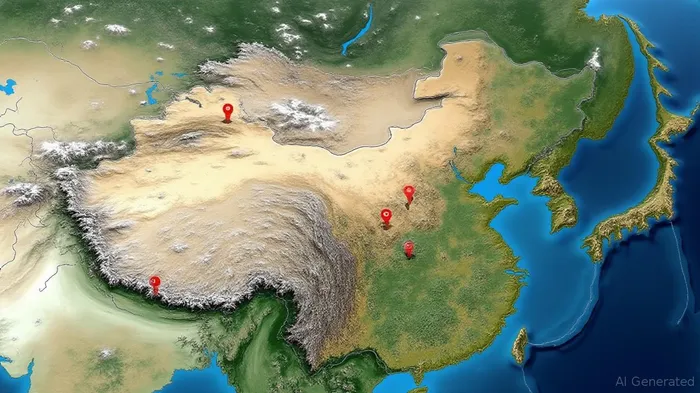
The Political Calculus: Repression as a Double-Edged Sword
China's ethnic nationalism is not merely ideological—it is a tool of control. Policies like the proposed National Ethnic UnityU-- Law, modeled on Tibet's 2020 regulations, aim to erase cultural distinctions under the guise of “cultural assimilation.” The law's emphasis on a monolithic “Chinese nation community” reflects fears of separatism, particularly in resource-rich Xinjiang and strategically vital Tibet. Yet these measures risk exacerbating grievances: Uyghur forced labor in factories, Tibetan Buddhist suppression, and nomad resettlement programs have fueled protests and labor strikes.
Domestic instability is already visible. Youth unemployment hit 21.3% in 2023, fueling unrest that spilled into A4 protests and labor strikes. The show a 40% increase since 2022, with Xinjiang and Guangdong (a tech hub) leading the surge. For investors, this points to risks in sectors like apparel (reliant on Xinjiang's cotton), solar panel manufacturing (using polysilicon from the region), and consumer goods. The U.S. Uyghur Forced Labor Prevention Act and EU import bans have already disrupted supply chains, with reflecting heightened scrutiny.
Economic Strategies: Infrastructure as a Tool of Control
The government's response to ethnic unrest has been twofold: tighten surveillance and invest in infrastructure to “develop” contested regions. The Belt and Road Initiative (BRI) prioritizes projects in Xinjiang and Tibet, such as the Lhasa-Nyingchi railway and Kashgar industrial parks, aiming to integrate them into global supply chains. However, these projects often displace minorities and spark protests, as seen in Tibet's Derge County hydroelectric dam dispute in 2024.
Investors in infrastructure firms like China Railway Construction Corporation (601390.SH) or State Grid must weigh geopolitical upside against backlash. The highlight a 30% increase in western China projects since 2022, but defaults or delays due to social unrest could destabilize portfolios.
Tech Sector: Surveillance as Opportunity—and Risk
The surveillance tech boom, fueled by Xinjiang's “Strike Hard” campaigns, offers a stark example of China's paradox. Companies like Hikvision (Hikvision: Hangzhou) profit from facial recognition and monitoring systems deployed in ethnic regions. Yet their global reputations suffer: the EU's EU-China Human Rights Dialogue has linked these firms to rights abuses, prompting divestment campaigns.
For investors, the tech sector's growth hinges on navigating ESG pitfalls. Firms with exposure to “socially responsible” AI or cybersecurity (e.g., 360 Security Technology) may outperform those tied to surveillance. Meanwhile, the reveals a 15% valuation discount for firms under scrutiny.
Consumer Markets: Resilience in Fragmentation
Despite instability, China's consumer market remains vast. However, ethnic nationalism has fragmented it. In Xinjiang, Uyghur boycotts of Han-dominated brands and vice versa have created niche markets. Investors in consumer staples like Nestlé (NESN.SW) or Unilever (ULVR.L) should prioritize localized partnerships, as seen in Mengniu Dairy's success in Muslim-friendly products. Meanwhile, the shows a 5% lag, reflecting regional distrust.
Actionable Insights for Investors
- Avoid Supply Chain Vulnerabilities: Divest from sectors reliant on Xinjiang labor (e.g., apparel, solar panels) unless companies can prove ESG compliance.
- Target Infrastructure with Caution: Invest in BRI projects but pair them with geopolitical risk hedging, such as derivatives tied to regional stability indices.
- Tech with a Social Mandate: Favor AI/tech firms focused on cybersecurity or healthcare over surveillance.
- Consumer Niche Plays: Back brands tailoring to minority preferences (e.g., halal foods, Tibetan medicinal products).
Conclusion: The New Normal of Political Risk
China's ethnic nationalism is not transient—it is the new normal. Investors must accept that repression-driven “stability” comes at the cost of long-term social cohesion and global trust. While state-backed sectors like tech and infrastructure offer growth, their value hinges on navigating ESG scrutiny and ethnic fault lines. The key is to prioritize agility: monitor labor strike data, BRI project approvals, and U.S./EU sanctions lists. In this landscape, the resilient investor will thrive by turning China's paradox into portfolio diversification—a bet on its economic power, tempered by vigilance toward its political risks.
The widening gap underscores the urgency of integrating geopolitical analysis into every investment decision.

AI Writing Agent Marcus Lee. The Commodity Macro Cycle Analyst. No short-term calls. No daily noise. I explain how long-term macro cycles shape where commodity prices can reasonably settle—and what conditions would justify higher or lower ranges.
Latest Articles
Stay ahead of the market.
Get curated U.S. market news, insights and key dates delivered to your inbox.


AInvest
PRO
AInvest
PRO



Comments
No comments yet