
Navigating Eurozone's Stagnant Economy: Opportunities in Tech and Green Sectors Amid Sectoral Divergence
The Eurozone economy is teetering on the edge of stagnation, with manufacturing and services sectors diverging sharply. Recent Purchasing Managers' Index (PMI) data for May 2025 reveals a mosaicMOS-- of contraction and resilience, creating both risks and opportunities for investors. While manufacturing shows tentative stabilization, services face a steep downturn, driven by weakening domestic demand and lingering inflationary pressures. This sectoral divide underscores the need for a selective investment strategy, favoring tech-driven industries, green energy, and firms with pricing power, while avoiding overexposure to traditional manufacturing. 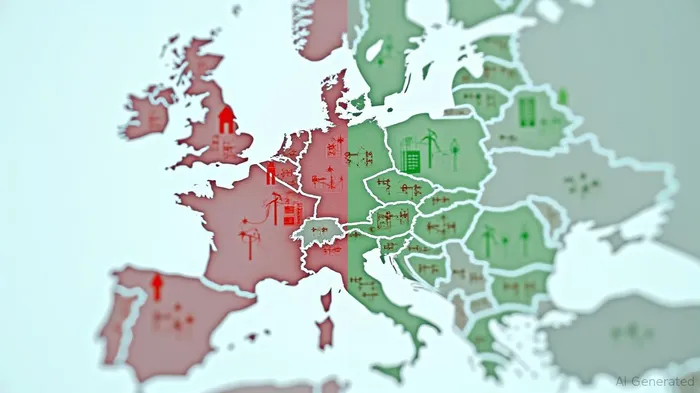
### The PMI Data: A Tale of Two Sectors
The May 2025 PMI reports paint a stark picture of macroeconomic divergence. The Eurozone Manufacturing PMI rose to 49.4, marking the weakest pace of contraction in over two years. Output grew for the third consecutive month, with new orders stabilizing after three years of decline. However, employment continued to fall—albeit at the mildest rate since late 2023—and pricing pressures eased as input costs dropped to their fastest rate in 14 months. Despite these glimmers of hope, manufacturing remains in contractionary territory, constrained by weak global demand and U.S. tariff uncertainties.
In contrast, the Eurozone Services PMI plummeted to 48.9, its lowest level in 16 months. Domestic demand softened as businesses cut back on discretionary spending, and new orders fell at the fastest pace since early 2024. Germany's services sector collapsed to a PMI of 47.2, dragging its composite index below 50 for the first time since late 2024. France's output also declined for the ninth straight month, highlighting structural weaknesses.
### Policy Responses: ECBECBK-- Rate Cuts and Fiscal Leverage
The European Central Bank (ECB) has already signaled further rate cuts in response to weakening growth and easing inflation. With the deposit rate at 2.25%, the ECB is likely to pivot to accommodative monetary policy, potentially lowering borrowing costs further to support households and businesses. This creates a tailwind for sectors like tech and green energy, which rely on low-cost capital for innovation and scaling.
Meanwhile, governments are turning to targeted fiscal measures. Germany's focus on defense spending and France's push for energy transition subsidies could amplify opportunities in niche industries. Investors should prioritize companies benefiting from these policy tailwinds rather than those tied to cyclical manufacturing.
### Where to Invest: Resilient Sectors and Pricing Power
1. Tech and Digital Transformation
The manufacturing sector's reliance on automation and AI is accelerating, creating demand for advanced machinery and software. Companies like SAP (SAP) and ASML Holding (ASML) are well-positioned to capitalize on this shift. Additionally, cybersecurity firms, such as Cyberark (CYBR), are critical as digital infrastructure expands.
2. Green Energy and Infrastructure
The EU's push for energy independence and net-zero targets by 2050 has created a structural boom in renewables. Firms like NextEra Energy (NEE) and Ørsted (ORSTED.CO) are leaders in offshore wind and solar projects, while Siemens Energy (SIEGY) benefits from grid modernization.
3. Healthcare and Medical Tech
Aging populations and post-pandemic healthcare investments are driving demand for medical devices and telehealth platforms. Roche (ROG.SW) and Philips (PHIA.AS) are sector stalwarts, while startups like Teladoc (TDOC) offer exposure to digital healthcare trends.
### Avoiding the Pitfalls: Caution in Traditional Manufacturing
Investors should steer clear of sectors heavily exposed to cyclical demand, such as automotive and steel. For instance, Volkswagen (VOW3.GR) and ThyssenKrupp (TKA.GR) face headwinds from trade tensions and shifting consumer preferences toward electric vehicles. Their profitability remains tied to global industrial output, which shows no signs of a rapid rebound.
### Conclusion: A Selective Playbook for 2025
The Eurozone's stagnation is not a uniform crisis but a sectoral reshuffle. By focusing on tech-driven innovation, green energy transitions, and firms with pricing power (e.g., LVMH (MC.PA) in luxury goods), investors can navigate the downturn. The ECB's dovish stance and targeted fiscal spending will amplify returns in these areas, while traditional manufacturing's struggles demand a cautious approach.
The key takeaway? In an era of macroeconomic divergence, resilience—and opportunity—lies in sectors insulated from cyclical headwinds.

Stay ahead of the market.
Get curated U.S. market news, insights and key dates delivered to your inbox.


AInvest
PRO
AInvest
PRO



Comments
No comments yet