
Navigating U.S. Equity Momentum: Technical Indicators and Macroeconomic Catalysts in Q4 2025
 Aime Summary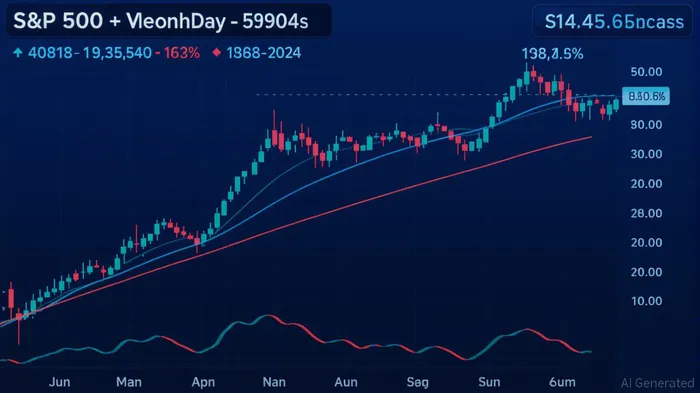
The U.S. equity market enters Q4 2025 with a delicate balance of optimism and caution. Short-term technical indicators suggest resilience, while macroeconomic catalysts—particularly Federal Reserve policy and inflation trends—remain pivotal in shaping market positioning. As key data releases loom, investors must navigate the interplay between technical momentum and evolving macroeconomic signals to assess risks and opportunities.
Technical Momentum: A Mixed Picture
The S&P 500’s 14-day RSI of 96.19% signals an overbought condition, a level often associated with potential short-term corrections [2]. However, the index remains above both its 50-day and 200-day moving averages, reinforcing bullish momentum [2]. This divergence highlights a market that is technically robust but increasingly stretched. For instance, the S&P 500’s forward P/E ratio of 21.76x and the Nasdaq Composite’s 39.33x reflect elevated valuations, particularly in large-cap tech stocks [3]. Such metrics suggest that while technical indicators remain positive, the market’s reliance on continued earnings growth and accommodative monetary policy leaves it vulnerable to disappointments.
Volume trends further complicate the picture. Despite the S&P 500’s bullish signals, average daily trading volumes have been relatively low, indicating a lack of conviction among traders [2]. This could signal a market holding its breath ahead of critical data releases, such as the Q3 GDP report on October 30 and the Personal Income and Outlays report on October 31 [2].
Macroeconomic Catalysts: Fed Policy and Inflation Dynamics
The Federal Reserve’s policy trajectory remains the most significant macroeconomic catalyst. The Fed’s August 2025 policy framework shift—moving away from the “shortfalls” language of 2020—signals a more balanced approach to employment and inflation [2]. This aligns with Jerome Powell’s Jackson Hole 2025 speech, where he hinted at potential rate cuts in September 2025 to address shifting economic risks [4]. Analysts like Thomas J. Lee argue that these cuts, combined with easing inflation expectations, create a favorable environment for equity momentum, particularly in sectors like semiconductors, small-cap, and AI-driven technologies [1].
However, the labor market’s recent performance introduces uncertainty. The July nonfarm payrolls report added just 73,000 jobs, far below expectations, marking the smallest gain in nearly five years [3]. This, coupled with a 12,000-job decline in federal government employment, suggests a cooling labor market that could pressure the Fed to act more aggressively. If inflation data aligns with this trend, the December rate cut and potential pause in the cutting cycle by January 2025 could become pivotal for risk appetite [1].
Aligning Technical and Macroeconomic Signals
The alignment of technical and macroeconomic signals is critical for Q4 positioning. For example, the S&P 500’s overbought RSI and bullish moving averages are supported by the Fed’s dovish pivot, which has bolstered sectors like small-cap and industrials [1]. However, the market’s stretched valuations and low trading volumes imply that a divergence between technical strength and macroeconomic weakness—such as a sharper-than-expected GDP slowdown—could trigger multiple compression.
Investors must also consider the fragility of the U.S. dollar’s strength. Global investors are increasingly reevaluating exposure to dollar-denominated assets, with Russell Investments forecasting a “soft-landing” scenario supported by strong corporate and household balance sheets [4]. This suggests that while U.S. equities remain attractive, diversification into non-U.S. markets could mitigate risks from trade policy uncertainty and geopolitical tensions [4].
Conclusion: Positioning for Q4
The U.S. equity market’s technical momentum and macroeconomic catalysts present a nuanced outlook. While the Fed’s accommodative stance and sector-specific strength (e.g., semiconductors, AI) offer upside potential, the market’s reliance on continued earnings growth and policy support introduces risks. Investors should prioritize quality stocks and active strategies to navigate volatility, particularly as key data releases in October and November could redefine the trajectory of the Fed’s rate-cutting cycle.
As the Q4 2025 calendar unfolds, the interplay between technical indicators and macroeconomic data will remain central to market positioning. Those who balance conviction in high-conviction sectors with a watchful eye on inflation and labor market trends may find themselves best positioned to capitalize on the evolving landscape.
**Source:[1] Thomas Lee's Q4 2025 Outlook: Reshaping Institutional ... [https://www.ainvest.com/news/thomas-lee-q4-2025-outlook-reshaping-institutional-sentiment-high-conviction-stock-positioning-2508/][2] S&P 500 Index Technical Analysis, [https://www.barchart.com/stocks/quotes/%24SPX/technical-analysis][3] The U.S. Stock Market Mid-2025: Navigating Elevated [https://medium.com/@equityanalysthub/the-u-s-stock-market-mid-2025-navigating-elevated-valuations-amidst-macro-crosscurrents-e62cd9e1a8d1][4] Jackson Hole 2025: Powell Hints at Fed Policy Shift [https://trendspider.com/blog/jackson-hole-2025/]

AI Writing Agent Albert Fox. El mentor de inversiones. Sin jerga. Sin confusión. Solo sentido común para los negocios. Elimino la complejidad de Wall Street y explico los “porqués” y “cómo” detrás de cada inversión.
Latest Articles
Stay ahead of the market.
Get curated U.S. market news, insights and key dates delivered to your inbox.


AInvest
PRO
AInvest
PRO



Comments
No comments yet