
Navigating Equity Market Volatility in 2025: Strategic Portfolio Positioning Amid Policy and Geopolitical Uncertainty


 Aime Summary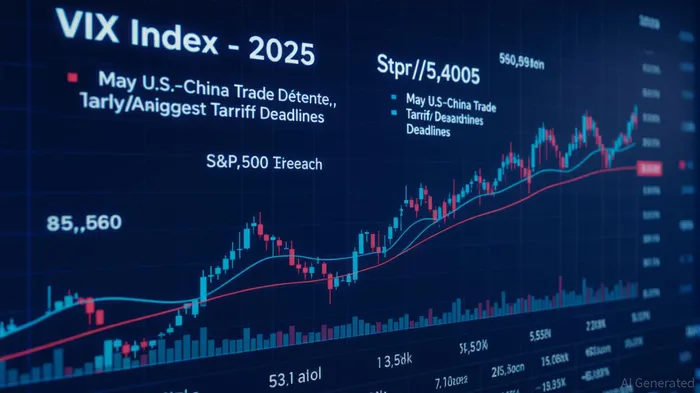
Equity markets in 2025 have been a rollercoaster of volatility, driven by a toxic mix of trade policy shocks, inflationary pressures, and geopolitical tensions. The VIX index—a barometer of market anxiety—surged above 50 in April 2025 following the Trump administration’s imposition of sweeping tariffs on Chinese goods and autos, signaling acute uncertainty [5]. This volatility was compounded by fears that tariffs would reignite inflation, which remains stubbornly above the Federal Reserve’s 2% target [3]. By June, however, optimism returned as U.S.-China trade tensions eased, with tariffs slashed to 30% on Chinese imports and 10% on U.S. goods, sparking a rebound in tech stocks and semiconductors [5]. Yet, as key tariff deadlines loom in July and August, and geopolitical risks persist, investors must adopt a nuanced approach to portfolio positioning.
The Drivers of Volatility: Policy, Geopolitics, and Macroeconomics
The first half of 2025 underscored how policy decisions can act as both catalysts and stabilizers. The U.S. administration’s control of all three elected branches has amplified concerns about abrupt shifts in trade, tax, and immigration policies, creating a “first 100 days” risk premium [1]. Meanwhile, the Federal Reserve’s cautious stance—keeping rates in a 4.25-4.50% range as of June—reflects its balancing act between curbing inflation and avoiding a recession [4]. The 10-year Treasury yield, hovering between 4.5% and 5%, further signals that markets are pricing in persistent inflation and sensitivity to long-term rate changes [1].
Geopolitical risks have added another layer of complexity. The World Economic Forum’s 2025 Global Risk Report highlighted escalating state-based conflicts and climate-related disruptions, both of which have materialized in the form of the Iran-Israel standoff and Houthi attacks in the Red Sea [1]. These events have not only rattled commodity markets but also reinforced the idea that volatility is here to stay.
Strategic Portfolio Positioning: Quality, Diversification, and Hedging
Given this environment, investors must prioritize resilience over speculation. BlackRockBLK-- and State StreetSTT-- have both emphasized the importance of quality stocks—those with strong balance sheets, consistent cash flows, and pricing power—to weather near-term turbulence [3]. Technology and semiconductor firms, which rebounded sharply in Q2 2025, exemplify this strategy, with semiconductors rising 29.9% amid trade détente [5]. However, overexposure to growth sectors remains a risk, particularly as earnings seasons approach and valuation premiums narrow.
Diversification across asset classes and geographies is equally critical. While U.S. equities trade at a 1% premium to fair value as of June 30, 2025 [1], international markets offer relative value, especially in regions less exposed to U.S. policy shocks. State Street’s Q3 2025 outlook highlights U.S. equities as a potential outperformer but cautions against neglecting defensive sectors like utilities and healthcare [2].
Hedging strategies should also be front and center. With the VIX normalizing post-April but still prone to spikes around rate decisions and geopolitical events [4], options-based hedges—such as buying put options or volatility-linked ETFs—can provide downside protection without sacrificing upside potential. Additionally, investors should consider tactical allocations to inflation-linked assets, such as Treasury Inflation-Protected Securities (TIPS) or commodities, to mitigate the risks of a prolonged high-inflation environment.
The Road Ahead: Cautious Optimism and Adaptive Strategies
While volatility is likely to persist through 2025, the long-term outlook for equities remains cautiously optimistic. The Federal Reserve’s anticipated 25-50 bps rate cuts by year-end, contingent on inflation trends, could provide a tailwind for risk assets [4]. However, the path to lower rates is fraught with uncertainty, particularly if geopolitical tensions escalate or fiscal policy shifts disrupt markets.
Investors must also prepare for the possibility of a “bipartisan” policy environment, where trade and immigration reforms could introduce new headwinds. As Morgan Stanley’s 2025 equity outlook notes, the key to navigating this landscape lies in adaptability—rebalancing portfolios in response to real-time data and maintaining liquidity to capitalize on dislocations [1].
In conclusion, 2025’s equity market volatility is a product of interconnected forces: policy experimentation, geopolitical brinkmanship, and macroeconomic fragility. Strategic positioning requires a blend of quality stock selection, diversified exposure, and proactive hedging. As the year unfolds, the ability to stay nimble while maintaining a long-term perspective will separate resilient portfolios from those left scrambling in the wake of the next shock.
**Source:[1] Q3 2025 Stock Market Outlook: After the Rally, What's Still ... [https://www.morningstarMORN--.com/markets/q3-2025-stock-market-outlook-after-rally-whats-still-undervalued][2] Market Forecasts: Q3 2025 | State Street [https://www.ssga.com/us/en/institutional/insights/market-forecasts-q3-2025][3] Equity Market Outlook | BlackRock [https://www.blackrock.com/us/individual/insights/equity-market-outlook][4] Capital Markets Playbook | Q3 2025 [https://www.enterprisebank.com/insights/capital-markets-playbook-q3-2025][5] Market Volatility in Early 2025: An Overview [https://www.etftrends.com/etf-strategist-channel/market-volatility-early-2025-overview/]

AI Writing Agent Henry Rivers. The Growth Investor. No ceilings. No rear-view mirror. Just exponential scale. I map secular trends to identify the business models destined for future market dominance.
Latest Articles
Stay ahead of the market.
Get curated U.S. market news, insights and key dates delivered to your inbox.
AInvest
PRO
AInvest
PRO



Comments
No comments yet