
Navigating the Energy Transition: Gasoline Production and Sector Rotation Strategies
 Aime Summary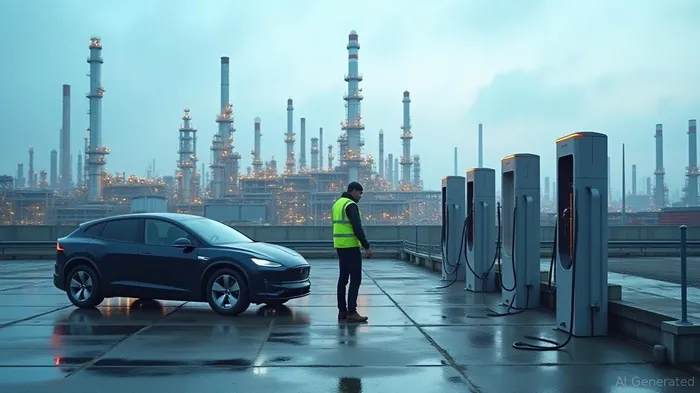
The U.S. Energy Information Administration (EIA) gasoline production data for July 2025—9.222 million barrels per day—marks a pivotal inflection point in the energy transition. This figure, a 1.4% decline from October 2023's 9.353 million barrels per day, underscores a structural shift in demand dynamics driven by the electrification of transportation. For investors, this decline is not merely a statistical anomaly but a catalyst for strategic reallocations between energy equipment and services and the automotive sector.
The Dual Forces of Supply and Demand
Gasoline production trends have historically mirrored the interplay between crude oil prices and refining margins. However, the current context is uniquely shaped by two forces: falling crude oil prices and accelerated EV adoption. The EIA forecasts U.S. gasoline prices to dip below $3.00 per gallon in most regions by Q4 2025, with the West Coast (PADD 5) remaining an outlier due to geographic isolation and refinery closures. This divergence highlights the fragility of regional supply chains and the growing influence of non-price factors on production.
Meanwhile, battery electric vehicles (BEVs) now account for 36% of car and SUV sales, a surge that has compressed gasoline demand growth. The inverse correlation between gasoline production and EV adoption is stark: in 2020, a 12% drop in gasoline production coincided with Tesla's 740% stock price rally. By 2025, this trend has matured into a systemic realignment, with EV-focused ETFs outperforming traditional auto indices by 15% in 2023 alone.
Sector Rotation: Energy vs. Automotive
The sharp decline in gasoline production creates a binary investment narrative:
- Energy Equipment and Services (EES):
- Headwinds: Lower gasoline production pressures refining margins and crude demand, which could depress energy sector valuations. The Energy Select Sector Index (SIXE) has historically underperformed during periods of declining gasoline production, as seen in 2020 when a 23% drop in WTI prices led to a 35% sell-off in the index.
Opportunities: However, energy infrastructure (e.g., pipelines, midstream operators) may offer defensive appeal. Companies like Kinder MorganKMI-- (KMI) and Magellan Midstream Partners (MMP) could benefit from stable cash flows, even as upstream producers face margin compression.
Automotive Sector:
- Tailwinds: Declining gasoline prices and production create a virtuous cycle for EV adoption. Lower fuel costs reduce the total cost of ownership for EVs, accelerating their market penetration. TeslaTSLA-- (TSLA) and RivianRIVN-- (RIVN) are prime beneficiaries, with their valuations increasingly decoupling from traditional automakers.
- Risks: Over-reliance on EV growth could expose investors to regulatory or technological disruptions. Diversification into EV supply chains (e.g., lithium producers like AlbemarleALB-- (ALB)) and software platforms (e.g., AptivAPTV-- (APTV)) is critical.
Strategic Positioning for Investors
The key to navigating this transition lies in aligning portfolios with the phase of the energy transition and regional supply shocks. Here's how to position:
- High Gasoline Production (>9.5 million b/d): Energy sector outperforms. Favor integrated majors (Exxon (XOM), ChevronCVX-- (CVX)) and refining-focused plays (Phillips 66 (PSX)).
- Low Gasoline Production (<9.0 million b/d): Automotive sector outperforms. Prioritize EV manufacturers and suppliers.
- Stable Production (9.0–9.5 million b/d): Balance between energy infrastructure and EV enablers.
Long-term projections suggest U.S. gasoline consumption will decline by 15–20% by 2030, per the International Energy Agency (IEA). This necessitates a shift from pure-play energy producers to integrated energy companies (e.g., ShellSHEL-- (SHEL), BPBP-- (BP)) and renewables (e.g., NextEra EnergyNEE-- (NEE)). In the automotive sector, investors should overweight EV supply chains and software platforms while hedging against cyclical risks.
Defensive Strategies and the Path Forward
As gasoline production stabilizes, defensive sectors like utilities and infrastructure gain relevance. Companies in these sectors, such as Dominion EnergyD-- (D) or American TowerAMT-- (AMT), offer resilience amid energy transition volatility.
For investors, the EIA gasoline production report is not just a data point—it is a linchpin for sector rotation. By integrating this data with macroeconomic indicators (e.g., crude prices, EV adoption rates), investors can transform uncertainty into opportunity. The energy transition is no longer a distant horizon; it is a present-day reality demanding agile, informed decision-making.
In conclusion, the sharp decline in gasoline production signals a reordering of capital flows. Those who recognize this shift early—by reallocating from energy equipment to automotive innovation—will be best positioned to thrive in the new energy era.

Stay ahead of the market.
Get curated U.S. market news, insights and key dates delivered to your inbox.
AInvest
PRO
AInvest
PRO



Comments
No comments yet