
Navigating Economic Uncertainty: Sector Rotation in Banks and Automobiles Amid Shifting Consumer Sentiment
 Aime Summary
The latest U.S. University of Michigan Consumer Expectations Index reading for December 2025—54.6 in its final revision—underscores a fragile economic landscape. While this marks a 7.8% improvement from November's 51.0, it remains 25% below the 73.3 level recorded a year earlier. This divergence between short-term optimism and long-term pessimism reflects a market caught between transient relief and enduring structural challenges. For investors, the implications are clear: sector rotation strategies must now account for the divergent trajectories of cyclical and defensive industries.
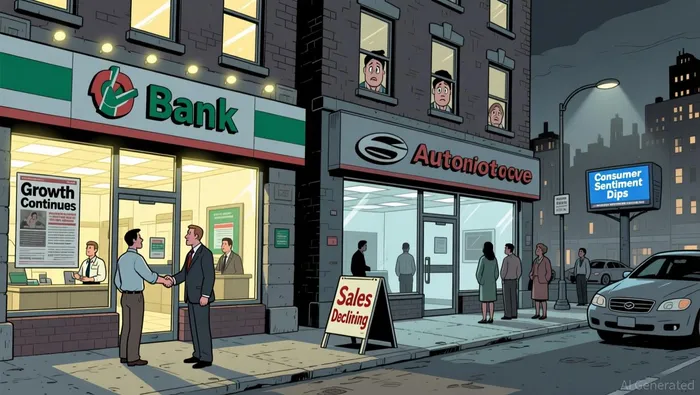
Historical patterns reveal a stark asymmetry in sector resilience during consumer sentiment downturns. When the University of Michigan Consumer Sentiment Index (UMCSI) dips below 60—a threshold it has approached in December 2025—the automobile sector has consistently underperformed, while banks have demonstrated relative strength. From 2005 to 2025, auto sales contracted by 10–15% within six months of sentiment falling below 55, driven by high prices, elevated loan rates, and low savings rates. In May 2025, for instance, auto sales plummeted 6.1% as the UMCSI hit 53.3, mirroring the 2008 and 2020 crises. FordF-- and General MotorsGM--, historically vulnerable to demand shocks, saw revenue declines of 30–40% during such periods.
Conversely, the banking sector has historically outperformed the S&P 500 by an average of 3.2% during similar downturns. This resilience stems from two pillars: interest rate tailwinds and regulatory fortification. With the Federal Reserve's terminal rate at 5.25% in 2025, banks like JPMorgan ChaseJPM-- and Bank of AmericaBAC-- have enjoyed expanded net interest margins. Post-2008 reforms, including Basel III and stress tests, have also bolstered capital ratios (14–16%) in regional banks, enabling them to withstand liquidity pressures. The KBW Bank Index's outperformance of 4–6% during rate hikes further validates this dynamic.
The current environment amplifies these historical trends. While the Inflation Reduction Act's fiscal policies have done little to alleviate cost-of-living pressures, the Federal Reserve's quantitative tightening has increased demand for bank deposits, allowing institutions to offer higher yields on savings accounts and CDs. Meanwhile, the automobile sector faces compounding headwinds: supply chain bottlenecks, the Inflation Reduction Act's limited impact on affordability, and shifting consumer behavior. Younger buyers, burdened by student debt and housing costs, are delaying purchases, exacerbating the sector's vulnerability.
For investors, the strategic imperative is evident. Underweighting the automobile sector—particularly names like Ford (F) and FCA (FCAU)—and overweighting banks such as JPMorgan Chase (JPM), Bank of America (BAC), and U.S. Bank (USB) aligns with historical returns during sentiment-driven downturns. The S&P 500 Automotive Index has historically underperformed the broader market by 8–12% during UMCSI declines below 55, while the banking sector's average outperformance of 3.2% offers a compelling risk-reward profile.
Yet, the path forward is not without nuance. While banks benefit from rate hikes, prolonged high rates could eventually strain credit quality. Similarly, the automobile sector's long-term prospects remain tied to innovation cycles, particularly in electric vehicles and autonomous technology. Tesla's stock price trajectory, for instance, reflects both cyclical demand pressures and structural shifts in the industry. Investors must balance short-term defensive positioning with long-term sectoral trends.
In conclusion, the December 2025 Consumer Expectations Index reading serves as a cautionary signal. As consumer sentiment remains subdued, sector rotation strategies must prioritize resilience over growth. Banks, fortified by regulatory safeguards and interest rate tailwinds, offer a hedge against economic uncertainty. The automobile sector, conversely, requires a more cautious approach, given its sensitivity to consumer confidence and macroeconomic volatility. By aligning portfolios with these historical patterns, investors can navigate the current landscape with both prudence and foresight.

Stay ahead of the market.
Get curated U.S. market news, insights and key dates delivered to your inbox.
AInvest
PRO
AInvest
PRO



Comments
No comments yet