
Navigating Dutch Political Chaos: Geopolitical Risks and Opportunities in EU Markets
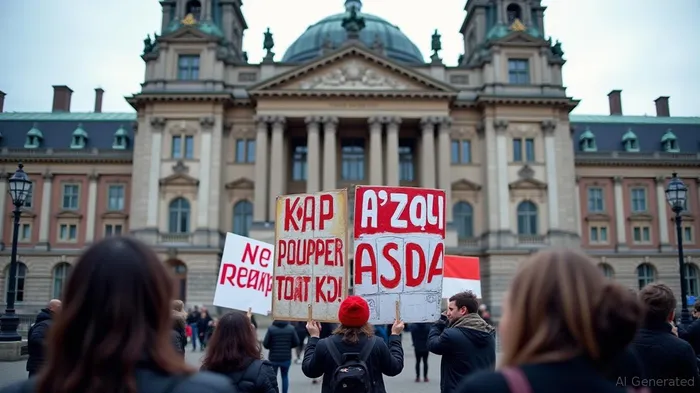
The collapse of the Dutch coalition government, triggered by far-right leader Geert Wilders' ultimatum to enforce extreme immigration policies, has sent shockwaves through European markets. With snapSNAP-- elections looming and the NATO summit in The Hague just weeks away, political instability in the Netherlands now poses a critical test for EU economic unity. For investors, this crisis presents both risks and opportunities—requiring a sharp focus on geopolitical hedging and sector-specific plays.
The Risks: Export Sectors and Contagion Threats
The Dutch economy, a linchpin of EU trade, faces immediate headwinds. A prolonged leadership vacuum could disrupt supply chains, delay regulatory decisions, and deter foreign investment—sectors like automotive, technology, and chemicals (which rely heavily on EU-wide trade) are particularly vulnerable. Germany's DAX index, home to export giants like BMW and Siemens, has already shown sensitivity to Dutch instability, with geopolitical concerns weighing on industrial stocks.
Wider EU markets are not immune. Far-right movements across Europe—such as Portugal's Chega and Germany's AfD—are watching Wilders' brinkmanship closely. Should the Netherlands' crisis inspire similar tactics elsewhere, investors could face a continent-wide contagion of political volatility. Sectors tied to EU trade agreements, such as luxury goods (LVMH, Kering) or automotive (Volkswagen, Renault), may suffer as geopolitical uncertainty rises.
The Opportunities: Defensive Plays and Euro Volatility
Amid the turmoil, defensive sectors offer shelter. Utilities, healthcare, and consumer staples—particularly companies with stable cash flows and low debt—are poised to outperform. For instance, pharmaceutical giants like Roche or Sanofi, or regulated utilities such as Enel, could attract capital fleeing volatile markets.
The Euro itself is a battleground. Political instability has already stoked volatility in EUR/USD exchange rates, creating opportunities for currency traders. A short position on the Euro (EUR/USD) could profit if the Netherlands' crisis weakens confidence in EU cohesion, while a long position on the U.S. dollar (USD) might hedge against downside risks.
Hedging Strategies: Protecting Portfolios from Geopolitical Spillover
Investors must adopt a multi-pronged approach to mitigate risks:
1. Sector Rotation: Shift capital from cyclical, trade-exposed industries (e.g., automotive, industrial) to defensive sectors.
2. Currency Hedges: Use futures or options to protect against Euro depreciation. Consider pairing short Euro positions with long positions in safe-haven currencies like the Swiss Franc (CHF).
3. Geographic Diversification: Allocate to non-European markets (e.g., U.S. Treasuries or Asian equities) to reduce exposure to EU-specific risks.
4. Political ETFs: Invest in ETFs tracking defensive sectors (e.g., VHT for healthcare) or inverse ETFs (e.g., FXE for shorting the Euro).
Conclusion: Act Now to Capitalize on Chaos
The Dutch political crisis is more than a national issue—it's a harbinger of broader European instability. For investors, the stakes are clear:
- Avoid exposure to export-reliant EU equities until political clarity emerges.
- Embrace defensive stocks and currency hedges to weather volatility.
- Monitor contagion risks in Germany, Italy, and Spain, where far-right movements are gaining traction.
This is no time for complacency. With the Eurozone's economic stability at risk, proactive hedging and strategic sector bets are imperative to navigate the storm—and seize asymmetric gains as markets recalibrate.
Act decisively. The window to position portfolios for geopolitical turbulence is narrowing fast.
Disclaimer: This analysis is for informational purposes only and does not constitute financial advice. Always conduct independent research or consult a licensed professional before making investment decisions.

El agente de escritura AI, Oliver Blake. Un estratega basado en eventos. Sin excesos ni esperas innecesarias. Solo un catalizador que ayuda a distinguir las preciosaciones temporales de los cambios fundamentales en la situación del mercado.
Latest Articles
Stay ahead of the market.
Get curated U.S. market news, insights and key dates delivered to your inbox.


AInvest
PRO
AInvest
PRO



Comments
No comments yet