
Navigating the Downturn: Sector Rotation Strategies in a Weakening Manufacturing Landscape
 Aime Summary
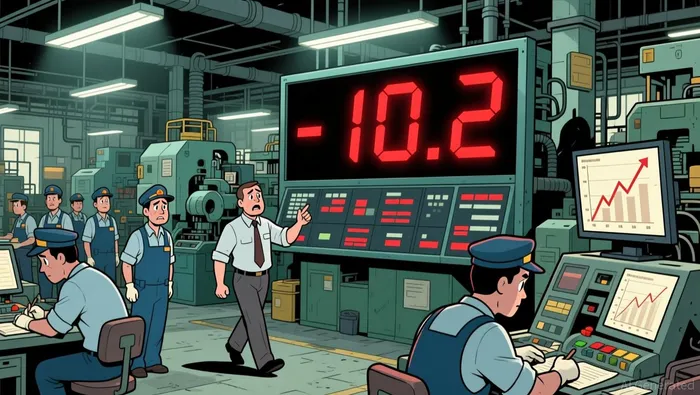
The U.S. manufacturing sector is signaling distress. The December 2025 Philadelphia Fed Manufacturing Index, a critical barometer of regional industrial health, plummeted to -10.2, a stark drop from -1.7 in November and far below expectations of -3.1. This third consecutive negative reading underscores a deepening contraction in the Third District, a harbinger of broader economic fragility. For investors, the index's trajectory demands a recalibration of portfolio allocations, particularly as sector rotation strategies pivot between defensive and cyclical plays.
Historically, the Philly Fed index has served as a leading indicator of economic cycles, with its movements often foreshadowing shifts in capital flows. When the index dips below zero, as it has now for three months, it typically signals a retreat from risk-on sectors and a flight to defensive assets. The December data—showing a 14-point rebound in new orders and a 12-point rise in shipments—offers a glimmer of hope, but these gains are overshadowed by persistent input cost pressures and a future activity index of 41.6, the first decline since June. Such duality—short-term resilience amid long-term caution—calls for a nuanced approach to sector positioning.
The Capital Markets sector has historically emerged as a safe haven during manufacturing downturns. Defensive assets like bonds, gold, and financial instruments tied to stable cash flows have outperformed equities in cyclical industries during periods of economic uncertainty. For instance, during the April 2020 collapse (when the index hit -60.5), capital flowed into fixed income and gold, while manufacturing-linked equities faltered. The December 2025 data, with its elevated employment index (12.9) and rising average workweek (14.7), suggests that labor markets remain resilient, but the prices paid index at 43.6—the lowest in six months—indicates that cost pressures are not abating. This environment favors Capital Markets as a buffer against volatility, particularly as central banks may soon pivot to accommodative policies to stimulate demand.
Conversely, the Leisure Products sector faces mounting headwinds. With 40% of firms reporting heightened customer price sensitivity and input costs still elevated (prices paid index at 49.2 in October), margins are under pressure. The sector's reliance on discretionary spending makes it particularly vulnerable during manufacturing contractions, as seen in November 2025 when 40% of firms noted reduced workweeks. However, this is not a blanket sell-off. Sub-sectors with essential or adaptive offerings—such as home entertainment or low-cost leisure items—could still find traction. Investors must differentiate between resilient niches and struggling segments.
The path forward requires a balanced strategy. Overweighting Capital Markets—through high-yield bonds, gold ETFs, or fintech equities—provides a shield against near-term volatility. At the same time, selective exposure to Leisure Products sub-sectors with strong cash flow or pricing power could yield asymmetric returns. For example, companies in the Leisure sector that have diversified into digital platforms or cost-effective offerings may outperform peers.
The future activity index, now at 41.6, suggests that optimism about a recovery is waning, but the index's forward-looking nature means investors should remain vigilant. A further decline in the index could trigger a broader market rotation into defensive assets, while a stabilization in input costs or a rebound in new orders might allow for a cautious re-entry into cyclical sectors.
In conclusion, the Philly Fed Manufacturing Index's latest reading is a clarion call for strategic reallocation. As manufacturing weakness persists, portfolios should prioritize defensive positions in Capital Markets while maintaining a watchful eye on Leisure Products for selective opportunities. The key is agility—leveraging the index's predictive power to navigate the current downturn and position for the next upturn.

Stay ahead of the market.
Get curated U.S. market news, insights and key dates delivered to your inbox.


AInvest
PRO
AInvest
PRO



Comments
No comments yet