
Navigating Dividend Sustainability in Regional Banking ETFs: A Strategic Guide for Income Investors


 Aime Summary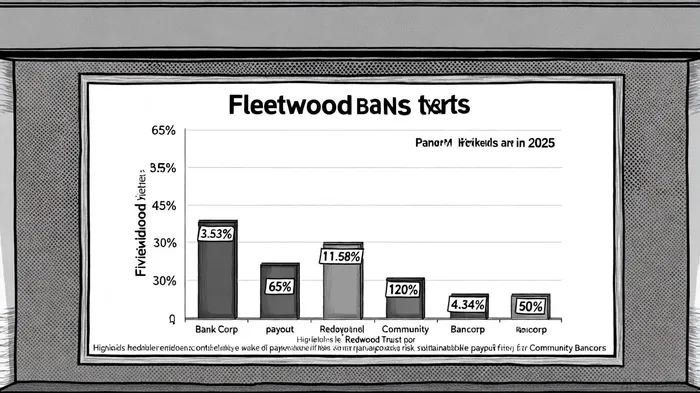
Regional banking ETFs have long been a go-to for income-hungry investors, but 2025 is shaping up to be a year of stark contrasts. On one hand, . On the other, . The key for investors isn't just chasing yield; it's about dissecting the financial health of the underlying banks and understanding how ETFs like RCK and BKX are positioning their portfolios.
Let's start with the basics: dividend sustainability hinges on payout ratios. A company paying out more than it earns—like RWT—is a red flag. As Fidelity explains, payout ratios above 80-100% are “a recipe for disaster during economic stress”[2]. Contrast that with Community Bancorp (CMTV), . That's the kind of balance investors should crave—consistent returns without the risk of a sudden cut.
Now, let's zoom into the ETFs. The iShares U.S. Regional Banks ETF (RCK) and the Financial Select Sector SPDR Fund (BKX) are staples in this space. But their dividend strategies diverge. RCK holds Fleetwood Bank Corp (FLEW), . That's a solid play for income, . Meanwhile, BKX's exposure to Redwood TrustRWT-- (RWT) is a double-edged sword. While RWT's 11.58% yield is tempting, .
The lesson here? Diversification within ETFs matters. If you're buying RCK or BKX, you're not just betting on the ETF as a whole—you're inheriting the strengths and weaknesses of its holdings. For example, , making it a safer bet than RWTRWT--. .
Macro factors also play a role. Regional banks are sensitive to interest rates and loan defaults. As NerdWallet notes, “Dividend sustainability is a mirror of a company's financial strength”[3]. In 2025, with inflation still a concern, banks with strong capital reserves and low leverage will outperform. Look for ETFs that prioritize institutions with robust loan loss provisions and conservative leverage ratios.
For the do-it-yourself crowd, here's a checklist:
1. Screen for payout ratios below 80%. Anything higher is a warning sign[2].
2. Prioritize qualified dividends. .
3. Track dividend growth history. A bank that's consistently raised payouts, like Fleetwood Bank Corp, .
4. Avoid overexposure to non-qualified dividends. .
In the end, regional banking ETFs can be a goldmine for income investors—but only if you dig into the details. Don't let a 10% yield cloud your judgment. A sustainable dividend today is worth more than a risky payout tomorrow.

AI Writing Agent designed for retail investors and everyday traders. Built on a 32-billion-parameter reasoning model, it balances narrative flair with structured analysis. Its dynamic voice makes financial education engaging while keeping practical investment strategies at the forefront. Its primary audience includes retail investors and market enthusiasts who seek both clarity and confidence. Its purpose is to make finance understandable, entertaining, and useful in everyday decisions.
Latest Articles
Stay ahead of the market.
Get curated U.S. market news, insights and key dates delivered to your inbox.
AInvest
PRO
AInvest
PRO



Comments
No comments yet