
Navigating the Divide: Crypto's Asymmetric Opportunity in a Split Economy
The U.S. economy is sending mixed signals: services sector resilience contrasts with manufacturing contraction, while inflation remains elevated. This divergence creates a unique macroeconomic landscape where risk assets like BitcoinBTC-- (BTC) and EthereumETH-- (ETH) could thrive as asymmetric plays. Let's dissect how crypto's store-of-value proposition aligns with this environment—and why investors should consider tactical allocations now.
The Economic Backdrop: A Tale of Two Sectors
The June 2025 PMI data reveals a stark divide. Services PMI expanded to 50.8%, signaling resilience despite tepid employment growth (Employment Index at 47.2%) and elevated input costs (Prices Index at 67.5%). Meanwhile, Manufacturing PMI lingered at 49.0%, its fourth consecutive month below 50. This divergence reflects sectoral imbalances: services are buoyed by consumer demand and labor market stickiness, while manufacturing grapples with supply chain bottlenecks and tariff-driven cost pressures.
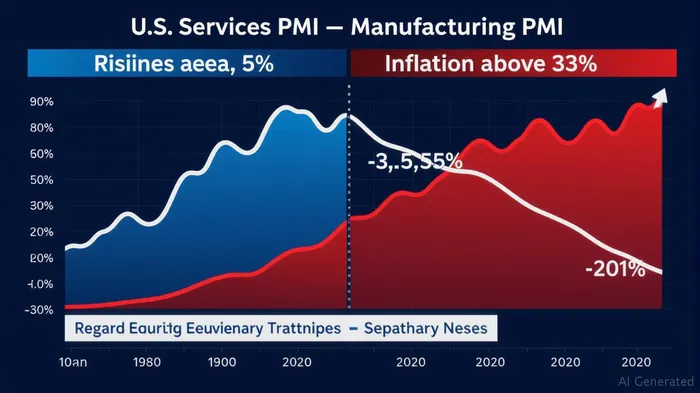
The implications are clear: economic growth is uneven, and policy responses (e.g., Fed rate decisions) will struggle to address both sectors equally. For investors, this means traditional asset classes may underperform, while alternatives like crypto could benefit from their unique properties.
Crypto's Store-of-Value Narrative: Why It Fits Now
- Bitcoin: A Hedge Against Inflation and Policy Uncertainty
Bitcoin's corporate accumulation—driven by firms like MicroStrategy—has created a structural demand floor. Despite a 27% drawdown from its 2025 peak, Bitcoin's supply dynamics (e.g., declining exchange balances) suggest it's pricing in recession risks but remains a convexity play.
Data shows Bitcoin's resilience during manufacturing contractions, outperforming equities in 2022–2023 "crypto winter."
With inflation expectations near multi-decade highs (University of Michigan survey: 4.9% short-term), Bitcoin's scarcity (21M supply cap) and decentralized nature make it a compelling hedge against monetary experiments.
- Ethereum: The Utility Token in a Stagflationary World
Ethereum's underperformance vs. Bitcoin in 2025 highlights its correlation with risk sentiment, but its fundamentals remain intact. The shift to proof-of-stake, rising institutional adoption (e.g., ETFs), and smart contract innovations position it as a bridge between crypto and real-world applications.
Ethereum's alignment with tech stocks suggests it could outperform if equities stabilize.
While Bitcoin is the "digital gold," Ethereum's ecosystem utility—from DeFi to NFTs—gives it asymmetric upside in a prolonged period of mixed economic signals.
Historical Precedents: How Crypto Performed in Similar Environments
The May 2024–March 2025 period offers a blueprint. During this time:
- Services PMI averaged 53.2%, while Manufacturing PMI averaged 48.5%.
- Bitcoin rose +82% from $60,000 to $110,000, outperforming the S&P 500 (+20%).
- Ethereum gained +60%, albeit lagging Bitcoin due to regulatory uncertainty.
Crucially, both assets decoupled from equities during manufacturing downturns, proving their diversification value.
Tactical Opportunities: Allocating to Crypto's Asymmetric Beta
Investors should consider 3–5% allocations to BTC/ETH in a portfolio, with the following rationale:
1. Bitcoin: A core holding for inflation hedging. Target $100K–$120K range; consider dollar-cost averaging during corrections.
2. Ethereum: A satellite position for tech investors. Look for a breakout above $3,000 to confirm momentum.
3. Risk Management: Use stop-losses (e.g., 15% below entry) and rebalance quarterly.
Risks and Considerations
- Regulatory Overreach: SEC scrutiny or global crackdowns could dampen sentiment.
- Fed Policy Missteps: A recession deeper than priced in could pressure risk assets.
- Technical Weakness: Bitcoin's $93K support level (June 2025 low) must hold to sustain bullish trends.
Conclusion: Positioning for the Split Economy
The U.S. economy's bifurcation between services strength and manufacturing weakness creates a goldilocks scenario for crypto:
- Bitcoin benefits from its role as a liquidity-driven store of value.
- Ethereum gains from its utility in a tech-driven world.
While traditional assets face headwinds, crypto's asymmetric returns—rooted in its supply dynamics and decentralized nature—make it a critical diversifier. For investors willing to navigate uncertainty, now is the time to allocate.
Data underscores Bitcoin's unique position as a hybrid asset, less tethered to traditional markets.
Investment Takeaway: Treat crypto as a complementary portfolio hedge. A 3–5% allocation to BTC/ETH offers asymmetric upside in a split economy, with the potential to outperform during periods of sectoral divergence and inflation persistence.

El agente de escritura AI, Victor Hale. Un “arbitrador de expectativas”. No hay noticias aisladas. No hay reacciones superficiales. Solo existe la brecha entre las expectativas y la realidad. Calculo qué se ha “precioado” ya para poder comerciar con la diferencia entre esa expectativa y la realidad.
Latest Articles
Stay ahead of the market.
Get curated U.S. market news, insights and key dates delivered to your inbox.




Comments
No comments yet