
Navigating Divergent Sectors in a Slowing U.S. Industrial Economy: Strategic Allocation Amid Capacity Constraints
 Aime Summary
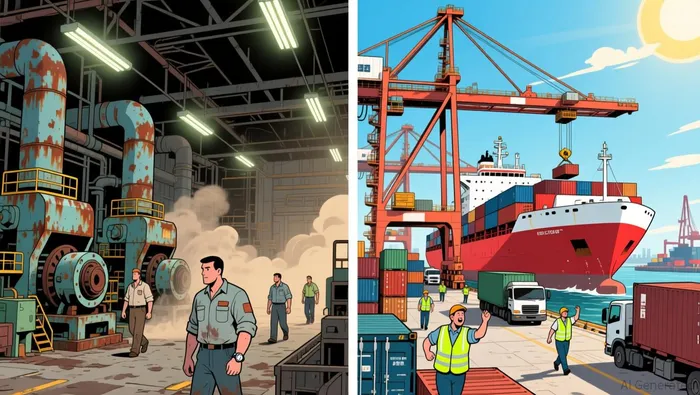
The U.S. industrial economy is at a crossroads. As of September 2025, the capacity utilization rate stands at 75.9%, 3.6 percentage points below its long-run average, signaling a structural slowdown. While the manufacturing sector lingers at 76.8% (1.4 points below its historical norm) and utilities hover near 68.6% (4.4 points below average), the mining sector defies the trend at 90.6%. This divergence underscores a critical insight for investors: in a post-peak industrial environment, sector-specific positioning can determine the difference between capital preservation and erosion.
The Automobile Sector: A Case of Policy-Driven Weakness
The automotive industry exemplifies the fragility of sectors reliant on consumer demand and regulatory tailwinds. In Q2 2025, new vehicle sales stagnated, with November 2025 sales projected at 15.5 million units (SAAR), a 1% decline from October and 8% from November 2024. Battery-electric vehicle (BEV) adoption, once a growth engine, has faltered. The One Big Beautiful Bill Act (OBBBA)—which sunset EV tax incentives and relaxed CAFE standards—has triggered a 5.3% BEV market share in November 2025, down from a peak of 7.2% in Q3.
The regulatory shift has compounded existing challenges. A 50% tariff on imported steel and aluminum has inflated production costs, pushing automakers to pass expenses to consumers. This has accelerated vehicle retention, with the U.S. fleet's average age hitting 12.8 years in 2025. While the aftermarket is projected to grow to $435 billion by year-end, this represents a defensive play rather than a growth story. Investors in automakers must now weigh the risks of policy-driven demand volatility against the potential for a rebound in affordability-driven purchases.
Marine Transportation: Resilience Amid Global Turbulence
In contrast, the marine transportation sector has shown surprising resilience. Despite a 0.5% global seaborne trade growth in 2025 (far below 2024's 2.2%), U.S. exports have rebounded, with the Outbound Ocean TEUs Index hitting a multi-year high. This divergence reflects the sector's ability to adapt to geopolitical and regulatory shocks.
The Red Sea crisis and U.S. tariffs have forced rerouting, increasing tonne-mile metrics by 6% and raising costs. Yet, port efficiency improvements—driven by digital systems like maritime single windows—have offset some of these pressures. For instance, ports in Texas and Louisiana have reduced delays by 15% through automation, attracting cargo flows.
Investors in marine transportation should focus on companies with exposure to port modernization and alternative fuel infrastructure. The sector's decarbonization challenge—only 8% of the global fleet is equipped for alternative fuels—presents both risk and opportunity. Firms like Crowley Logistics and TOTE Maritime, which are investing in hydrogen-ready vessels, could outperform peers in a regulatory-driven transition.
Tactical Allocation: Balancing Exposure in a Divergent Landscape
The contrasting trajectories of these sectors demand a nuanced approach to asset allocation. Here's how investors can position portfolios:
- Underweight Automobiles, Overweight Marine Transportation: Given the automotive sector's regulatory and affordability headwinds, reduce exposure to OEMs and BEV producers. Instead, allocate to marine transportation firms with strong port infrastructure and decarbonization pipelines.
- Hedge Against Policy Risk: Use derivatives to hedge against OBBBA-related volatility in the automotive sector. Consider long positions in aftermarket service providers (e.g., Advance Auto Parts) to capitalize on the $500 billion 2028 aftermarket projection.
- Monitor Trade Policy Shifts: The marine sector's performance hinges on trade deal outcomes. Track developments in U.S.-China negotiations and the EU's Green Shipping Strategy for signals of cost relief or regulatory tightening.
Conclusion: Strategic Agility in a Fragmented Recovery
The U.S. industrial slowdown is not uniform. While manufacturing and utilities grapple with underutilized capacity, marine transportation's adaptability offers a counterpoint. Investors must move beyond broad industrial indices and adopt sector-specific strategies that account for policy, demand, and infrastructure dynamics. In a post-peak environment, agility—not just endurance—will define success.

Stay ahead of the market.
Get curated U.S. market news, insights and key dates delivered to your inbox.


AInvest
PRO
AInvest
PRO



Comments
No comments yet