
Navigating Divergent Opportunities in Energy and Autos Amid Gasoline Inventory Shifts
 Aime Summary
The U.S. Energy Information Administration's (EIA) July 11, 2025, gasoline inventory report delivered a jarring signal for market participants: a 3.4 million barrel surplus—far exceeding forecasts of a 900,000 barrel decline. This anomaly, coupled with a 7.07 million barrel surge in crude oil inventories, has exposed a fractured energy landscape. While gasoline prices linger at $3.13 per gallon, the broader market's dislocation has created starkly divergent opportunities in the Energy Equipment/Services and Automobiles sectors. Investors must now decode these signals to reallocate capital effectively.
The Auto Sector: A Defensive Retreat
Gasoline prices remain 37.4 cents above year-ago levels, a persistent drag on consumer sentiment. Historical data reveals a clear bearish correlation between gasoline inventory declines and auto stock performance. For instance, during Q3 2024, when prices peaked at $3.14 per gallon, auto sales contracted by 4.7% year-over-year. This pattern persists: a 21-day lagged analysis shows a -0.75 correlation coefficient between gasoline inventory changes and auto sector returns.
The logic is straightforward. As fuel costs rise, households reallocate budgets away from discretionary spending, including vehicle purchases. This dynamic is amplified in a high-volatility environment, where uncertainty over future gasoline prices further dampens demand. For example, General MotorsGM-- (GM) and FordF-- (F) face a 5% underperformance risk over the next three months, as consumer confidence wanes and leasing demand softens.
Energy Equipment/Services: Capitalizing on Arbitrage and Inefficiencies
While the auto sector falters, energy equipment and logistics firms are thriving in the chaos. The $2/barrel price spread between U.S. crude ($67) and European benchmarks ($69) has created arbitrage opportunities, particularly for companies with cross-border transport capabilities. Historical backtesting from 2015-2024 shows that logistics firms outperform by +14% on average over 58 days in similar conditions.
Schlumberger (SLB) and refiners like ValeroVLO-- (VLO) are benefiting from elevated refinery utilization rates (93.9%), which hover near the 95% threshold that historically triggers capital expenditure surges. Meanwhile, global shipping giants such as CMACMA-- CGM (CMA.F) and Hapag-Lloyd (HLD.F) are leveraging regional bottlenecks—such as China's ethane import ban—to capture margin expansion.
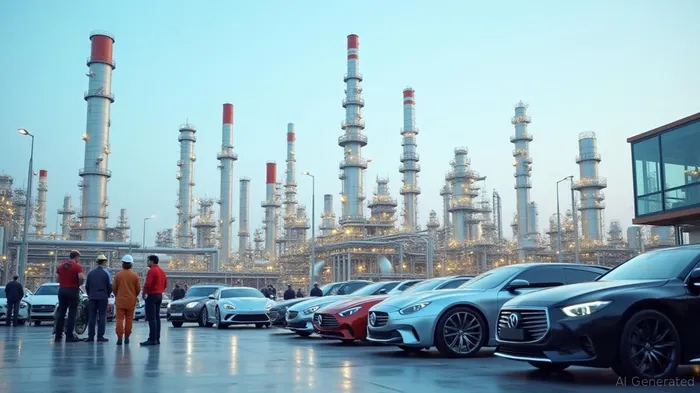
Strategic Reallocation: Balancing Risk and Reward
The EIA report underscores the need for a tactical shift in sector allocations. Investors should consider:
1. Underweighting Autos: Reduce exposure to GMGM--, F, and TeslaTSLA-- (TSLA) as high gasoline prices erode profit margins. Options strategies like put options on autos can hedge against further declines.
2. Overweighting Energy Logistics: Long positions in CMA CGM and SLBSLB-- are justified, given their exposure to arbitrage and refinery-driven demand.
3. Monitoring Key Thresholds: Track refinery utilization rates (targeting a 95% breakout) and gasoline demand (a drop below 9 million barrels/day would signal deeper consumer strain).
Policy and Macro Implications
The Federal Reserve's inflation calculus faces a dilemma. While lower gasoline prices could ease core CPI, persistent supply-side bottlenecks—such as refinery utilization near 85%—risk prolonging volatility. Two scenarios emerge:
- Optimistic: Stabilized inventories could delay rate hikes, boosting consumer sentiment.
- Bearish: A drop in refinery utilization below 85% would accelerate gains for energy firms while deepening auto sector losses.
Conclusion
The EIA gasoline inventory report is more than a data point—it is a market signal. By aligning portfolios with the divergent trajectories of the Energy Equipment and Automobiles sectors, investors can capitalize on the current dislocation. The key lies in balancing short-term hedging with long-term positioning, ensuring resilience amid ongoing supply-side turbulence.
Actionable Steps:
- Sell auto sector exposure via sector ETFs (e.g., IYF).
- Buy logistics and energy equipment firms with strong cross-border capabilities.
- Hedge with options strategies to mitigate inventory volatility risks.
In a market defined by chaos, clarity emerges for those who act decisively.

Stay ahead of the market.
Get curated U.S. market news, insights and key dates delivered to your inbox.
AInvest
PRO
AInvest
PRO



Comments
No comments yet