
Navigating the Cushing Conundrum: Energy Equipment & Services vs. Automobiles in a Tightening Oil Market
 Aime Summary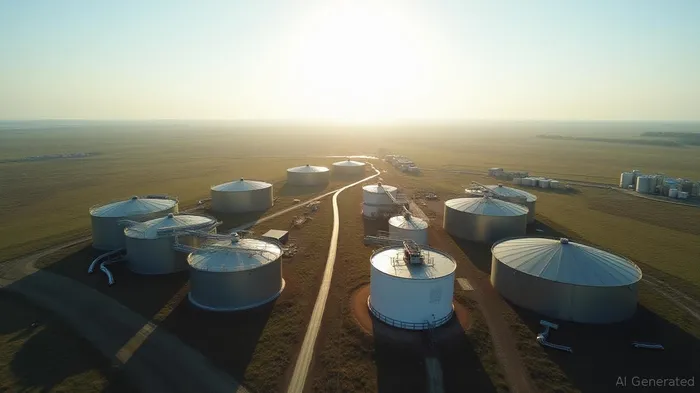
The U.S. Energy Information Administration's (EIA) latest report on Cushing, Oklahoma crude oil inventories has sparked a critical divergence in market sentiment. For the week ending August 1, 2025, Cushing inventories rose by 1.7 million barrels, defying broader U.S. crude oil draws and signaling a structural imbalance between production and refining capacity. This anomaly—where mid-continent storage builds while national stocks decline—has created a unique arbitrage opportunity and risk profile for energy and energy-sensitive sectors. Investors must now weigh how this inventory dynamic could reshape the short-to-medium-term performance of the Energy Equipment & Services (EES) industry and the Automobiles sector.
The Cushing Paradox: A Structural Bottleneck
Cushing's role as the U.S. crude oil pricing hub makes its inventory levels a barometer for regional supply-demand imbalances. The recent 1.7 million barrel increase, following a prior week's 465,000 barrel rise, highlights a persistent bottleneck. U.S. crude production averaged 13.4 million barrels per day in early July, while mid-continent refining capacity stood at 16.987 million barrels per day. This mismatch has forced crude to accumulate at Cushing, where storage costs and logistical constraints are pushing WTI prices to trade at a premium to Brent crude.
The EIA's data also reveals a broader U.S. crude draw of 3.03 million barrels for the same period, driven by robust refining activity and export demand. However, Cushing's localized buildup suggests that the mid-continent region is struggling to move crude to downstream markets, creating a “storage premium” that could persist until infrastructure bottlenecks are resolved.
Sector Implications: Energy Equipment & Services vs. Automobiles
Energy Equipment & Services (EES):
The EES sector stands to benefit from the Cushing bottleneck. As crude accumulates at the hub, demand for storage solutions, pipeline capacity, and logistics services is likely to rise. Companies specializing in midstream infrastructure—such as tank storage operators and pipeline transporters—could see increased revenue from higher utilization rates. Additionally, the need to resolve the bottleneck may accelerate investments in new infrastructure, such as expanded pipeline networks or rail transport solutions, further boosting EES demand.
However, risks remain. If the bottleneck is resolved quickly—through increased refining throughput or new export infrastructure—demand for EES services could normalize, reducing upside potential. Investors should monitor EIA reports for signs of inventory stabilization and track EES companies' earnings calls for commentary on capacity utilization.
Automobiles:
The Automobiles sector faces a more complex outlook. While lower crude prices typically benefit automakers by reducing fuel costs and boosting consumer spending, the current Cushing dynamics suggest a different trajectory. The WTI-Brent price inversion (where U.S. crude trades at a premium) indicates that global demand for U.S. crude is constrained, potentially limiting the downward pressure on gasoline prices. If gasoline prices remain elevated, consumer spending on discretionary purchases—such as new vehicles—could weaken, dampening auto sales.
Moreover, the Automobiles sector's exposure to energy costs extends beyond fuel. Electric vehicle (EV) manufacturers, for instance, may see reduced demand for internal combustion engine (ICE) vehicles if gasoline prices stay high. Conversely, if the Cushing bottleneck resolves and crude prices drop, ICE automakers could outperform EVs in the short term.
Strategic Positioning for Investors
- Energy Equipment & Services:
- Long-term plays: Invest in midstream infrastructure firms with exposure to Cushing storage and transportation. These companies are likely to benefit from prolonged bottlenecks.
Short-term trades: Consider options strategies on EES stocks to capitalize on volatility if the market overreacts to inventory data.
Automobiles:
- Hedging: Automakers with high exposure to U.S. gasoline prices should hedge against crude price volatility using futures contracts.
Sector rotation: If gasoline prices stabilize, shift allocations toward EV manufacturers, which are less sensitive to fuel costs.
Cross-sector arbitrage:
- Monitor the WTI-Brent spread. A narrowing of the spread (indicating improved Cushing logistics) could signal a shift in favor of the Automobiles sector, while a widening spread would favor EES.
Conclusion: A Market of Contrasts
The Cushing inventory data underscores the complexity of U.S. energy markets. While the broader U.S. crude draw suggests tightening supply, the mid-continent bottleneck creates a localized oversupply that benefits EES but poses risks for Automobiles. Investors must navigate these divergent trends by closely tracking EIA reports, refining capacity updates, and geopolitical developments. In a world where energy infrastructure bottlenecks can reshape sector dynamics overnight, agility and sector-specific insight will be key to capitalizing on the Cushing conundrum.

Stay ahead of the market.
Get curated U.S. market news, insights and key dates delivered to your inbox.


AInvest
PRO
AInvest
PRO



Comments
No comments yet