
Navigating Cryptocurrency Volatility: Is USDT Still a Safe Haven?


 Aime Summary
USDT's Stability: A Fragile Illusion?
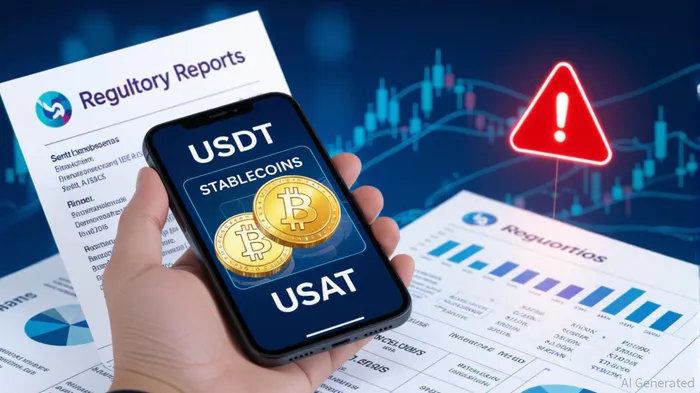
Tether's USDT, the largest stablecoin by market share, has faced mounting concerns over its reserve composition. S&P Global Ratings downgraded USDT's stability assessment to 5 (weak) in late 2025, citing a shift toward higher-risk assets such as bitcoinBTC-- and other investments vulnerable to credit and market risks. While TetherUSDT-- has expanded its gold reserves-holding 116 tonnes by September 2025, new U.S. legislation, the GENIUS Act, now bars compliant stablecoins from using gold as collateral. This regulatory shift has forced Tether to pivot, with plans for a new stablecoin, USAT to align with compliance standards.
The fragility of USDT's peg was starkly exposed during the October 2025 crypto "black swan" crash, where algorithmic stablecoins like USDe depegged to as low as $0.65, triggering panic among retail investors. Though USDT maintained a near-$1 peg, the event underscored the systemic risks of over-reliance on stablecoins, particularly when their reserves lack the liquidity of traditional fiat.
Regulatory Scrutiny and Systemic Risks
Regulators are no longer treating stablecoins as peripheral to the financial system. The European Central Bank (ECB) has warned that the concentration of U.S. stablecoins-particularly USDT and USD Coin (USDC)-poses systemic risks, with the potential for a single issuer's failure to destabilize global markets. Tether's limited transparency on custodians and risk management further fuels these concerns.
In response, the EU's Markets in Crypto-Assets Regulation (MiCAR) and the U.S. GENIUS Act are reshaping the stablecoin landscape. These frameworks mandate full reserve transparency and prohibit the use of non-liquid assets like gold, aiming to mitigate cross-border regulatory arbitrage. However, compliance remains a challenge for legacy stablecoins like USDT, which must navigate a rapidly evolving legal environment while retaining market share.
Behavioral Finance and Investor Reactions
The October 2025 crash also revealed how behavioral biases exacerbate stablecoin instability. Retail investors, driven by loss aversion and fear of missing out (FOMO), often overreact to depegging events, accelerating liquidity crises. Herd behavior-where panic selling or speculative buying dominates rational decision-making-has become a hallmark of crypto crises, as seen in the collapses of FTX, Celsius, and Terra-Luna.
These psychological dynamics are compounded by the interconnectedness of digital assets. Volatility in one segment, such as NFTs or DeFi platforms, can spill over into stablecoin markets, creating feedback loops that amplify systemic risk. For instance, leveraged positions using USDT as collateral during the October crash led to cascading liquidations, further deepening the liquidity crunch.
Debt Management and Leverage Risks
High leverage and liquidity stress have further exposed vulnerabilities in stablecoin ecosystems. During the 2025 market turbulence, borrowers using USDT to fund crypto positions with loan-to-value (LTV) ratios as high as 90% faced amplified losses when asset prices plummeted. This pro-cyclical behavior-where leverage fuels gains in bull markets but accelerates losses in downturns-has drawn comparisons to traditional banking crises, where a lack of a "lender of last resort" for stablecoins exacerbates defaults.
Regulators are now pushing for stablecoin issuers to maintain high-quality liquid assets (HQLA), such as cash and short-term Treasuries, to ensure redemption stability. The U.S. GENIUS Act's reserve requirements, for example, aim to prevent the kind of liquidity crises seen in 2025 by mandating transparency and stress-testing. However, DeFi platforms like AaveAAVE-- continue to facilitate stablecoin lending without such safeguards, creating asymmetries in risk management.
Is USDT Still a Safe Haven?
The answer hinges on balancing risks with evolving opportunities. While USDT's 62.16% market share as of mid-2025 suggests enduring demand, its stability is increasingly contingent on regulatory compliance and reserve transparency. The launch of USAT, Tether's compliant alternative, may offer a path forward, but it remains to be seen whether it can replicate USDT's dominance without the same vulnerabilities.
For investors, the key lies in diversification and risk mitigation. Stablecoin portfolios optimized with power-law-based strategies, such as SAS, have shown greater resilience during stress events. Additionally, debt management frameworks that incorporate stress-test scenarios and diversified funding sources can reduce exposure to liquidity shocks.
Conclusion
USDT's role as a safe haven in 2025 is undeniably complicated. While it retains a near-$1 peg and significant market share, its stability is now inextricably linked to regulatory compliance, reserve transparency, and investor behavior. As the crypto ecosystem matures, the line between innovation and systemic risk grows thinner. For investors, navigating this volatility requires not only a critical eye on stablecoin fundamentals but also an understanding of the behavioral and regulatory forces shaping their future.

Blending traditional trading wisdom with cutting-edge cryptocurrency insights.
Latest Articles
Stay ahead of the market.
Get curated U.S. market news, insights and key dates delivered to your inbox.






Comments
No comments yet