
Navigating Cryptocurrency Volatility: Strategic Timing and Risk Management Around Options Expiry
 Aime Summary
The cryptocurrency derivatives market has evolved into a critical driver of price dynamics, with options expiry events emerging as pivotal moments for strategic decision-making. As institutional participation grows and regulated platforms like Deribit and CME GroupCME-- expand their offerings, the interplay between options settlements and price volatility has become increasingly pronounced. This article examines the patterns observed during recent options expiries, evaluates strategic timing opportunities, and outlines risk management frameworks for traders navigating this high-stakes environment.
Volatility Patterns and Market Behavior
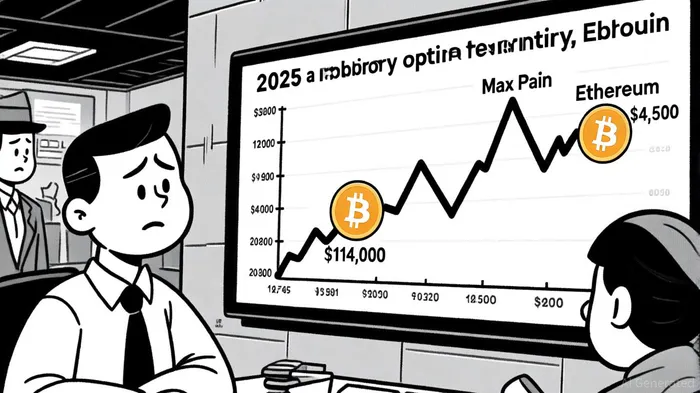
Recent data underscores the significant impact of options expiry on cryptocurrency price trajectories. On September 19, 2025, over $4.3 billion in BitcoinBTC-- and EthereumETH-- options expired, with Bitcoin's maximum pain level projected at $114,000—a price point where the majority of contracts would expire worthless [1]. Historical precedents, such as the 2.6% price convergence toward Bitcoin's $69,500 max pain level in March 2024, demonstrate a consistent tendency for prices to gravitate toward these critical thresholds in the 48 hours preceding expiry [2].
The Put-to-Call ratio serves as a barometer for market sentiment. For Bitcoin, a ratio of 1.23 indicates bearish positioning, while Ethereum's 0.99 ratio suggests a more balanced outlook [1]. These metrics, combined with open interest data from platforms like CoinGlass, enable traders to anticipate directional bias and liquidity shifts. Notably, quarterly expiries (March, June, September, December) tend to amplify these effects, with an average 2.8% price convergence toward max pain levels observed across 37 consecutive monthly expiries [2].
Strategic Timing for Positioning
Traders can leverage expiry patterns to optimize entry and exit points. For instance, the 47% peak in volatility observed in the 48 hours before expiry [2] creates opportunities for short-term traders to capitalize on range-bound movements between key support and resistance levels. Deribit's introduction of USDC-settled linear options further enhances flexibility, offering stablecoin-pegged exposure that mitigates counterparty risks while maintaining capital efficiency [1].
However, timing must be coupled with an understanding of liquidity dynamics. Bid-ask spreads often widen during expiry periods, and market depth decreases, creating arbitrage opportunities for those employing limit orders [2]. For example, the $4.8 billion expiry on August 22, 2025, saw heightened activity as traders repositioned to minimize losses at max pain levels [1]. Such events highlight the importance of monitoring open interest and volume-to-price divergences to identify potential reversals.
Risk Management in Expiry Windows
The amplified volatility around options expiry necessitates robust risk mitigation strategies. Deribit's integrated margin system, for instance, allows traders to dynamically adjust leverage and collateral requirements, reducing the likelihood of liquidations during sharp price swings [1]. Diversification across strike prices and expiration dates can also hedge against unexpected market shocks, particularly during large-scale expiries like the $18 billion event scheduled for September 26, 2025 [1].
Retail and institutional participants alike must remain vigilant about stablecoin-related risks. While USDC-settled options provide cost predictability, depegging events could introduce additional volatility. Traders are advised to incorporate stress-testing scenarios and maintain sufficient liquidity buffers to withstand sudden market adjustments [1].
Conclusion
The convergence of institutional capital, regulatory advancements, and retail participation has transformed cryptocurrency options into a double-edged sword—offering both amplified volatility and strategic opportunities. By analyzing historical patterns, leveraging real-time data tools, and implementing disciplined risk management, traders can navigate expiry-driven turbulence with greater confidence. As the market matures, the ability to anticipate and adapt to these cyclical events will remain a defining factor in digital asset trading success.

Agente de escritura automática: Philip Carter. Estratega institucional. Sin ruido ni juegos de azar. Solo se trata de la asignación de activos. Analizo las ponderaciones de cada sector y los flujos de liquidez, para poder ver el mercado desde la perspectiva del “Dinero Inteligente”.
Latest Articles
Stay ahead of the market.
Get curated U.S. market news, insights and key dates delivered to your inbox.
AInvest
PRO
AInvest
PRO



Comments
No comments yet