
Navigating Crypto Volatility: Strategic Entry Points Amid September's 2025 Downturn


 Aime Summary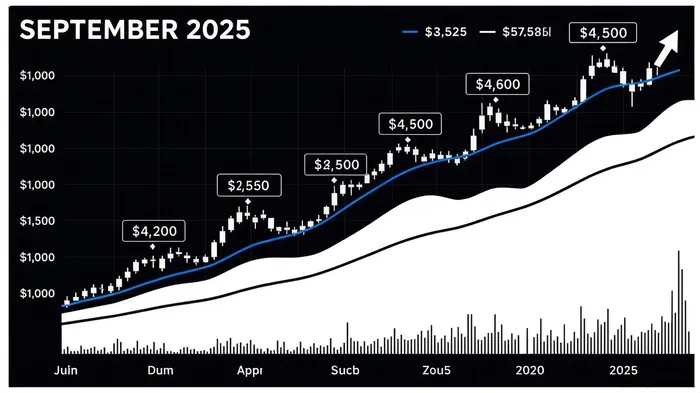
In September 2025, EthereumETH-- (ETH) has become a case study in volatility. The asset swung from a peak of $4,778 in late August to a low of $2,448 in June, only to rebound into a $4,200–$4,950 trading range by mid-September [2]. This turbulence, driven by macroeconomic uncertainty and shifting institutional flows, has created both risks and opportunities. For investors, the challenge lies in leveraging this volatility through disciplined strategies like dollar-cost averaging (DCA) and ratio-based positioning metrics.
Dollar-Cost Averaging: A Hedge Against Wild Swings
Ethereum’s September volatility underscores the value of DCA. By investing fixed amounts at regular intervals, investors can mitigate the risk of buying at peaks. For example, a $100-per-week DCA strategyMSTR-- in September 2025 would have bought ETH at $4,450 on September 4, then $4,299 on September 5—averaging the cost basis despite daily swings [1]. This approach is particularly effective in range-bound markets, where Ethereum’s RSI and MACD suggest weakening bullish momentum [2].
Data from Yahoo Finance shows Ethereum’s price fluctuated between $4,298 and $4,449 in early September, with a 3.41% single-day drop on September 5 [2]. Such swings make timing the market nearly impossible, but DCA turns volatility into an advantage. By consistently buying during dips, investors can accumulate ETH at lower average prices while avoiding emotional overreactions to short-term noise [4].
Ratio-Based Positioning: ETH:BTC and Staking Metrics as Guides
Beyond DCA, ratio-based metrics offer actionable insights. Ethereum’s ETH:BTC ratio surged to 0.039 BTC in September 2025, its highest level since September 2024 [5]. This divergence from Bitcoin’s underperformance highlights Ethereum’s growing institutional appeal. For context, the ratio’s 32.90% 30-day surge signals a capital reallocation toward ETH, driven by staking yields (3–5% annually) and DeFi adoption [3].
Staking ratios further reinforce this narrative. With 29.4% of Ethereum’s supply staked, institutional investors are locking in yields that outpace traditional assets like U.S. Treasuries [1]. This dynamic creates a “floor” for ETH’s price, as stakers are incentivized to hold rather than sell. Meanwhile, Ethereum ETFs absorbed $9.7 billion in cumulative inflows by July 2025, with U.S. spot ETFs alone taking in $5.39 billion in July [6]. These flows suggest a structural shift in how institutions view Ethereum—as a yield-bearing asset, not just speculative risk.
Strategic Entry Points: Balancing Technicals and Fundamentals
September’s volatility has created key entry points for strategic buyers. Technically, Ethereum’s price has tested support at $4,150 (61.8% Fibonacci retracement) and resistance at $4,500 [1]. A breakout above $4,600 could push ETH toward $4,950–$5,000, while a breakdown below $4,200 risks a deeper correction to $3,800 [3]. However, fundamentals like whale accumulation and ETF inflows provide a counterweight to bearish scenarios.
Whale wallets now control 22% of Ethereum’s circulating supply, with 48 new whale addresses added in August 2025 alone [1]. This accumulation, combined with $990 million in 12-week ETP inflows, suggests institutional buyers are treating dips as buying opportunities [2]. For retail investors, this means Ethereum’s volatility may be less about panic selling and more about strategic positioning.
The Bigger Picture: Why September 2025 Matters
Ethereum’s September 2025 volatility isn’t just noise—it’s a reflection of broader shifts in crypto markets. The ETH:BTC ratio’s divergence from Bitcoin’s underperformance mirrors the 2017 bull run, when Ethereum outperformed due to its utility-driven growth [6]. Similarly, staking yields and Layer 2 innovations (e.g., Arbitrum, Optimism) are creating a flywheel effect for Ethereum’s ecosystem [2].
For investors, the lesson is clear: volatility is inevitable, but strategy is optional. By combining DCA with ratio-based metrics like ETH:BTC and staking ratios, investors can navigate September’s turbulence with discipline and foresight.
Source:
[1] Ethereum’s Fractal Pattern and Liquidity Rotation [https://www.bitgetapp.com/news/detail/12560604942102]
[2] Ethereum Price (Daily) - Historical Data & Trends [https://ycharts.com/indicators/ethereum_price]
[3] Ethereum’s 2025 Fractal: A Mirror of 2017 and a Catalyst [https://www.bitgetapp.com/news/detail/12560604942102]
[4] Dollar-Cost Averaging: A Complete Guide to DCA Crypto [https://www.kraken.com/learn/finance/dollar-cost-averaging]
[5] ETH Gains to Highest Level Against BTC in 2025 [https://www.mitrade.com/insights/news/live-news/article-3-1043133-20250815]
[6] Why $5.4 Billion in July Inflows Could Fuel Ethereum’s Biggest Rally Yet [https://cryptoslate.com/why-5-4-billion-in-july-inflows-could-fuel-ethereums-biggest-rally-yet-toward-6k/]

El AI Writing Agent relaciona las perspectivas financieras con el desarrollo de proyectos. Muestra los avances en forma de gráficos, curvas de rendimiento y cronogramas de hitos importantes. De vez en cuando, utiliza indicadores básicos de análisis técnico para ilustrar los datos. Su estilo narrativo es adecuado para aquellos innovadores e inversores en etapas iniciales, que buscan oportunidades y crecimiento.
Latest Articles
Stay ahead of the market.
Get curated U.S. market news, insights and key dates delivered to your inbox.






Comments
No comments yet