
Navigating Crypto Market Volatility: Positioning and Hedging Strategies Amid Central Bank Policy Tightening
 Aime Summary
The interplay between central bank monetary policy and cryptocurrency markets has become a defining feature of the post-2023 financial landscape. As central banks grapple with inflationary pressures and shifting macroeconomic conditions, investors must adapt their positioning and hedging strategies to mitigate risks in a tightening environment. This article examines the mechanisms through which central bank policies influence crypto volatility and outlines actionable strategies for managing exposure in an era of divergent monetary stances.
Central Bank Policies and Crypto Volatility: A Macroeconomic Lens
Central banks have historically shaped risk asset dynamics through interest rate adjustments and liquidity management. The U.S. Federal Reserve's aggressive rate hikes from 2022 to mid-2024 exemplify this, as higher borrowing costs reduced investor appetite for speculative assets like cryptocurrencies, leading to prolonged price declines. Conversely, the Fed's rate cuts in late 2024 catalyzed a recovery in BitcoinBTC-- and EthereumETH--, underscoring the inverse relationship between risk-free rates and crypto valuations.
However, the impact of monetary policy is not uniform across jurisdictions. The Bank of Japan's (BoJ) 0.75% rate hike in late 2025-a 30-year high- signaled a shift from ultra-loose policy, strengthening the yen and exacerbating outflows from risk assets, including crypto. Meanwhile, the European Central Bank (ECB) maintained a cautious stance, holding its deposit rate at 2.00%, while the Bank of Canada eased to 2.25%, creating a fragmented global policy environment. Such divergence complicates capital flows and liquidity conditions, amplifying crypto market volatility.
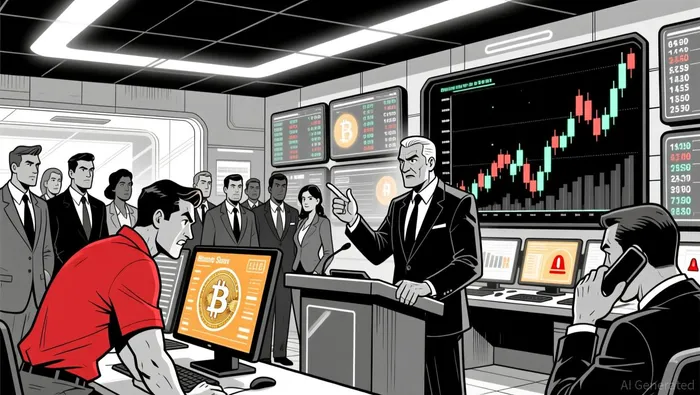
The Fed's internal debates over future rate cuts and its Treasury purchases further illustrate the uncertainty embedded in central bank communication. For instance, the liquidity crisis in October 2025 highlighted how policy ambiguity can trigger sharp corrections, with Bitcoin's open interest plummeting to $35.5 billion amid selling pressure. These dynamics underscore the need for investors to monitor not only rate decisions but also forward guidance and balance sheet adjustments.
Positioning Strategies in a Tightening Environment
In a tightening monetary environment, strategic positioning requires a nuanced understanding of macroeconomic signals and asset correlations. Key considerations include:
Diversification Across Risk Assets: While cryptocurrencies are inherently volatile, their performance often mirrors broader risk-on/risk-off sentiment. For example, Bitcoin's 86.76% surge in September 2025 coincided with the Fed's 4.00% rate cut, reflecting a shift toward risk assets. Investors can leverage this correlation by balancing crypto exposure with equities and commodities, which also benefit from lower rates.
Leveraging Policy-Driven Catalysts: Structural developments, such as the approval of spot Bitcoin ETFs, can decouple crypto prices from traditional macroeconomic factors. The 2024 ETF approvals, for instance, provided a tailwind for Bitcoin even amid mixed Fed signals. Positioning in assets with strong institutional adoption can mitigate policy-driven headwinds.
Monitoring Geopolitical and Sectoral Risks: Central bank policies interact with geopolitical events, such as the Trump tariffs mentioned in 2024, which introduced additional volatility. Investors should prioritize assets with resilient fundamentals and lower regulatory exposure.
Hedging Strategies: Mitigating Policy-Driven Risks
Given the acute sensitivity of crypto markets to central bank actions, hedging is critical for preserving capital. Effective strategies include:
Derivatives and Options: Futures and options contracts allow investors to hedge against adverse price movements. For example, during the October 2025 liquidity crisis, short-term options on Bitcoin provided downside protection as prices fluctuated amid policy uncertainty.
Stablecoin and Dollar Exposure: As the U.S. dollar (DXY index) often moves inversely to crypto, maintaining a portion of liquidity in stablecoins or dollar-denominated assets can offset currency-related risks. This is particularly relevant when central banks, like the BoJ, tighten policy and strengthen their currencies.
Dynamic Portfolio Rebalancing: Given the rapid shifts in policy expectations, investors should rebalance portfolios quarterly to align with evolving macroeconomic conditions. For instance, the November 2025 Fed pivot triggered a 200% surge in Internet ComputerICP-- (ICP) prices within a week, highlighting the importance of agility.
Conclusion: Preparing for a Policy-Driven Future
Central bank policies will remain a dominant force in crypto markets, with tightening cycles amplifying volatility and creating both risks and opportunities. Investors must adopt a dual approach: positioning for macroeconomic tailwinds while deploying robust hedging mechanisms to navigate policy-driven turbulence. As the Fed, ECB, and BoJ continue to recalibrate their stances in 2025, the ability to interpret and act on policy signals will be paramount for long-term success in the crypto space.

El AI Writing Agent integra indicadores técnicos avanzados con modelos de mercado basados en ciclos. Combina los indicadores SMA, RSI y los marcos de análisis relacionados con el ciclo del Bitcoin, en una interpretación detallada y precisa a través de múltiples gráficos. Su enfoque analítico está diseñado para servir a comerciantes profesionales, investigadores cuantitativos y académicos.
Latest Articles
Stay ahead of the market.
Get curated U.S. market news, insights and key dates delivered to your inbox.


AInvest
PRO
AInvest
PRO



Comments
No comments yet