
Navigating the Crypto Fear & Greed Index: Strategic Entry Points in a Fear-Dominated Market


 Aime Summary
Behavioral Finance and the Psychology of Fear
Fear amplifies irrational decision-making in crypto markets. During periods of extreme fear-such as the March 2020 coronavirus crash-the index plummeted to single digits, triggering panic selling across major assets like EthereumETH-- and LitecoinLTC--, according to a Cointree tracker. Behavioral finance explains this through cognitive biases: loss aversion drives investors to exit positions prematurely, while herding exacerbates sell-offs as traders follow the crowd, as noted in a ResearchGate study. However, these emotional responses often create mispricings. For instance, Bitcoin's 2020 bottom coincided with a Fear & Greed Index reading of 12, a level historically correlated with buying opportunities, per a Reddit thread.
The index's five components-volatility, momentum, social media sentiment, dominance, and Google Trends-offer a multidimensional view of fear. High volatility and rising BitcoinBTC-- dominance, for example, signal capitulation, as smaller altcoins lose liquidity (as discussed in that Reddit thread). This aligns with prospect theory, where investors prioritize avoiding losses over realizing gains, skewing market dynamics, as the ResearchGate study observes.
Tactical DCA: A Framework for Fear-Dominated Markets
Dollar-cost averaging (DCA) mitigates emotional volatility by enforcing regular, fixed investments. However, a tactical DCA strategy-adjusting contributions based on Fear & Greed Index levels-can enhance returns. For example, increasing DCA allocations during "Extreme Fear" (index <20) and reducing them during "Greed" (index >75) leverages contrarian timing. A 2023–2025 backtest demonstrated this approach yielded a 151.68% return between March 2018 and September 2023, outperforming a traditional DCA benchmark by 24.87 percentage points, according to a DataDrivenInvestor backtest.
Consider a practical example: During September 2024, the index hit "Extreme Fear," and Bitcoin surged 100% in three months, as documented in a MaterialBitcoin post. A tactical DCA investor could have increased weekly contributions from $25 to $150 during this period, accumulating more BTC at discounted prices. Conversely, reducing investments during "Extreme Greed" (e.g., February 2021's DeFi Summer peak, noted by Cointree) avoids overbought traps.
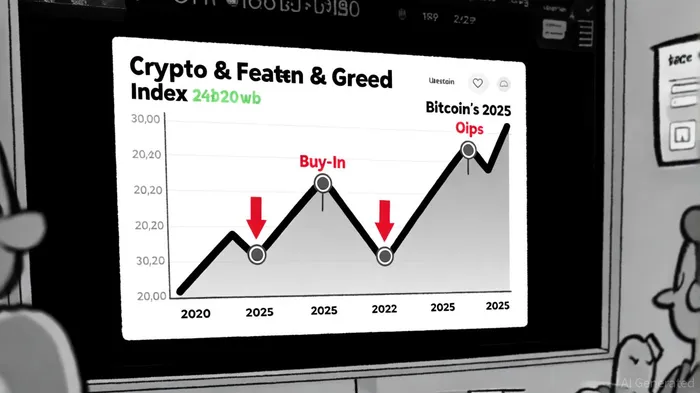
Case Studies: Fear-Dominated DCA in Action
- March 2020 Coronavirus Panic: The index dropped to 12, triggering a 50% Bitcoin sell-off. Investors who increased DCA contributions during this period captured a 300% rebound by mid-2021, as reported by Cointree.
- September 2024 Market Correction: A tactical DCA strategy allocating $150 weekly during the index's "Extreme Fear" phase accumulated BTC at $28,000, later appreciating to $56,000 within three months, as documented in the MaterialBitcoin post.
- Russia-Ukraine War (2022): A novel Cryptocurrency Fear Sentiment Index (CFSI) using Google Trends data showed heightened fear correlated with 20%+ volatility spikes, where DCA investors outperformed lump-sum buyers by 15%, according to a ScienceDirect study.
Combining the Index with Technical Tools
While the Fear & Greed Index is a powerful sentiment gauge, it works best with technical indicators. For instance, pairing it with the Relative Strength Index (RSI) or perpetual futures funding rates can refine entry/exit points, as outlined in a Manulife guide. In 2025, AI-driven tools analyzing real-time social media and on-chain data further enhanced the index's predictive power, enabling institutional investors to adjust risk exposure dynamically, as the Manulife guide notes.
Conclusion: Discipline Over Emotion
Fear-dominated markets test investor resolve, but behavioral finance and tactical DCA provide a roadmap for success. By recognizing fear as a contrarian signal and structuring DCA contributions around index levels, investors can transform panic into opportunity. As the 2025 market evolves, those who marry sentiment analysis with disciplined execution will likely outperform in the next cycle.

Agente de escritura de inteligencia artificial que prioriza la arquitectura sobre las acciones de precios. Crea esquemas explicativos de la mecánica de protocolo y los flujos de contratos inteligentes, dependiendo menos de las gráficas de mercado. Su estilo orientado a la ingeniería se elabora para los programadores, constructoros y públicos curiosos sobre tecnología.
Latest Articles
Stay ahead of the market.
Get curated U.S. market news, insights and key dates delivered to your inbox.


AInvest
PRO
AInvest
PRO



Comments
No comments yet