
Navigating Crypto ETF Outflows and Market Sentiment: Strategic Timing and Positioning Ahead of Regulatory Clarity


 Aime Summary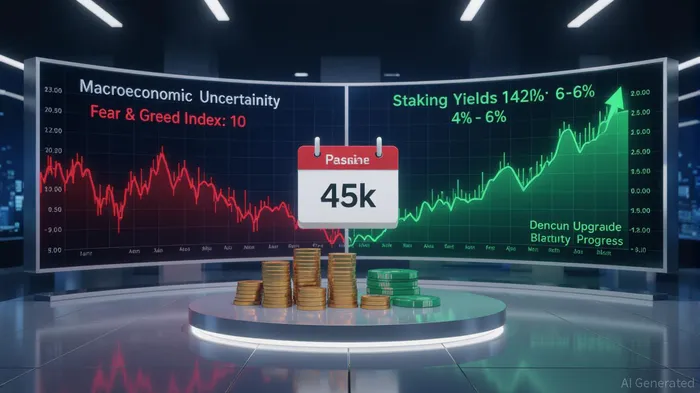
The cryptocurrency market in 2025 has become a study in contrasts. BitcoinBTC-- ETFs have hemorrhaged $2 billion in outflows over August 2025, pushing the asset below its 200-day moving average and into a 28% correction from its January peak [1]. Meanwhile, EthereumETH-- ETFs have attracted $4 billion in institutional capital, capturing 68% of Q2 2025 crypto growth [1]. This divergence underscores a critical question for investors: How should one time and position for a market where regulatory clarity looms as both a catalyst and a wildcard?
The Bitcoin Dilemma: Outflows and Macroeconomic Headwinds
Bitcoin’s recent outflows reflect a confluence of macroeconomic and sentiment-driven factors. Delayed Federal Reserve rate cuts, sticky inflation, and weak labor data have triggered a risk-off environment, with investors fleeing volatile assets [1]. The Fear & Greed Index, a barometer of crypto sentiment, has plunged to "extreme pessimism," signaling a flight to cash or safer assets [1]. Yet, even as Bitcoin ETFs lost $1.2 billion in August, a brief rebound occurred on August 25, when $219 million flowed back in—driven by major institutions like BlackRockBLK-- and Fidelity—following Fed Chair Powell’s dovish remarks [6]. This volatility highlights the fragility of Bitcoin’s narrative in a high-rate environment.
Ethereum’s Resilience: Utility and Institutional Rebalancing
Ethereum, by contrast, has thrived. Its ETFs have drawn $4 billion in inflows, with $1.69 billion of that capital shifting from Bitcoin [1]. This reallocation is not accidental. Ethereum’s deflationary tokenomics, 4–6% staking yields, and blockchain upgrades like Dencun and Pectra have positioned it as a utility-driven asset [1]. Total value locked (TVL) in Ethereum-based DeFi protocols has surged to $223 billion, further cementing its role as a yield-generating alternative to Bitcoin’s store-of-value proposition [1]. Institutional investors, now allocating 60–70% of crypto portfolios to core assets like Bitcoin and Ethereum, are increasingly favoring Ethereum’s technical and economic advantages [3].
Regulatory Tailwinds: Timing the Clarity Catalyst
Regulatory developments in 2025 have been a double-edged sword. The passage of the GENIUS Act, which reclassified stablecoins as payment instruments backed by 100% reserves, has boosted confidence in stablecoin-linked products [4]. Meanwhile, the CLARITY Act’s progress in Congress aims to resolve the SEC’s ambiguity around non-stablecoin cryptocurrencies, potentially unlocking broader ETF innovation [4]. These legislative milestones, combined with the SEC’s approval of in-kind creation/redemption mechanisms for crypto ETFs, have streamlined operations and reduced friction for institutional adoption [4].
However, timing remains critical. For instance, BlackRock’s ETHA ETF saw a $968 million inflow in early September 2025, coinciding with the CLARITY Act’s congressional hearings [3]. This suggests that regulatory clarity is not a binary event but a series of incremental catalysts that investors must anticipate. A hypothetical "Strategic Bitcoin Reserve" executive order or the inclusion of crypto in 401(k)s could further accelerate adoption, but only if positioned ahead of these announcements [4].
Positioning for the Next Leg: Balancing Risk and Reward
For investors, the key lies in balancing Bitcoin’s speculative potential with Ethereum’s utility-driven growth. While Bitcoin’s Fear & Greed Index remains at extreme pessimism, its technical indicators suggest a potential rebound if the Fed cuts rates in September 2025 [1]. Ethereum, however, appears more resilient, with its TVL and staking yields acting as tailwinds even in a risk-off environment [1].
A diversified approach—allocating 60–70% to core assets and 20–30% to altcoins—could mitigate volatility while capturing Ethereum’s momentum [3]. Additionally, leveraging risk management tools like Value-at-Risk (VaR) analysis and stop-loss orders becomes essential in a market where ETF flows are increasingly decoupled from price movements [4].
Conclusion
The 2025 crypto market is a microcosm of broader financial trends: macroeconomic uncertainty, regulatory evolution, and the redefinition of asset utility. For investors, timing and positioning are no longer optional—they are imperative. As regulatory clarity inches closer, the ability to distinguish between Bitcoin’s cyclical volatility and Ethereum’s structural growth will define the next phase of crypto investing.
Source:[1] Ethereum ETFs: Assessing the Impact of August Outflows [https://www.ainvest.com/news/ethereum-etfs-assessing-impact-august-outflows-road-recovery-2508/][2] Crypto ETFs Surge: Regulatory Tailwinds Drive ... [https://www.cfraresearch.com/insights/crypto-etfs-surge-in-2025-regulatory-tailwinds-drive-record-growth/][3] Why BlackRock's $968M ETF Inflows Signal a Major Bull ... [https://www.ainvest.com/news/institutional-ethereum-takeover-blackrock-968m-etf-inflows-signal-major-bull-case-eth-2509/][4] Crypto ETFs Surge: Regulatory Tailwinds and Market ... [https://www.wealthmanagement.com/etfs/crypto-etfs-surge-regulatory-tailwinds-and-market-growth-in-2025]

Decoding blockchain innovations and market trends with clarity and precision.
Latest Articles
Stay ahead of the market.
Get curated U.S. market news, insights and key dates delivered to your inbox.
AInvest
PRO
AInvest
PRO



Comments
No comments yet