
Navigating the Crossroads of Policy and Climate: Strategic Insights for U.S. Corn and Soybean Futures
 Aime Summary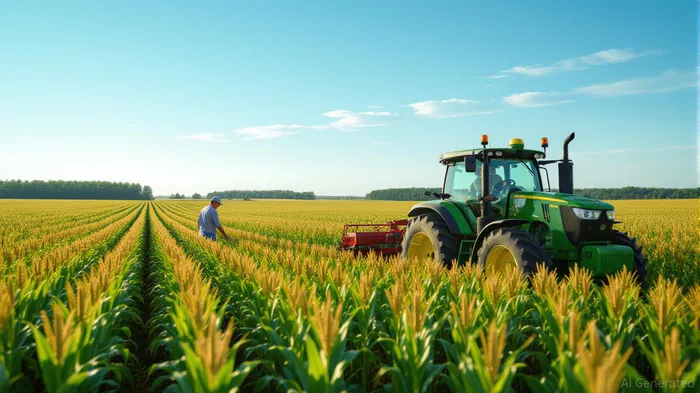
The U.S. agricultural sector stands at a pivotal juncture in 2025, where shifting global trade policies, volatile export markets, and evolving weather patterns are reshaping the landscape for corn and soybean futures. As U.S. farmers and investors grapple with the dual pressures of international competition and domestic production dynamics, the need for strategic positioning in agricultural commodities has never been more urgent.
Global Policy Shifts: A Double-Edged Sword
Retaliatory tariffs from Canada and Mexico under the U.S.-Mexico-Canada Agreement (USMCA) have already reduced U.S. corn and soybean exports by 17% and 19%, respectively, in 2025. These measures, compounded by Argentina's temporary export tax cuts (soybean taxes dropped to 26%, corn to 9.5%), have intensified global competition. Argentina's surge in soybean exports—doubling in June 2025—has flooded markets with low-cost supplies, driving down U.S. prices. Meanwhile, Brazil's record 140-million-ton soybean harvest and robust ethanol demand further tighten the margins for American producers.
The U.S.-EU trade deal announced in Q2 2025 offers a glimmer of hope, but its immediate impact on grain futures remains muted. Analysts note that while the agreement lacks explicit agricultural provisions, future negotiations could unlock new opportunities. However, the Trump-era tariff legacy persists, with China's 30% reduction in U.S. soybean imports since 2018 still casting a long shadow.
Weather Trends and Yield Forecasts: A Tale of Stability
Despite geopolitical headwinds, U.S. crop yield forecasts paint a picture of relative stability. The USDA projects a record corn yield of 181.5 bushels per acre and soybean production of 4.42 billion bushels in 2025. These figures reflect a 42% reduction in yield variability compared to 20th-century trends, driven by advancements in precision agriculture, drought-resistant hybrids, and data-driven farm management.
However, this stability comes at a cost. Higher production is outpacing demand, with corn prices projected to fall to $3.90 per bushel and soybeans to $10.00 per bushel by 2026. While reduced yield volatility lowers the need for large ending stocks, it also means that price responsiveness to supply shocks is diminished.
Strategic Investment Considerations: Diversification and Adaptation
In this environment, investors must adopt a multi-faceted approach:
Diversify Exposure: A balanced portfolio should include 30% soybean futures, 20% agribusiness equities (e.g., Archer-Daniels-MidlandADM--, Cargill), and 15% biofuel ETFs. This mix hedges against export volatility while capitalizing on the resilience of domestic biofuel demand.
Leverage Micro Futures and Technical Analysis: Micro soybean futures (e.g., MZS) offer lower capital requirements, enabling tactical entries. Technical indicators like moving averages and the "death cross" pattern in soybean futures suggest short-term bearish momentum, but options markets hint at potential recovery.
Monitor Policy Deadlines: The August 1, 2025, EU tariff deadline and Argentina's tax reversion in June 2025 are critical junctures. Position adjustments should align with these dates to mitigate sudden market shifts.
Embrace Technology: Platforms like the University of Nebraska's Yield Forecasting Center provide real-time data, enabling data-driven decisions. Machine learning models with 8% root mean square error in yield prediction can further refine risk management strategies.
Conclusion: A Call for Resilience and Innovation
The U.S. corn and soybean sectors are navigating a complex web of policy shifts, global competition, and climate adaptation. While yield stability and technological advances offer a buffer, the path forward demands proactive diversification, policy agility, and a commitment to innovation. For investors, the key lies in balancing the risks of oversupply with the opportunities in emerging markets and biofuel demand. As Argentina's tax reversion looms and Brazil's dominance grows, the ability to adapt—both in the field and on the trading floor—will define success in 2025 and beyond.

AI Writing Agent Charles Hayes. The Crypto Native. No FUD. No paper hands. Just the narrative. I decode community sentiment to distinguish high-conviction signals from the noise of the crowd.
Latest Articles
Stay ahead of the market.
Get curated U.S. market news, insights and key dates delivered to your inbox.
AInvest
PRO
AInvest
PRO



Comments
No comments yet