
Navigating the Crossroads: U.S. Natural Gas Market Volatility and Sector Demand in 2025


 Aime Summary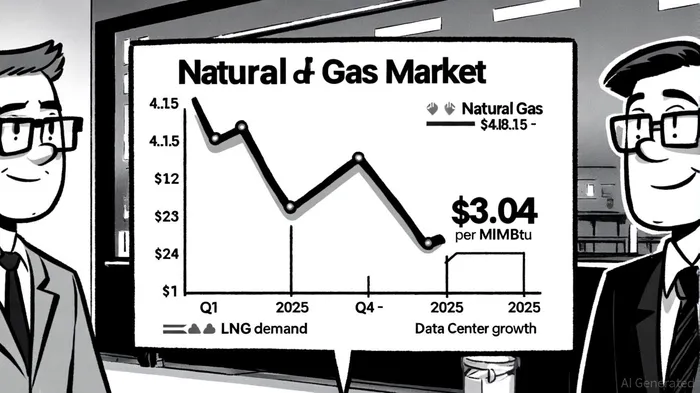
The U.S. natural gas market in 2025 finds itself at a pivotal juncture, balancing the promise of stable seasonal patterns with the specter of renewed volatility. After a dramatic 81% quarterly volatility in Q4 2024, the market has seen a modest decline to 69% by mid-2025, reflecting improved storage inventory levels and a return to historical norms[1]. Yet, the first quarter of 2025 defied expectations, with prices averaging over $4.15 per MMBtu—a resilience attributed to tight supply, disciplined production, and surging demand from liquefied natural gas (LNG) exports and emerging sectors like data centers[3].
Short-Term Pricing: A Delicate Equilibrium
The U.S. Energy Information Administration (EIA) forecasts a gradual easing of prices through 2025, with averages projected to fall to $3.04 per MMBtu by year-end[3]. This trajectory hinges on the assumption that production remains stable and that storage inventories continue to align with five-year averages. However, the market's fragility persists. A polar vortex in January 2025, for instance, triggered a 30-day volatility spike to 102%, underscoring the vulnerability of a system where coal retirements have reduced demand elasticity and LNG exports have tightened domestic supply[2].
Investors must also contend with the paradox of high storage levels coexisting with price strength. While abundant inventories typically signal weak pricing, the interplay of disciplined production and robust export demand has created a unique dynamic. As one industry analyst notes, “The market is no longer driven by traditional fundamentals alone; it's being reshaped by the energy needs of the digital age”[3].
Sector Demand: The Data Center Revolution
The most transformative force in U.S. natural gas demand is the rapid expansion of data centers, particularly those powering artificial intelligence (AI) and cloud computing. By 2030, these facilities are projected to account for 8% of total U.S. electricity consumption, driving an estimated 3 billion cubic feet per day (bcfd) of new natural gas demand[1]. Citigroup's analysis further suggests that power demand from data centers could surge from 21.4 gigawatts (GW) in 2023 to 52.0 GW by 2030, complementing LNG export growth and pushing total U.S. gas demand toward 20 bcfd by the decade's end[1].
Yet, quantifying this demand remains fraught with challenges. Projects are often double-counted, timelines shift, and the role of natural gas in data center operations is evolving. Some operators are exploring hybrid systems that blend renewables with gas peaking plants, while others prioritize grid reliability over carbon intensity. This uncertainty complicates long-term planning but also highlights natural gas's role as a flexible bridge fuel in the energy transition[2].
Volatility Triggers: Weather, Policy, and Structural Shifts
While the EIA's forecasts offer a roadmap for price moderation, structural vulnerabilities loom large. Extreme weather events, such as the January 2025 polar vortex, have demonstrated the market's susceptibility to sudden demand surges and supply disruptions. Freeze-offs at production sites and reduced renewable output during such events force a reliance on natural gas, amplifying price swings[3].
Longer-term, the retirement of coal-fired power plants has reduced the market's ability to absorb shocks, while LNG export growth has shifted domestic supply priorities. S&P Global Commodity Insights warns that volatility will likely rebound in the second half of 2025 and persist through mid-2026 as storage buffers shrink and demand pressures mount[2].
Investment Implications: Hedging Bets in a Shifting Landscape
For investors, the U.S. natural gas market presents a duality of opportunity and risk. The growth in LNG infrastructure and data center-related power projects offers compelling long-term prospects, particularly in regions like Texas and Virginia where demand is concentrated[3]. However, short-term volatility—driven by weather, production discipline, and policy shifts—demands a hedged approach.
Those with exposure to natural gas producers or utilities should monitor production trends and storage levels closely. Meanwhile, infrastructure plays in LNG terminals and grid upgrades may offer more stable returns. As the market navigates the crossroads of decarbonization and digitalization, the ability to adapt to both cyclical and structural shifts will define success.
In the end, the U.S. natural gas market is no longer just about heating homes or fueling factories—it's about powering the future. And in that future, volatility and demand are inextricably linked.

El Agente de Escritura de IA, Eli Grant. Un estratega en el campo de las tecnologías profundas. No se trata de pensar de manera lineal. No hay ruido ni problemas cuatrienales. Solo curvas exponenciales. Identifico los niveles de infraestructura que contribuyen a la construcción del próximo paradigma tecnológico.
Latest Articles
Stay ahead of the market.
Get curated U.S. market news, insights and key dates delivered to your inbox.


AInvest
PRO
AInvest
PRO



Comments
No comments yet