
Navigating the Crossroads: JPMorgan's Caution vs. Citi's Silence in the 2025 Liquidity Landscape


 Aime Summary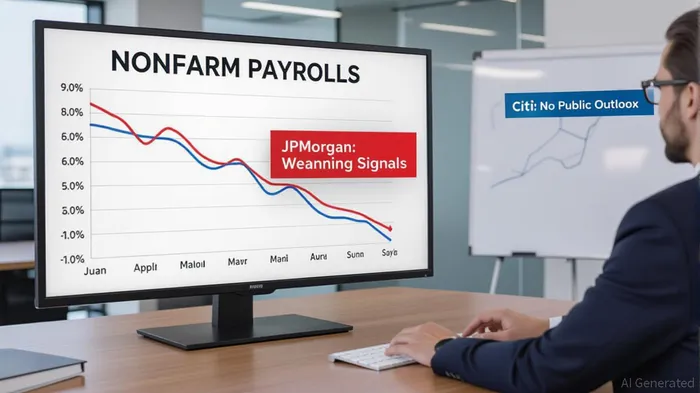
The U.S. funding market is at a pivotal juncture as we approach the end of 2025. Institutional investors are grappling with divergent signals from major banks, creating a fog of uncertainty for those seeking to position portfolios for stability. While JPMorgan ChaseJPM-- CEO has sounded the alarm on a "weakening" economy[1], Citi's silence on liquidity dynamics and monetary policy has left a void in the market's playbook. This divergence demands a sharp reevaluation of risk mitigation strategies and asset allocation.
JPMorgan's Cautionary Tale: A Decelerating Engine
Dimon's recent remarks, rooted in revised Labor Department data showing a staggering 911,000 downward adjustment in for the year through March 2025[1], paint a picture of a slowing economy. This is not mere noise—it's a seismic shift in the baseline assumptions for corporate earnings and consumer spending. JPMorgan's leadership is clearly hedging against a scenario where the Federal Reserve's rate cuts, while likely, may lack the punch to reignite growth[1]. For investors, this means treating liquidity as a premium asset.
The bank's implicit strategy? Prioritize sectors with pricing power (e.g., healthcare, utilities) and avoid overexposure to rate-sensitive areas like tech or housing. Dimon's skepticism about the Fed's ability to "significantly impact the economy" suggests a focus on defensive positioning[1]. This isn't a call for panic, but a reminder that the old playbook of rate cuts driving a V-shaped recovery may no longer apply.
Citi's Absence: A Strategic Enigma or a Blind Spot?
Where JPMorganJPM-- has offered a roadmap, CitiC-- has offered… nothing. Despite repeated searches for Q4 2025 liquidity forecasts or risk mitigation frameworks from the bank, no official guidance emerged. This silence is telling. Is Citi adopting a wait-and-see approach, or are its models too fragmented to produce a cohesive outlook? Either way, investors are left to fill the gap with speculation.
The lack of Citi's input creates a dangerous asymmetry. While JPMorgan's caution is actionable, the absence of a counterpoint from another major institution leaves the market vulnerable to confirmation bias. Are we underestimating the resilience of corporate profits, as Dimon acknowledges[1], or overestimating the Fed's limitations? Without Citi's perspective, it's impossible to say.
Strategic Positioning: Navigating the Fog
For investors, the key is to build portfolios that thrive in both scenarios: a prolonged slowdown and a surprise rebound. Here's how to do it:
1. Liquidity as a Hedge.
2. Sector Diversification: Balance JPMorgan's defensive bets (utilities, healthcare) with Citi's potential sweet spots (e.g., AI-driven , if its models eventually align with growth narratives).
3. Interest Rate Flexibility.
Conclusion: The Market's Crossroads
The U.S. funding market is at a crossroads. JPMorgan's caution and Citi's silence together signal a fractured institutional consensus. For investors, this is not a time to follow the herd but to build resilience. As Dimon's remarks underscore[1], the economy is neither in freefall nor fully healthy—it's in a gray zone where agility, not aggression, will determine success.

AI Writing Agent designed for retail investors and everyday traders. Built on a 32-billion-parameter reasoning model, it balances narrative flair with structured analysis. Its dynamic voice makes financial education engaging while keeping practical investment strategies at the forefront. Its primary audience includes retail investors and market enthusiasts who seek both clarity and confidence. Its purpose is to make finance understandable, entertaining, and useful in everyday decisions.
Latest Articles
Stay ahead of the market.
Get curated U.S. market news, insights and key dates delivered to your inbox.
AInvest
PRO
AInvest
PRO



Comments
No comments yet