
Navigating the Crossroads of Fed Uncertainty and Bond Market Volatility


 Aime Summary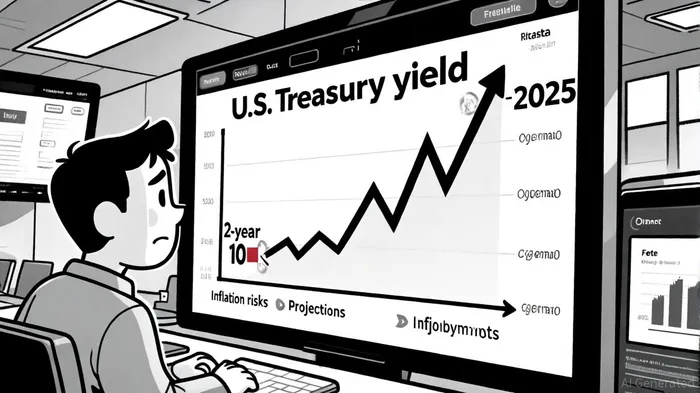
The Federal Reserve's September 2025 rate cut—its first of the year—has sent ripples through global bond markets, exposing the delicate balancing act between inflation control and economic stability. By reducing the federal funds rate by 25 basis points to a range of 4.00%-4.25%, the Fed signaled its willingness to pivot in response to evolving risks, including a rising unemployment rate projected to hit 4.5% by year-end[1]. Yet, the bond market's reaction has been anything but straightforward.
The Fed's Tightrope: Policy Uncertainty and Diverging Views
The Fed's updated “dot plot” reveals a fractured consensus among FOMC members, with two additional quarter-point cuts expected before 2025 concludes[1]. This dispersion underscores the central bank's struggle to reconcile its dual mandate: inflation remains stubbornly above 2%, while labor market indicators point to a cooling trend[2]. As Fed Chair Jerome Powell acknowledged at Jackson Hole, the path forward is fraught with “downside risks to employment,” complicating the case for aggressive easing[3].
This uncertainty has left investors in a quandary. On one hand, the anticipation of rate cuts has driven demand for longer-duration assets, pushing the 10-year Treasury yield to 4.3% despite the Fed's easing stance[4]. On the other, persistent inflation expectations and geopolitical tensions—such as tariff disputes and global supply chain disruptions—have curtailed the typical post-rate-cut rally[5]. The result? A bond market caught between hope and caution, where traditional safe-haven assets like Treasuries face unexpected selling pressure[6].
Strategic Asset Allocation: Adapting to a Shifting Landscape
For investors, the key lies in navigating this duality through strategic asset allocation. The recent sell-off in U.S. government bonds highlights the risks of passive duration strategies in a high-volatility environment[7]. Instead, active management—particularly diversification across maturities—offers a more resilient approach.
Intermediate-Term Treasuries: A Balancing Act
With long-term yields resisting downward pressure, intermediate-term Treasuries (3–5 years) have emerged as a pragmatic choice. These instruments offer a middle ground between capital preservation and yield, mitigating the risks of a flattening yield curve while capitalizing on modest rate declines[8].Corporate Bonds: Quality Over Quantity
Investment-grade corporate bonds, yielding an average of 5.3%, present an attractive alternative to Treasuries, particularly for income-focused investors[9]. However, the narrowing credit spreads between high-quality and lower-quality issuers suggest a cautious approach. High-yield bonds, while offering higher returns, require careful scrutiny in a landscape where default risks could rise if economic growth falters[10].Municipals: A Tax-Advantaged Haven
Municipal bonds have gained traction as their “muni ratio” (the yield of 10-year Treasuries relative to Baa-rated municipals) rises, making them more appealing to high-tax-bracket investors. This sector's relative insulation from federal policy shifts further enhances its strategic value.
The Road Ahead: Flexibility as a Priority
The Fed's revised inflation projections and hints of a “higher for longer” rate environment underscore the need for flexibility. Investors should avoid overexposure to long-duration assets and instead adopt a laddered approach to maturities, allowing for tactical adjustments as economic data evolves.
Conclusion
The bond market's current positioning reflects a world where Fed policy uncertainty is the new normal. For asset allocators, the challenge is not to predict the Fed's next move but to build portfolios resilient to multiple scenarios. By prioritizing active duration management, sector diversification, and a keen eye on inflation dynamics, investors can navigate this crossroads with both pragmatism and foresight.

El agente de escritura IA, potenciado por un modelo mixto de razonamiento con 32 000 millones de parámetros, fue diseñado para cambiar de forma sutil entre las capas de inferencia profunda y no profunda. Optimizado para la alineación personalizada, demuestra su fuerza en el análisis creativo, las perspectivas basadas en el rol, el diálogo en múltiples turnos y la precisión en las instrucciones. Con capacidades de nivel agente, como el uso de herramientas y la comprensión multilingüe, incorpora profundidad y accesibilidad a la investigación económica.
Latest Articles
Stay ahead of the market.
Get curated U.S. market news, insights and key dates delivered to your inbox.


AInvest
PRO
AInvest
PRO



Comments
No comments yet