
Navigating the Crossroads: U.S. Diplomacy, ASEAN Trade, and Investment Opportunities in Southeast Asia's Conflict-Averse Markets
 Aime Summary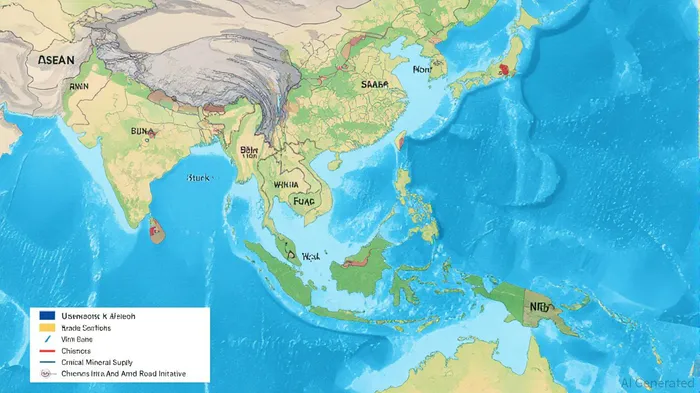
The U.S. diplomatic footprint in Southeast Asia has long been a balancing act between strategic ambition and economic pragmatism. However, recent policy shifts—marked by unilateral tariffs, inconsistent trade agreements, and a retreat from multilateral frameworks—have created a ripple effect across ASEAN trade dynamics. For investors, the question is no longer whether the U.S. will recalibrate its engagement with the region but how this recalibration reshapes opportunities in Southeast Asia's conflict-averse markets.
The Tariff Paradox: Uncertainty as a Catalyst for Diversification
The Trump administration's imposition of steep tariffs on ASEAN exports—49% on Cambodia, 48% on Laos, and 46% on Vietnam—has done more than disrupt supply chains. It has forced ASEAN nations to reevaluate their economic dependencies, accelerating a pivot toward China and other partners. While ASEAN has publicly avoided retaliatory measures, the U.S. has lost ground in the region. China's Belt and Road Initiative (BRI) now accounts for over 70% of infrastructure financing in Southeast Asia, with projects in Indonesia's port expansion and Vietnam's high-speed rail networks exemplifying this shift.
This “strategic multi-alignment” by ASEAN has created a paradox: while U.S. trade policies aim to counter Chinese influence, they inadvertently empower it. For investors, this underscores the importance of hedging against geopolitical volatility. Sectors like Southeast Asia's digital economy—projected to grow to $1 trillion by 2030—offer a buffer, as they are less susceptible to traditional trade wars and more aligned with global tech trends.
The ASEAN Advantage: Pragmatism Over Ideology
ASEAN's ability to leverage global fragmentation is its greatest strength. The region has become a manufacturing hub for companies relocating from China, with the Philippines and Vietnam emerging as key beneficiaries. This trend is reflected in the surge of IPOs for tech-driven firms in growth markets. By 2025, Southeast Asia hosted over 2,000 listed growth companies, with Indonesia's PEFINDO Market and Vietnam's Ho Chi Minh Stock Exchange (HOSE) leading the charge.
However, these markets remain underdeveloped. Liquidity constraints and weak institutional investor participation persist, as seen in Malaysia's 15.2% Q1 2025 drop in FDI inflows. The U.S. withdrawal from the Trans-Pacific Partnership (TPP) and the stalled Indo-Pacific Economic Partnership (IPEP) have further eroded confidence in American-led economic frameworks, leaving a vacuum China is eager to fill.
U.S. Policy Gaps and the Rise of Alternative Capital Sources
The U.S. has attempted to counter China's influence through initiatives like the Development Finance Corporation (DFC) and the Export-Import Bank, but these efforts lack the scale and consistency of BRI. For instance, the DFC's $1.5 billion investment in Indonesia's nickel supply chain pales against China's $12 billion in BRI-linked projects across the region. This gap has pushed ASEAN countries to diversify their capital sources, with private equity and venture capital (VC) funds now accounting for 60% of tech sector investments in Southeast Asia.
For investors, this means reassessing traditional “safe-haven” narratives. While U.S. tariffs have reduced FDI inflows to the Philippines (a 82% drop in Q1 2025), domestic consumption-driven growth and government stimulus packages have cushioned the blow. The Philippines' central bank cut interest rates to 5.5% in April 2025, signaling a pivot toward accommodative policies—a trend mirrored in Malaysia and Indonesia.
Strategic Investment Opportunities in Conflict-Averse Markets
- Growth Company Markets: Southeast Asia's growth equity markets, particularly in Vietnam and Indonesia, offer high-growth exposure to tech and industrial firms. However, investors must navigate low liquidity and limited analyst coverage.
- State-Owned Enterprise (SOE) Listings: Vietnam's SOEs, which account for 40% of the Ho Chi Minh Stock Exchange's market cap, provide stable, large-cap opportunities. Recent reforms in corporate governance have improved transparency, though political risks remain.
- Private Equity and VC: Singapore's Temasek and China's Temasek have become dominant players in Southeast Asia's VC ecosystem. For U.S. investors, partnerships with local funds may offer better alignment with regional dynamics.
- Infrastructure and Critical Minerals: The U.S. push for supply chain resilience (e.g., nickel in Indonesia, lithium in the Philippines) creates niche opportunities, but competition from Chinese state-backed firms is intense.
Conclusion: A New Equilibrium in ASEAN Trade
The U.S. remains a critical player in Southeast Asia, but its influence is increasingly contingent on policy consistency and strategic alignment with ASEAN's economic priorities. For investors, the path forward lies in diversification—balancing exposure to U.S.-aligned initiatives with opportunities in China's BRI-adjacent projects and ASEAN's own digital and manufacturing ecosystems.
In this evolving landscape, conflict-averse markets are not passive observers but active architects of their economic destinies. Those who navigate the U.S.-China-ASEAN triangle with nuance will find fertile ground for long-term, resilient returns.

Stay ahead of the market.
Get curated U.S. market news, insights and key dates delivered to your inbox.


AInvest
PRO
AInvest
PRO



Comments
No comments yet