
Navigating the Crossroads: How Demographics and Policy Reforms Reshape Retirement Strategies in 2025
 Aime Summary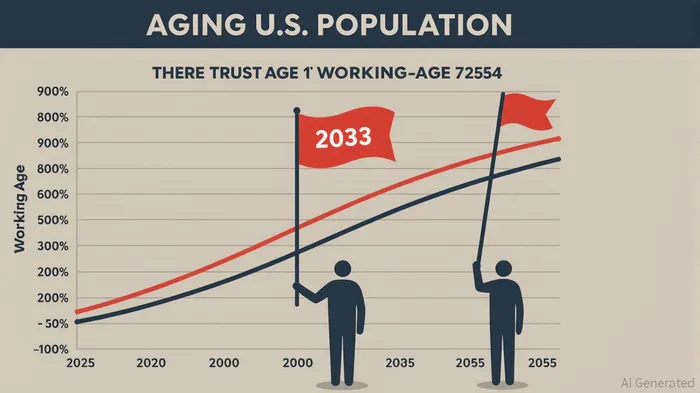
The U.S. retirement landscape in 2025 is a tightrope walk between demographic headwinds and policy uncertainty. With the Social Security trust fund projected to be depleted by 2033, retirees and investors must act decisively to safeguard their futures. The aging of the population, declining fertility rates, and shifting policy reforms are forcing a reevaluation of retirement strategies, asset allocation, and long-term fiscal planning. Let's break it down.
The Demographic Tsunami: A Shrinking Workforce, a Growing Burden
The Congressional Budget Office (CBO) paints a stark picture: by 2055, the U.S. will have just 2.2 workers for every retiree, down from 2.8 in 2025. This declining worker-to-retiree ratio means fewer contributors are funding a larger number of beneficiaries. Meanwhile, life expectancy has risen from 78.9 to 82.3 years by 2055, extending the payout period for benefits.
The fertility rate, stuck below the 2.1 replacement level at 1.6 births per woman, compounds the problem. Without immigration, the U.S. population would shrink by 2033. Even with immigration, the working-age population (25–54) grows at a glacial 0.2% annually. This demographic shift isn't just a numbers game—it's a fiscal crisis in the making.
Policy Reforms: A Delicate Balancing Act
The 2025 Social Security Trustees Report underscores a 75-year deficit of 3.82% of taxable payroll. To close this gap, the report suggests either a 3.82 percentage point increase in payroll taxes (1.91 points from employees and employers) or a 22.4% reduction in benefits. The Social Security Fairness Act, which boosted benefits for certain state and local workers, worsened the deficit by 0.16%.
Policymakers face a tough choice: raise taxes, cut benefits, or do both. For example, delaying the normal retirement age from 67 to 70 could reduce the deficit by 1.8%. Alternatively, increasing the payroll tax cap—which currently excludes income above $160,200—could add $2.5 trillion over a decade. These reforms are inevitable, but their timing and implementation will shape retirement outcomes for millions.
Retirement Strategies: The Bridge to 70 and Beyond
With the depletion date looming, retirees must rethink their timelines. Delaying Social Security benefits from age 62 to 70 boosts monthly payments by 77%, according to the Bipartisan Policy Center. For a $2,000 benefit at 67, this means $1,400 at 62 and $2,480 at 70. However, this “bridge strategy” requires a cash runway. Retirees must fund the gap between claiming early and waiting, often through part-time work, annuities, or portfolio withdrawals.
The S&P 500's performance in 2025—up 12% year-to-date—offers a silver lining for those with equity exposure. But retirees must balance growth with risk. A 60/40 portfolio (60% stocks, 40% bonds) may no longer suffice in a low-yield environment. Instead, a “tilted ladder” approach—mixing short-term Treasuries, high-quality corporate bonds, and dividend-paying equities—can provide both growth and stability.
Asset Allocation: Diversify, Hedge, and Lock In
The 2025 asset allocation playbook includes:
1. Annuities as a Core Component: Only 12% of retirees use annuities, despite their ability to mitigate longevity risk. Fixed index annuities, which offer downside protection and participation in market gains, are gaining traction.
2. Geographic Diversification: U.S. investors are increasingly eyeing non-U.S. equities, particularly in China (tech sector) and Europe (consumer cyclical stocks). J.P. Morgan's 2025 Global Asset Allocation favors Italian BTPs and UK Gilts over U.S. Treasuries for yield.
3. Short-Dated Bonds: With long-term rates uncertain, retirees are shifting to 1–3 year bonds to avoid interest rate volatility.
4. Dynamic Withdrawal Strategies: Instead of rigid 4% rules, retirees are adopting “guardrail” systems that adjust withdrawals based on portfolio performance.
Actionable Advice for 2025
- Delay Social Security: If you can afford to wait, do it. Every year until 70 adds 8% to your benefit.
- Annuitize a Portion of Your Portfolio: Allocate 20–30% of savings to annuities for guaranteed income.
- Rebalance Aggressively: Shift from a growth-focused portfolio to a “safety-first” approach. Prioritize high-quality bonds and dividend stocks.
- Engage a Fiduciary Advisor: A fee-only advisor can help navigate policy risks and optimize your tax-deferred accounts.
The 2025 retirement environment is fraught with uncertainty, but it's also an opportunity to innovate. By embracing annuities, diversifying globally, and staying ahead of policy shifts, retirees can build resilient portfolios that outlast the fiscal challenges of the coming decades. The clock is ticking, but the tools to succeed are within reach.

Delivering real-time insights and analysis on emerging financial trends and market movements.
Latest Articles
Stay ahead of the market.
Get curated U.S. market news, insights and key dates delivered to your inbox.


AInvest
PRO
AInvest
PRO



Comments
No comments yet