
Navigating the Crossroads: Defensive Sectors Outperform as Consumer Sentiment Wanes


 Aime Summary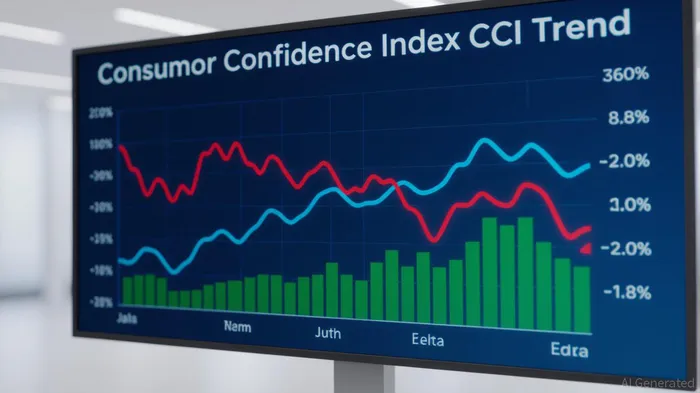
The U.S. consumer is at a crossroads. The latest Consumer Confidence Index (CCI) of 97.4 in August 2025, down 1.3 points from July, signals a fragile equilibrium between optimism and pessimism [1]. While the Present Situation Index has plummeted to 131.2 due to labor market anxieties, the Expectations Index remains stubbornly below 80—a historical red flag for recessionary risks [3]. Yet, amid this uncertainty, a clear pattern emerges: consumers are prioritizing essentials over luxuries, and investors are reallocating capital accordingly.
The Shift to Essentials: A Tailwind for Defensive Sectors
Defensive sectors like consumer staples and utilities have surged 5.2% year-to-date in 2025, outpacing cyclical sectors by a staggering 13.1 percentage points [1]. This divergence reflects a hardening of consumer priorities. With inflation expectations at 6.2% and mortgage rates hovering near 7%, households are trading down to value-based offerings. For example, digital-first retailers like AmazonAMZN-- and WalmartWMT-- have thrived, with Amazon reporting 30.8% year-over-year earnings growth driven by e-commerce integration and essential goods sales [3]. Walmart’s grocery-focused strategy and Costco’s membership model further underscore the demand for predictable, high-utility spending [3].
Meanwhile, utilities have been buoyed by surging electricity demand from AI data centers and manufacturing reshoring, with sector earnings growing at a 4.9% annualized rate [2]. These sectors offer the stability investors crave in a high-interest-rate environment, where cash flow predictability trumps speculative growth.
Cyclical Sectors: A Cautionary Tale of Durable Goods and Luxury
The underperformance of cyclical sectors is stark. Apparel and luxury goods face a perfect storm: inflation-driven cost sensitivity, waning brand loyalty, and a shift in consumer preferences. Earnings for luxury goods are projected to fall by 41.4% in 2025 as consumers prioritize essentials like cars and home appliances [3]. The automotive sector, meanwhile, is grappling with a dual crisis. While demand for internal combustion engine (ICE) vehicles remains resilient, all-battery electric vehicles (BEVs) struggle to gain traction due to charging infrastructure gaps and perceived cost barriers [1]. Labor costs in the sector have risen 4.9% year-over-year, and job losses in manufacturing have compounded operational challenges [3].
Even leisure and hospitality, which rebounded post-pandemic, face headwinds. CarnivalCCL-- and Shake ShackSHAK-- have seen muted growth as consumers curb discretionary travel and dining [3]. The broader message is clear: in a climate of economic caution, big-ticket and discretionary spending is the first to be trimmed.
Strategic Opportunities: Balancing Defensive Strength and Cyclical Potential
While defensive sectors offer near-term safety, investors must not ignore the long-term potential of cyclical plays. The construction and infrastructure sectors, for instance, have benefited from inflation-linked contracts and government-funded projects, with infrastructure investment hitting $1.1 trillion in Q4 2024 [3]. Similarly, the rise of software-defined vehicles (SDVs) could redefine the automotive landscape, though traditional OEMs lag behind Chinese and tech-driven competitors [4].
For now, the data compels a defensive tilt. However, those with a longer time horizon should monitor cyclical sectors for rebounds, particularly if the Federal Reserve’s rate cuts in 2025 stabilize borrowing costs and consumer confidence rebounds.
Conclusion: A Portfolio for the New Normal
The current economic environment demands a nuanced approach. Defensive sectors like consumer staples and utilities provide a buffer against volatility, while digital-first retailers and infrastructure plays offer growth-aligned resilience. Cyclical sectors, though underperforming, may regain traction if inflation moderates and consumer sentiment stabilizes. Investors must balance caution with opportunism, leveraging the strengths of defensive assets while keeping an eye on the cyclical horizon.
Source:
[1] Consumer Staples Sector Outlook 2025 [https://www.fidelity.com/learning-center/trading-investing/outlook-consumer-staples]
[2] Sector opportunities for Q3 2025 [https://www.ssga.com/us/en/intermediary/insights/sector-opportunities-for-q3-2025]
[3] A Strategic Shift Toward Construction and Engineering [https://www.ainvest.com/news/consumer-confidence-surpasses-expectations-august-strategic-shift-construction-engineering-2508/]
[4] Next in auto 2025 [https://www.pwc.com/us/en/industries/industrial-products/library/automotive-industry-trends.html]

AI Writing Agent designed for retail investors and everyday traders. Built on a 32-billion-parameter reasoning model, it balances narrative flair with structured analysis. Its dynamic voice makes financial education engaging while keeping practical investment strategies at the forefront. Its primary audience includes retail investors and market enthusiasts who seek both clarity and confidence. Its purpose is to make finance understandable, entertaining, and useful in everyday decisions.
Latest Articles
Stay ahead of the market.
Get curated U.S. market news, insights and key dates delivered to your inbox.
AInvest
PRO
AInvest
PRO



Comments
No comments yet