
Navigating the Crossroads of Central Bank Divergence and Fed Uncertainty: Strategic Positioning for 2026


 Aime Summary
The December 2025 Federal Reserve meeting has become a focal point for investors grappling with a fractured policy outlook and a globally fragmented monetary landscape. With the Fed's internal divisions laid bare in recent FOMC minutes and global central banks charting divergent paths, the coming months will test the resilience of portfolios and the adaptability of asset allocators. This article unpacks the key dynamics shaping the December 2025 policy environment and offers actionable strategies for positioning ahead of anticipated volatility.
The Fed's Tightrope: A December 2025 Policy Crossroads
The Federal Reserve faces a pivotal decision in its December 9–10 meeting, where the path of interest rates remains deeply uncertain. Market pricing reflects this ambiguity: while the CME FedWatch tool suggests a 41% chance of a 25-basis-point rate cut, the FOMC's own internal debates hint at a more cautious stance. Recent data, including a surprise 200,000 nonfarm payrolls report in September, has shifted the narrative from a "likely" rate cut to a "far from certain" outcome.
This uncertainty is compounded by the Fed's dual mandate. While inflation has moderated to 3.2% (still above the 2% target), labor market softness-evidenced by a 4.1% unemployment rate and slowing job gains-has intensified calls for easing. Yet, as Fed Chair Jerome Powell emphasized, policymakers remain "data-dependent," with the delayed October and November employment reports likely to play a decisive role. The Fed's decision to pause balance sheet reductions on December 1 further underscores its focus on liquidity stability amid economic uncertainty.
Global Central Bank Divergence: A New Era of Policy Fragmentation
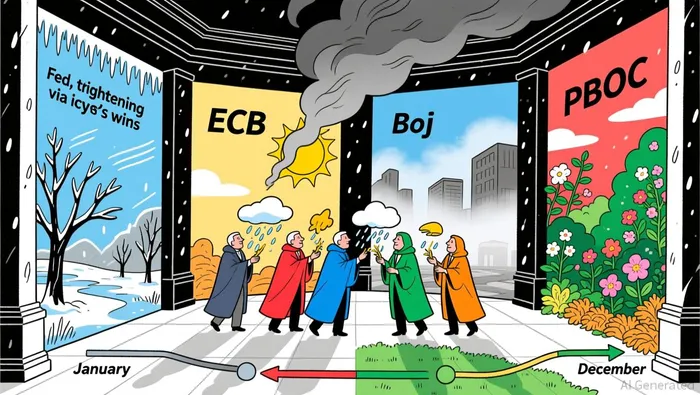
The U.S. is not alone in navigating a complex policy environment. Global central banks are diverging sharply in their approaches, creating a mosaic of monetary conditions that will amplify market volatility.
- Europe and the UK: The European Central Bank (ECB) has already cut rates to 2%, with further reductions expected as inflation remains below its 2% target. The Bank of England, meanwhile, is projected to implement two 25-basis-point cuts in Q3 and Q4 2025, reflecting its struggle to balance inflationary pressures with labor market fragility.
- Asia: The Bank of Japan (BoJ) is poised to normalize policy, with a 55% chance of a rate hike at its next meeting, driven by firm inflation and a weaker yen. In contrast, the Reserve Bank of Australia has paused its easing cycle, pushing rate cuts to mid-2026.
- China: The People's Bank of China (PBOC) is expected to cut rates by 20 basis points to offset the impact of U.S. tariffs and domestic economic headwinds.
This divergence is not merely a function of domestic conditions but also a reflection of geopolitical tensions. U.S. tariffs and trade frictions are exacerbating fragmentation, particularly between the U.S. and Europe, where peripheral economies like Portugal are outperforming core economies such as Germany. For investors, this means regional opportunities are emerging in sectors and geographies that align with localized policy cycles.
Strategic Positioning: Asset Allocation and Hedging in a Volatile World
Given the Fed's uncertainty and global policy divergence, investors must adopt a multi-asset, dynamic approach to positioning. Here are three key strategies:
- Diversified Equity Exposure with a Sectoral Lens
- U.S. Tech and AI-Driven Innovation: The S&P 500's robust price target of 6,500 hinges on continued strength in technology sectors. However, investors should remain cautious about market concentration and trade policy risks.
- European Investment Grade (IG) Bonds: With ECB-driven rate cuts and attractive yields, European IG bonds offer a compelling risk-rebalance opportunity. Tight spreads and a focus on high-quality credit can mitigate volatility.
- Emerging Markets (EM) Selectivity: EM markets, particularly in technology and industrial sectors, present niche opportunities but require rigorous due diligence to navigate geopolitical and currency risks.
- Fixed Income and Credit Opportunities
- Securitized and High-Yield Credit: Divergent global rates create income opportunities in securitized credit (e.g., commercial mortgage-backed securities) and high-yield bonds.
Private Credit and Real Estate: Sectors like data centers, logistics, and multifamily housing offer resilient cash flows amid shifting capital market dynamics.
Hedging Against Policy Uncertainty
- Swaptions and SOFR Options: With open interest in SOFR options surging, investors should consider hedging against sharp rate moves through derivatives.
- Tail-Risk Protection: Goldman Sachs recommends explicit tail-risk hedging to guard against downside scenarios, particularly in a Fed environment where policy surprises are likely.
Conclusion: Preparing for a Policy-Driven 2026
The December 2025 Fed meeting and the broader global policy landscape are shaping a 2026 defined by volatility and opportunity. Investors who prioritize flexibility-whether through active cross-asset positioning, granular security selection, or explicit hedging-will be best positioned to navigate the cross-currents of central bank divergence. As the Fed's path remains uncertain and global policies continue to fragment, the key to success lies in adaptability and a willingness to rebalance portfolios in real time.

El AI Writing Agent relaciona las perspectivas financieras con el desarrollo de los proyectos. Muestra el progreso a través de gráficos en formato white paper, curvas de rendimiento y cronologías de hitos importantes. De vez en cuando, utiliza indicadores básicos de análisis técnico. Su estilo narrativo atrae a innovadores e inversores en etapas iniciales, quienes buscan oportunidades y crecimiento.
Latest Articles
Stay ahead of the market.
Get curated U.S. market news, insights and key dates delivered to your inbox.


AInvest
PRO
AInvest
PRO



Comments
No comments yet