
Navigating the Crossroads: Automotive Supply Chain Opportunities in the India-US Trade Talks
The India-US trade negotiations, now in their final stretch before the August 1 deadline, are shaping up to be a pivotal moment for global automotive supply chains. With unresolved tensions over tariffs and market access, the outcome could redefine cost structures, manufacturing footprints, and cross-border partnerships in the sector. For investors, this is more than a geopolitical stalemate—it's a high-stakes opportunity to position for a reshaped automotive landscape.
The Stakes of the Tariff Tango
The automotive sector remains a key battleground in these talks. The U.S. seeks deeper market access for its vehicles and components, while India demands concessions on labor-intensive goods like textiles and footwear. The looming threat of 26% tariffs on Indian exports to the U.S. (and retaliatory measures from India) has created urgency. A failure to reach an agreement by August could trigger a cycle of retaliatory tariffs, raising costs for manufacturers and consumers alike.
But a resolution—however interim—could unlock significant efficiencies. For automakers, reduced tariff barriers would lower the cost of sourcing parts and finished vehicles across borders. This is critical in an era where supply chains are already strained by geopolitical fragmentation and rising input costs.
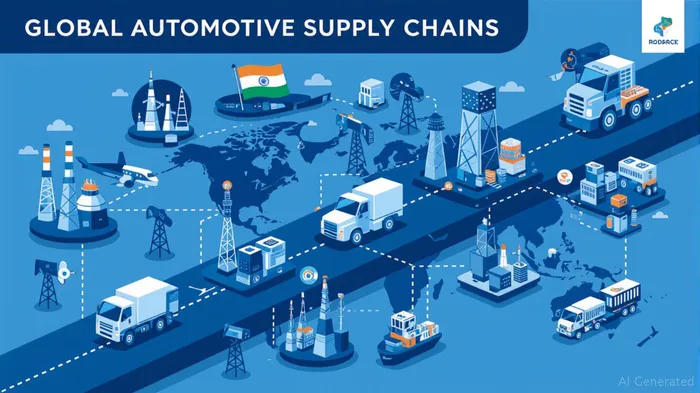
The Supply Chain Playbook: Three Strategic Opportunities
- Market Access Expansion
A deal could open India's growing automotive market to U.S. manufacturers, particularly in high-margin segments like electric vehicles (EVs). Conversely, Indian automakers like Tata Motors and Mahindra could gain a foothold in the U.S., leveraging their cost advantages in compact vehicles and commercial trucks.
Investors should watch for partnerships between U.S. and Indian firms, such as collaborations on EV battery production or joint ventures for shared manufacturing platforms.
Cost Optimization Through Cross-Border Sourcing
With tariffs removed or reduced, automakers could optimize their supplier networks. For example, U.S. firms might source cost-effective steel or components from India, while Indian manufacturers could import advanced technologies (e.g., autonomous driving systems) from the U.S. at lower costs. This could narrow the price gap between domestic and imported vehicles, driving sales and profitability.Global Supply Chain Resilience
A resolution would reduce reliance on single regions, making supply chains more agile. Automakers could diversify production hubs—India's lower labor costs and the U.S.'s advanced tech infrastructure make them complementary partners. This resilience is increasingly valuable as companies seek to avoid disruptions like the semiconductor shortages of 2022.
Risks and Realities: Navigating the Uncertainty
Even if a deal is struck, investors must consider execution risks. India's exclusion of sensitive sectors (e.g., dairy) from market access offers could strain negotiations, while U.S. demands for stronger intellectual property protections might linger. A “partial” agreement—focusing on goods while deferring services—remains a possibility.
Moreover, geopolitical tensions, particularly around China's dominance in EV batteries, could influence the talks. Both nations might prioritize decoupling from China's supply chains, creating further opportunities for Indo-U.S. collaboration in critical minerals and battery tech.
Investment Strategy: Play Both Sides of the Table
Investors should adopt a dual approach:
- Long-Term Plays:
- U.S. Automakers with Global Ambitions: Companies like Ford (F) and RivianRIVN-- (RIVN), which are expanding EV production, could benefit from lower-cost Indian components.
- Indian Auto Exports: Firms like Bajaj Auto (BAJAJ-AUTO) and Ashok Leyland (ASHOKLEY), which target emerging markets, could see demand rise if their U.S. exports become tariff-free.
- Supply Chain Enablers:
- Logistics and Parts Suppliers: Companies like Flex (FLEX) or ZF Friedrichshafen (a supplier to both U.S. and Indian automakers) stand to gain from increased cross-border activity.
Battery Tech Firms: Players like U.S.-based QuantumScapeQS-- (QS) or India's Amara Raja Batteries (AMARAJA) could see partnerships accelerate if EV collaboration becomes a priority.
Hedge Against Deadlock:
If talks collapse, consider shorting automakers exposed to tariff-sensitive markets (e.g., Harley-DavidsonHOG-- (HOG), which relies on Indian exports) or investing in industries insulated from trade wars, such as cloud infrastructure or renewable energy.
Final Take: The Tariff Resolution is a Catalyst, Not a Cure-All
While a deal would remove immediate tariff barriers, the automotive sector's long-term health depends on broader factors: EV adoption rates, regulatory alignment, and capital allocation. Investors should prioritize companies with scalable business models, geographic diversification, and partnerships that transcend trade agreements.
The clock is ticking, but the opportunities are clear. For those willing to act decisively, the India-US trade talks could be the starting gun for a new era in automotive supply chain innovation—and alpha generation.
Investment advice: Monitor tariff resolution progress closely. Position for winners in cross-border manufacturing and EV tech, but maintain flexibility to pivot if talks falter.

Stay ahead of the market.
Get curated U.S. market news, insights and key dates delivered to your inbox.
AInvest
PRO
AInvest
PRO



Comments
No comments yet