
Navigating the Crossfire: ASML's Geopolitical Risks and Strategic Opportunities in a Tariff-Tense World
 Aime Summary
The U.S.-EU tariff standoff, delayed until August 2025 but still looming, has thrust ASML—a Dutch semiconductor equipment giant—at the heart of a geopolitical storm. With proposed tariffs of up to 50% on EU imports, including ASML's critical lithography tools, the company faces a precarious balancing act: maintaining supply chain resilience while navigating the shifting sands of transatlantic trade policy. For investors, this volatility creates both risks and opportunities, particularly as 2026 growth forecasts hinge on how these tensions resolve.
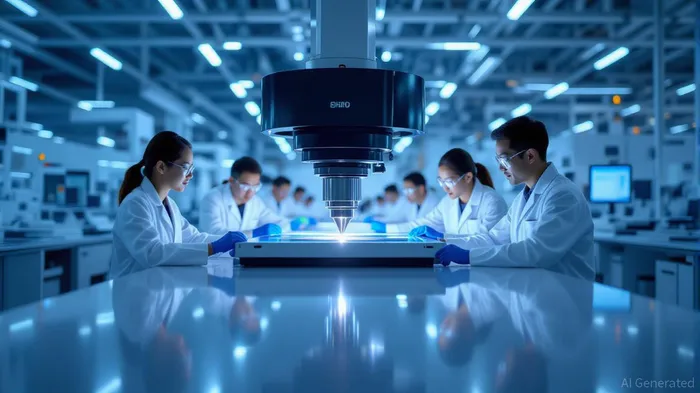
Supply Chain Crossroads: Tariffs as a Double-Edged Sword
ASML's business model relies on a global supply chain, with components sourced from the U.S., Japan, and Europe. The proposed tariffs threaten to disrupt this intricate web. For instance, U.S. tariffs on EU-made equipment could force ASML's customers—chipmakers like IntelINTC-- or Samsung—to absorb higher costs or seek alternatives. Conversely, EU retaliatory measures could impede ASML's access to U.S. markets, where it holds a 28% revenue share.
However, ASML's position as an irreplaceable supplier of extreme ultraviolet (EUV) lithography tools—a cornerstone of advanced chip manufacturing—may grant it strategic immunity. shows its resilience despite tariff fears, as investors bet on its “national security” status. The U.S. and EU are unlikely to cripple a company pivotal to both sides' tech sovereignty.
Geopolitical Leverage: When Technology Becomes a Weapon
The U.S. and EU are engaged in a high-stakes game of strategic interdependence. While Washington seeks to curb China's semiconductor ambitions through export controls, it also relies on ASML's EUV technology to maintain its edge in advanced chip design. Similarly, the EU's RePowerEU plan and green tech initiatives depend on ASML's tools for silicon wafer production.
This interdependence creates leverage for ASML. Unlike other EU exporters, its role in defense and AI infrastructure (e.g., U.S. data centers) may secure exemptions or softer tariff terms. In contrast, industries like automotive—where BMW and StellantisSTLA-- are reshoring production—are more exposed. ASML's ability to lobby as a “critical supplier” could mitigate the worst-case scenario.
2026 Growth Forecasts: Betting on Certainty Amid Uncertainty
Analysts project ASML's revenue to grow 12% in 2026, assuming tariffs are avoided or diluted. However, a full 50% tariff implementation could slash that to 6%, as customers delay orders and seek alternatives like older DUV technology.
Yet, ASML's long lead times (3–5 years for EUV systems) mean orders placed in 2025 will still ship in 2026, shielding near-term results. The bigger risk lies beyond 2026: prolonged tariffs could accelerate a “decoupling” of global chip supply chains, forcing ASML to localize production in both regions. This would increase capital expenditure but also deepen its moat against competitors.
Valuation Asymmetry: A Contrarian's Playbook
ASML's current valuation reflects tariff fears, trading at 22x 2026E earnings—a 20% discount to its five-year average. This creates a compelling entry point for contrarians.
- Risk Factors to Monitor:
- Tariff Resolution: If exemptions are granted by August 2025, ASML could rebound sharply.
China's Response: Beijing's push to build domestic EUV capacity (e.g., Shanghai Microelectronics) remains years behind ASML, but U.S. export bans on ASML shipments to China could limit its growth there.
Investment Thesis:
Buy ASML now if you believe geopolitical pragmatism prevails—i.e., tariffs are diluted to preserve tech alliances. Avoid if you expect a full-scale trade war that forces chipmakers to abandon EU suppliers entirely.
Conclusion: Positioning for the Post-Tariff Era
The U.S.-EU tariff dispute is a catalyst for reshaping global semiconductor dynamics, but ASML's role as an indispensable partner to both sides ensures its long-term survival. For investors, the next 60 days will reveal whether tariffs become a speed bump or a roadblock. With a 40% dividend yield on cost over the past decade and a backlog of $25 billion in orders, ASML offers a rare blend of defensive income and upside potential. For contrarians, now may be the moment to bet on the company's resilience—and the world's inability to do without its technology.

Stay ahead of the market.
Get curated U.S. market news, insights and key dates delivered to your inbox.
AInvest
PRO
AInvest
PRO



Comments
No comments yet