
Navigating Crosscurrents: Sector Rotation Strategies in a Cooling Inflation Landscape
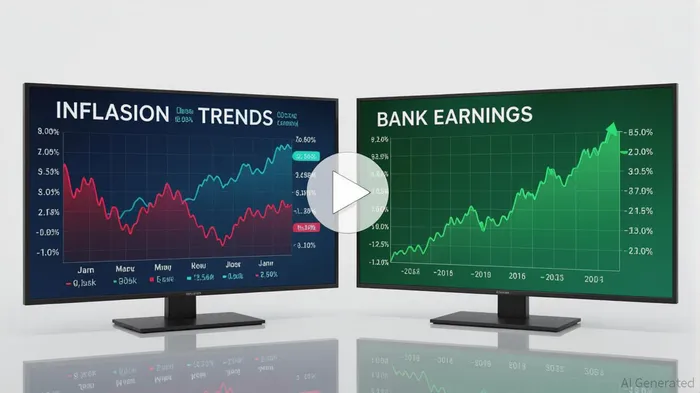
The U.S. equity market is at an inflection pointIPCX--. Recent data shows inflation easing to a 2.4% annual rate in May 2025, only to rebound to 2.7% in June, while banking sector earnings reveal a paradox of resilience amid macroeconomic uncertainty. For investors, this creates a strategic crossroads: how to capitalize on sector divergence as inflationary pressures wane unevenly and financials defy expectations. The answer lies in tactical sector rotation, focusing on undervalued inflation hedges and growth-oriented financials that can thrive in this liminal environment.
Inflation: A Delicate Balancing Act
The June CPI report, which rose to 2.7% year-over-year, underscores a critical nuance: inflation is cooling but not collapsing. Core inflation (excluding food and energy) hit 2.9%, driven by stubborn shelter costs (+3.8% annually) and healthcare (+2.8%). Meanwhile, energy prices declined 0.8% annually, with gasoline prices falling 8.3%. This mixed picture complicates the Fed's path: further rate hikes are unlikely, but aggressive easing remains distant.
Investors should focus on sectors that benefit from this Goldilocks scenario—stable but not scorching inflation. Utilities and real estate investment trusts (REITs), traditionally defensive plays, now offer compelling valuations. Utilities (e.g., NextEra EnergyNEE--, Duke Energy) boast stable cash flows and low volatility, while REITs (e.g., Simon Property GroupSPG--, Prologis) are directly tied to shelter costs, a key CPI component.
Banking Sector: A Beacon of Resilience
Despite macroeconomic headwinds, U.S. banks delivered robust Q2 2025 earnings. JPMorganJPM--, CitigroupC--, and Wells FargoWFC-- exceeded expectations, with net interest income (NII) growth remaining a standout theme. Bank of America's 7% NII rise to $14.82 billion, despite a modest revenue miss, highlights the sector's underlying strength.
The banking sector's performance defies broader economic softness, driven by:
1. Stable consumer spending: Credit metrics remain healthy, with delinquency rates near historic lows.
2. Deposit growth: Banks are capitalizing on sticky savings and corporate liquidity.
3. Trading revenue surprises: Fixed income and equities divisions outperformed, signaling liquidity-driven opportunities.
Investors should favor banks with diversified revenue streams (e.g., JPMorgan's asset management division) and strong capital ratios (CET1 above 11%). Avoid institutions overly reliant on volatile trading businesses.
Sector Rotation: Playing Defense and Offense
The divergence in sector performance creates two clear opportunities:
1. Inflation-Hedge Plays: Utilities and REITs
Utilities are undervalued relative to their stable earnings profile. With the 10-year Treasury yield at 3.8%, utilities' dividend yields (around 3.5%) offer a compelling risk-adjusted trade-off. Meanwhile, REITs benefit from rising rental demand and shelter inflation pass-through.
- Utilities: Target regulated utilities like NextEra Energy (NEE) or Dominion EnergyD-- (D), which benefit from infrastructure spending and rate hikes.
- REITs: Focus on industrial (e.g., Prologis) and residential (e.g., AvalonBay) REITs, which align with shelter cost trends.
2. Financials: Selective Exposure to Growth
While the banking sector is resilient, differentiation is key. Prioritize banks with:
- Diversified revenue: JPMorgan (JPM), Goldman SachsGS-- (GS), and Wells Fargo (WFC) have balanced commercial and consumer portfolios.
- Strong NII momentum: Regions FinancialRF-- (RF) and Truist FinancialTFC-- (TFC) are outperforming in regional banking.
Avoid banks overly exposed to cyclical sectors like energy or consumer discretionary, which may suffer if economic softness deepens.
Historical Patterns and Risk Factors
Historically, sector rotation thrives during inflation transitions. In the 1990s and 2000s, utilities and REITs outperformed by 20–30% annually during the final 12–18 months of disinflation. Today's environment mirrors this setup, though risks remain:
- Trade policy uncertainty: Tariffs could reignite inflationary pressures in late 2025, favoring defensive plays.
- Labor market cooling: A weakening job market may pressure consumer discretionary stocks but benefit utilities.
Investment Thesis
Allocate 30–40% of equity exposure to inflation hedges (utilities/REITs) and 20–30% to select financials. Pair these with a 10–15% allocation to rate-sensitive sectors like healthcare (e.g., UnitedHealth Group) and consumer staples (e.g., Procter & Gamble). Avoid overexposure to cyclical sectors until macro clarity emerges.
The Fed's pause on rates, coupled with sector divergence, creates a landscape where patience and sector focus are rewarded. By rotating into undervalued inflation hedges and resilient financials, investors can navigate these crosscurrents and position portfolios for the next phase of the cycle.
Final Note: Monitor the August CPI report and Q3 earnings for confirmation of these trends. Stay agile.

Stay ahead of the market.
Get curated U.S. market news, insights and key dates delivered to your inbox.
AInvest
PRO
AInvest
PRO



Comments
No comments yet