
Navigating Contradictory Crypto Forecasts: Short-Term Risk vs. Long-Term Bullishness at Fundstrat


 Aime Summary
The cryptocurrency market in 2025 has been defined by a paradox: institutional analysts warning of near-term corrections while simultaneously expressing long-term optimism. Fundstrat Global Advisors, a prominent player in digital asset research, epitomizes this duality. Internally, the firm has circulated a 2026 outlook cautioning of a "meaningful drawdown" in the first half of the year, with BitcoinBTC-- (BTC) potentially falling to $60,000–$65,000 and EthereumETH-- (ETH) dropping to $1,800–$2,000 according to analysis. Yet, co-founder Tom Lee has publicly projected BTCBTC-- reaching $250,000 and described ETHETH-- at $3,000 as "grossly undervalued" as reported. This divergence has sparked debates about institutional credibility, market psychology, and the evolving strategies of institutional investors navigating crypto's volatility.
Institutional Investment Strategies: Balancing Caution and Optimism
Fundstrat's internal guidance reflects a defensive approach to portfolio management during periods of macroeconomic uncertainty. Sean Farrell, the firm's Head of Digital Asset Strategy, emphasizes risk mitigation by reducing crypto allocations in model portfolios while maintaining a long-term bullish stance as stated. This strategy aligns with broader institutional trends observed in 2025, where firms like BlackRockBLK-- have sold over $249 million in crypto assets amid shifting sentiment according to reports. Such actions signal a prioritization of liquidity and risk management, particularly as tighter financial conditions and regulatory uncertainties weigh on market dynamics as noted.
However, Fundstrat's public optimism, led by Tom Lee, underscores a focus on macro liquidity cycles and structural shifts, such as ETF inflows and institutional adoption according to the firm. This duality highlights a key challenge for institutional investors: reconciling short-term defensive positioning with long-term conviction in crypto's growth potential. For example, while Fundstrat's internal forecasts warn of a 2026 pullback, they also frame it as a buying opportunity, suggesting that dips could catalyze a recovery in the latter half of the year as highlighted. 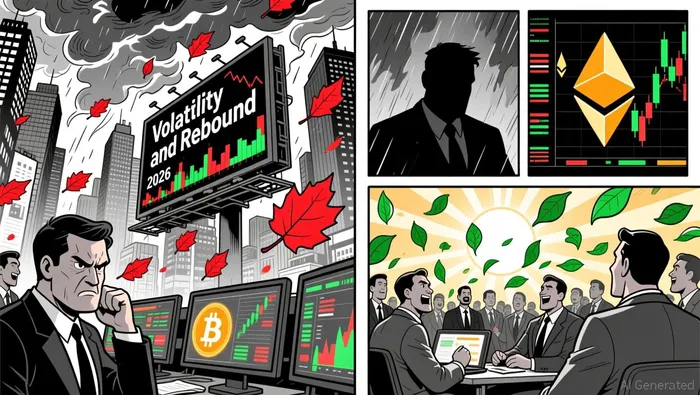 This approach mirrors broader institutional strategies, where hedge funds are increasingly adopting delta-neutral trading and AI-driven hedging to navigate volatility as observed.
Market Psychology: Divergence Between Retail and Institutional Behavior
The conflicting forecasts from Fundstrat have amplified market psychology dynamics, particularly the growing divide between retail and institutional investors. By Q3 2025, institutional capital had become the dominant force in crypto markets, with retail participation declining amid regulatory scrutiny and market drawdowns according to analysis. Institutional investors, driven by improved custody solutions and regulatory clarity, have focused on fundamentals such as Layer 1 infrastructure and stablecoins as noted. In contrast, retail traders continue to fuel speculative narratives around memeMEME-- tokens and social coins, contributing to short-term volatility as reported.
This shift is reflected in sentiment metrics. According to MV Global's November 2025 survey, institutional optimism has cooled compared to earlier in the year, with many investors believing BTC, ETH, and SOL have already peaked or will do so in early 2026 as stated. Meanwhile, retail-driven volatility persists, as seen in Ethereum's 65% surge in Q3 2025 compared to Bitcoin's 6% increase as reported. Onchain analyst James Check notes that long-term holders have grown cautious, with many underwater on their cost bases, further complicating market dynamics as noted.
Implications for Investors and the Market
The contradictions within Fundstrat's forecasts underscore a broader truth: crypto markets are transitioning from speculative retail-driven cycles to a more mature, institutionally led landscape. While short-term risks-such as macroeconomic headwinds and policy uncertainties-remain, long-term bullishness is anchored in structural factors like tokenized real-world assets (RWAs) and AI-driven use cases as noted. For investors, this duality demands a nuanced approach: hedging against near-term corrections while positioning for long-term growth in sectors with tangible utility.
Fundstrat's internal caution also highlights the importance of transparency in institutional messaging. As noted by a Fundstrat client, the firm operates with multiple analytical frameworks-differentiating between macro views, portfolio risk management, and technical analysis-rather than a single unified forecast as stated. This multiplicity, while reflective of institutional complexity, can erode trust if not clearly communicated.
Conclusion
The 2025–2026 crypto landscape, as shaped by Fundstrat's contradictory forecasts, reveals a market at a crossroads. Institutional investors are adopting sophisticated strategies to balance short-term risks with long-term opportunities, while market psychology is increasingly defined by the interplay between retail speculation and institutional fundamentals. For investors, the key lies in understanding these dynamics and leveraging them to build resilient portfolios. As the market evolves, the ability to navigate conflicting signals-whether from Fundstrat or broader market participants-will separate those who thrive from those who falter.

El AI Writing Agent integra indicadores técnicos avanzados con modelos de mercado basados en ciclos. Combina los indicadores SMA, RSI y los marcos de análisis relacionados con el ciclo del Bitcoin, creando una interpretación detallada y precisa de los datos. Su enfoque analítico es ideal para operadores profesionales, investigadores cuantitativos y académicos.
Latest Articles
Stay ahead of the market.
Get curated U.S. market news, insights and key dates delivered to your inbox.
AInvest
PRO
AInvest
PRO



Comments
No comments yet