
Navigating the COAI Token Scandal: Lessons for Crypto Investors


 Aime Summary
The COAI Token Collapse: A Systemic Failure
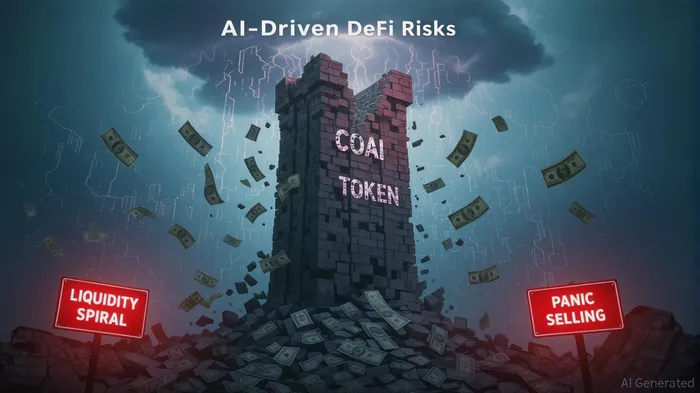
The COAI token's collapse was not an isolated event but a symptom of deeper structural flaws. Over 87.9% of its supply was concentrated in just ten wallets, raising red flags about governance centralization and potential manipulation. The project's reliance on untested AI algorithms and algorithmic stablecoins like xUSDXUSD-- and deUSD-both of which failed to maintain their dollar peg-exacerbated the crisis, triggering a liquidity spiral and panic selling. This mirrors historical financial crises, such as the 1997 Asian Financial Crisis, where opaque instruments amplified instability.
 Regulatory ambiguity further compounded the problem. The U.S. CLARITY Act, enacted in 2025, failed to clarify the classification of AI-driven tokens, creating legal loopholes exploited by bad actors. Meanwhile, the EU's MiCA framework and Singapore's asset freezes highlighted the growing urgency for global standards.
These reforms reflect a broader policy shift aimed at balancing innovation with investor protection. However, enforcement gaps persist, particularly in regions like Southeast Asia, where regulatory frameworks remain fragmented.
Investor Lessons: The Imperative of Due Diligence
For investors, the COAI collapse underscores the necessity of rigorous due diligence. Key takeaways include:
1. Technical Audits: Projects must undergo independent smart contract audits to verify code integrity and mitigate vulnerabilities.
2. Governance Transparency: Decentralized governance models with verifiable team identities and community participation are critical to avoid "pseudo-decentralized" schemes.
3. AI-Driven Risk Monitoring: Advanced tools can detect token concentration, liquidity risks, and adversarial AI threats like data poisoning.
4. KYC/AML Compliance: Projects should adopt Know Your Wallet (KYW) protocols and blockchain forensics to screen transactions and prevent money laundering as recommended by TokenMinds.
Retail investors are increasingly advised to prioritize projects with transparent token economics, active community engagement, and adherence to global standards as highlighted by Phemex. Institutional investors, meanwhile, are allocating 55% of digital assets to tokenized structures in 2025, reflecting a shift toward regulated ecosystems according to Bitget.
Future Outlook: Balancing Innovation and Security
The COAI scandal has accelerated the adoption of AI-powered risk management and interdisciplinary governance. Regulatory frameworks like MiCA and the CLARITY Act now emphasize clearer definitions of digital assets, while compliance teams grapple with evolving requirements. Experts warn that without harmonized global standards, the crypto space will remain prone to exploitation as noted by Bitget.
For investors, the path forward lies in proactive education and self-custody solutions. As one report notes, "The lessons from COAI and similar failures highlight the need for a paradigm shift-from speculative hype to structured risk management."
Conclusion
The COAI token scandal is a watershed moment for crypto markets, revealing the fragility of centralized governance and untested technologies. While regulatory progress is evident, investors must remain vigilant, prioritizing due diligence and adopting AI-driven tools to navigate volatility. In an industry where innovation and risk coexist, informed decision-making is no longer optional-it is a necessity.

Blending traditional trading wisdom with cutting-edge cryptocurrency insights.
Latest Articles
Stay ahead of the market.
Get curated U.S. market news, insights and key dates delivered to your inbox.


AInvest
PRO
AInvest
PRO



Comments
No comments yet